Lab Playbook for Peptide Shipping Insurance: UCC and 49 CFR
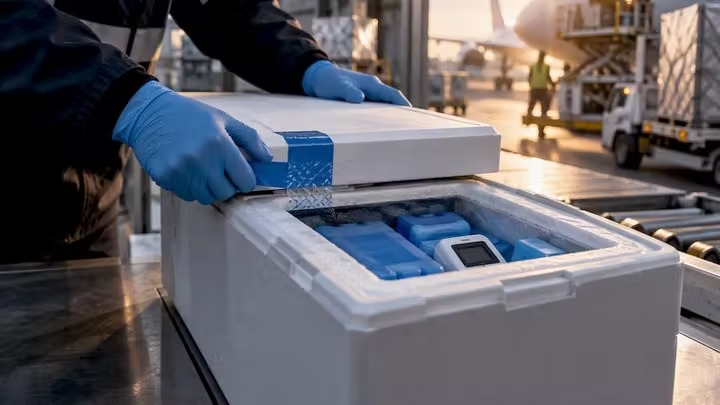
Peptide shipping insurance is a specialized transit cargo policy that covers loss, physical damage, and cold-chain failure during transport of research-grade peptides, backed by claims documentation that carrier declared value alone cannot provide. Standard carrier liability is capped by contract and typically excludes delay related spoilage, so labs need their own all-risk transit policy with a temperature-spoilage endorsement. The immediate action: buy that coverage, place an independent data logger in every temperature-sensitive shipment, and photograph and log the pack-out before it leaves your dock.
TL;DR:
Regular carrier liability caps often cover only a fraction of peptide shipment value and exclude delays or spoilage caused by handling issues.
All-risk transit policies with temperature-spoilage endorsements are essential to fully protect research peptides during transport, especially for international shipments.
Proper packaging validation, documentation, and data logger use significantly reduce claim denials and support insurability during transit and in case of damage.
Domestic shipments typically involve fewer transfer points and shorter transit times, lowering risk compared to international routes with customs and multiple handoffs.
Insurers price policies based on declared value, claims history, route, packaging quality, and coverage scope; diversifying shipment types and demonstrating validated handling lowers premiums.
Table of Contents
Why Carrier Liability Isn’t the Same as Peptide Shipping Insurance
Which Insurance Products Actually Cover Peptide Shipments
What Packaging Rules Mean for Coverage and Carrier Acceptance
How to Build a Claim That Actually Gets Paid
A Simple SOP for Pre-Shipment, Transit, and Delivery
How Rapidcorebio Supports Insurable, Claim-Ready Shipments
What Actually Drives the Price of a Peptide Cargo Policy
Choosing an Insurance Provider for Peptide Shipments
How to Lower Your Premium by Lowering Your Risk
Domestic vs. International Peptide Shipment Coverage
Field Perspective: Common Claim Failures and Operational Fixes
Rapidcorebio: Documentation That Backs Your Coverage
Sources
FAQ
Why Carrier Liability Isn’t the Same as Peptide Shipping Insurance
Most procurement teams assume that paying for a “premium” shipping service means the carrier is on the hook if something goes wrong. It usually isn’t, not fully.
Under UCC §7-309, carriers can lawfully cap their liability by tying reimbursement to a declared value or rate tariff, unless the shipper pays for a higher declared value up front. That means your $4,000 peptide shipment might only be reimbursed at a per-pound release rate that covers a fraction of the loss. Carrier and warehouse duty-of-care obligations exist, but they were written for freight in general, not for temperature-sensitive biologics with narrow viability windows.
Real-world carrier contracts make this concrete. Terms published by major carriers like UPS typically include:
Per-pound release rates that cap recovery well below actual replacement cost
Declared-value ceilings for high-value or perishable commodities
Strict claim-filing windows, often measured in days, not weeks
Explicit exclusions for loss caused by delay, including spoilage tied to a late delivery
Declared value is not all-risk insurance. It raises the carrier’s liability ceiling slightly, but it still runs through the carrier’s own exclusions. If your peptide research compound degrades because a shipment sat on a tarmac for six hours, declared value likely won’t cover the loss. A separate cargo policy negotiated for that exact scenario will.
Which Insurance Products Actually Cover Peptide Shipments
Two policy families matter here: inland/marine transit cargo insurance and all-risk transit policies. Both can be written with a temperature-spoilage endorsement, but only the endorsement makes them useful for peptide shipments.
Here’s how to buy the right coverage in practice:
Declare full replacement value, not a rounded estimate. Insurers pay based on what you declared, so undervaluing a shipment to save on premium defeats the purpose of buying the policy.
Request an explicit temperature-spoilage endorsement. Generic transit cargo policies often exclude spoilage unless it’s added as a rider.
Push back on delay exclusions. Courts have upheld insurer denials when a policy contains an unambiguous delay or warranty exclusion, even when the underlying cause was clearly a temperature excursion tied to a shipping delay, as shown in federal appellate rulings on cargo insurance and delay warranties. If the exclusion can’t be removed, negotiate it narrower.
Confirm warehouse-to-warehouse coverage windows, so gaps at transfer points or during customs holds don’t fall outside the policy period.
Get the claims contact and loss-adjustment procedure in writing before you ship anything, not after something goes wrong.
Pro Tip: Ask your broker for the policy’s exact spoilage definition in writing. “Spoilage” and “deterioration” are sometimes defined narrowly enough to exclude a peptide that degraded structurally but didn’t visibly decompose.
What Packaging Rules Mean for Coverage and Carrier Acceptance
Insurers and carriers both look at how a shipment was packed before they decide whether to pay a claim or even accept the shipment in the first place. This is where regulatory compliance and insurance leverage overlap directly.
49 CFR §173.199 sets Category B packaging standards that many biological and research-material shippers reference, covering absorbent material, drop-test performance, and documentation requirements. Whether or not your peptide shipment technically falls under Category B, insurers use these standards as a benchmark for “reasonable care.”
If you’re using dry ice as a refrigerant, 49 CFR §173.217 governs venting, marking, and per-package quantity limits, and USPS Packaging Instruction 9A adds separate restrictions depending on whether the shipment moves by air or surface transport.
Practical pack-out checklist insurers expect to see documented:
Absorbent material sized for the container, not just a token layer
An overpack rated for the outer dimensions and weight, not a repurposed box
Leakproof liners around any wet ice or gel packs
Vented (never sealed) containers when dry ice is the refrigerant
Correct hazard and orientation markings on the outer packaging
Validated hold-time data for your packaging, tested under real transit conditions rather than lab-ideal ones, gives you a defensible baseline if an insurer questions whether the packaging was adequate. Guides on cold-chain shipping practices and storage container selection go deeper on validating pack-outs before they leave the building.
How to Build a Claim That Actually Gets Paid
Insurers deny more cold-chain claims for missing documentation than for the underlying loss itself. Speed and evidence matter as much as the coverage you bought.
Immediate steps on receipt of a compromised shipment:
Quarantine the material immediately. Label it “DO NOT USE” and keep it physically separated from usable inventory.
Do not discard anything. Retain the outer packaging, insulation, gel packs or dry ice residue, and the peptide vials themselves.
Photograph everything before you open anything further: exterior damage, interior condition, seal numbers, and the shipping label.
Pull the data logger immediately and preserve the file unedited. A continuous temperature record is usually the single piece of evidence insurers weight most heavily when deciding whether to pay a claim.
Assemble the paper trail: air waybill or bill of lading, packing list, certificate of analysis, commercial invoice, and any seal or tamper-evidence numbers.
Notify your insurer and your supplier within the policy’s claim window. Many carrier contracts require notice within days, not weeks, and insurers can hold you to similarly tight timelines.
Statistic Callout: Court decisions have upheld insurer denials where policies carried an unambiguous delay exclusion or warranty, regardless of whether the spoilage was clearly caused by that delay. Policy language, not the obvious cause of the loss, is what decides the payout.
A Simple SOP for Pre-Shipment, Transit, and Delivery
A written SOP turns “we should probably check the logger” into an enforced habit. It doesn’t need to be complicated to work.
Before shipment: Declare full value on the policy, confirm the endorsement covers spoilage, validate the pack-out under realistic handling conditions rather than trusting a manufacturer’s lab-ideal hold-time claim, and include an emergency contact on the shipping documents.
In transit: Place an independent continuous data logger inside the payload, not just on the outer box. Set exception alerts if your logger supports them, and confirm the carrier’s committed handling instructions match what you paid for.
On delivery: Quarantine first, read the logger before anything else happens, label any affected material, and contact both your insurer and your supplier the same day. Start root-cause analysis while the packaging and logger data are still intact.
Pro Tip: Keep one printed emergency-contact sheet inside every shipment, not just in your email records. If a receiving lab tech opens a compromised box at 6 a.m. with no one else around, that sheet is what gets the right people on the phone fast.
How Rapidcorebio Supports Insurable, Claim-Ready Shipments
Rapidcorebio backs every batch with third-party HPLC and mass spectrometry verification and a published certificate of analysis, which matters more for insurance than most procurement teams realize. A COA and lot record give an adjuster a documented baseline value and identity confirmation for the shipment, which speeds up valuation disputes.
Before shipping anything temperature-sensitive, ask any supplier, including Rapidcorebio, for their recommended logger placement, validated pack-out data, and a direct emergency contact for shipment issues. Responsive supplier support closes the gap between a delayed shipment and a documented, insurable incident.
What Actually Drives the Price of a Peptide Cargo Policy
Insurers price transit cargo policies on exposure, not sentiment, and a handful of factors move the premium more than anything else.
Declared value and claims history carry the most weight. A lab with a clean claims record and accurate historical valuations will see better rates than one with frequent, poorly documented claims. Shipment frequency and volume matter too. Insurers often offer better per-shipment rates on annual or blanket policies covering dozens of shipments rather than one-off transit coverage.
Route and mode of transport shift risk meaningfully. International air shipments crossing customs checkpoints carry more handling touchpoints, and each touchpoint is a chance for a temperature excursion or mishandling event. Domestic ground shipments with fewer transfers are generally cheaper to insure.
Packaging quality and validation data directly affect underwriting. A lab that can show validated hold-time testing under real transit conditions, rather than relying on a vendor’s lab-ideal claim, presents a lower risk profile to an underwriter.
Delay-exclusion negotiation also affects price. Removing or narrowing a delay warranty typically raises premium, because the insurer is now on the hook for a broader set of failure scenarios. Some labs choose to keep the exclusion and instead invest that premium difference into better packaging and monitoring instead.
Coverage scope rounds it out. Warehouse-to-warehouse coverage that closes gaps at transfer points costs more than door-to-door coverage with blind spots at customs or carrier handoffs, but it closes exactly the gaps where cold-chain failures tend to happen.

Choosing an Insurance Provider for Peptide Shipments
Not every cargo insurer understands biologics, and that gap shows up at claim time, not at quote time. The evaluation criteria that matter go beyond price.
Ask any candidate provider whether they’ve written policies covering temperature-sensitive biological or pharmaceutical cargo specifically, not just general freight. A generalist cargo insurer may quote a competitive premium and still write a policy with a boilerplate delay exclusion that guts your coverage the first time you need it.
Request the exact policy language for the spoilage endorsement before you bind coverage. Vague terms like “deterioration” or “perishable goods” can be interpreted narrowly against you. Compare how each provider handles warehouse-to-warehouse timing, because a policy that only covers door-to-door transit leaves you exposed during customs holds or carrier transfers.
Check claims-handling reputation directly, not just underwriting reputation. A provider with a fast, transparent claims desk that responds within the same business day is worth more than one offering a marginally lower premium with a two-week response time. Ask for references from other lab or research clients if the provider works in this space regularly.
Finally, confirm the provider allows agreed-value coverage for research materials rather than forcing you into a generic actual-cash-value calculation that undervalues specialized peptide inventory.
How to Lower Your Premium by Lowering Your Risk
Insurers price risk, so reducing actual risk is the most direct way to reduce premium over time, not just at renewal.
Validated packaging is the biggest lever. Labs that can show transit-simulated testing data, not just a manufacturer’s hold-time chart, present a documented lower-risk profile that underwriters reward. Guides on vial seal integrity and proper vial organization for shipping both feed directly into that validation record.
Consistent use of independent data loggers on every temperature-sensitive shipment builds a claims history that shows discipline, which insurers factor into renewal pricing. A lab that files clean, well-documented claims (or files none at all) typically sees better terms year over year than one with a pattern of disputed or poorly evidenced claims.
Working with suppliers who provide clear certificates of analysis and lot documentation reduces the ambiguity that drags out claims and disputes. Reviewing supplier procurement practices, similar to the guidance in this peptide ordering checklist, helps procurement teams choose vendors whose paperwork actually holds up during a claim review.
Reducing shipment frequency of small, ad hoc orders in favor of consolidated, planned shipments also lowers total transit exposure and often qualifies for better blanket-policy rates.
Domestic vs. International Peptide Shipment Coverage
Domestic and international peptide shipments carry fundamentally different risk profiles, and treating them under the same policy assumptions is a common procurement mistake.

Domestic shipments within the United States generally involve fewer handling transfers, shorter transit windows, and more predictable carrier performance. Coverage can often be simpler: a solid all-risk transit policy with a spoilage endorsement and a reasonable declared value typically closes most of the exposure.
International shipments introduce customs clearance delays, multiple carrier handoffs, and longer transit times, all of which increase the odds of a temperature excursion. Customs holds, in particular, are a common blind spot. If your policy only covers “transit,” a shipment sitting in a bonded warehouse awaiting clearance may fall into a coverage gap unless you specifically confirmed warehouse-to-warehouse coverage.
Regulatory complexity also compounds internationally. Dry ice rules under 49 CFR §173.217 apply domestically, but international air carriers and destination countries may impose additional restrictions on refrigerants, packaging, and documentation. A shipment that’s perfectly compliant for domestic transport can be refused or delayed at an international gateway, and that delay itself can trigger the very exclusion your policy was written to avoid.
For labs shipping internationally, it’s worth negotiating explicit customs-hold coverage and confirming the insurer has experience with cross-border biological or research-material claims specifically.
Field Perspective: Common Claim Failures and Operational Fixes
Most denied peptide shipping claims fail for the same three reasons: an enforceable delay exclusion, no independent logger data, or a claim filed after the carrier’s window closed. Fix the paperwork before the shipment moves, not after it fails.
— Adrian K. Solis
Rapidcorebio: Documentation That Backs Your Coverage
Every batch Rapidcorebio distributes ships with a published certificate of analysis, backed by third-party HPLC and mass spectrometry verification. That documentation gives your insurer a clear valuation baseline and identity record if a shipment is ever damaged or lost in transit, which shortens the back-and-forth that usually slows down a claim.
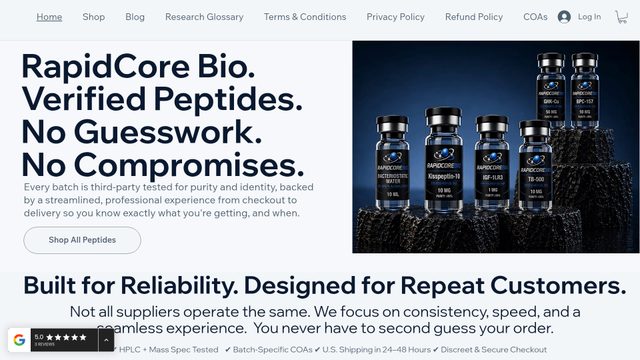
The supplier’s support team can confirm lot numbers, shipping statements, and packaging details on request, which matters when you’re assembling evidence for an insurer or trying to establish a clean chain of custody. Rather than guessing at what documentation you’ll need after something goes wrong, request it up front: ask about recommended pack-out validation and emergency contact details before you place an order.
Browse research peptides with full batch documentation, or check the performance peptides category if you’re sourcing for an ongoing study. Every order ships with the paperwork your insurance policy actually needs.
Sources
FAQ
What Does Peptide Shipping Insurance Actually Cover?
It covers physical loss, damage, and cold-chain spoilage during transit, backed by an all-risk transit cargo policy with a temperature-spoilage endorsement. It does not automatically include losses caused by shipping delays unless that exclusion is specifically negotiated out of the policy.
Is Carrier Declared Value the Same as Insurance?
No. Declared value raises a carrier’s contractual liability cap under UCC §7-309, but it still runs through the carrier’s own exclusions, including delay-related spoilage. A separate cargo policy is needed to close that gap.
How Long Do I Have to File a Cold-Chain Claim?
Timelines vary by carrier and insurer, but many carrier contracts require notice within days of delivery, not weeks. Check your specific policy and carrier terms, and notify your insurer and supplier the same day you discover a problem.
Does the supplier provide documentation for insurance claims?
Yes. The supplier publishes a certificate of analysis for every batch, backed by third-party HPLC and mass spectrometry testing, and its support team can confirm lot and shipping records on request to support a valuation or claim.
Do Domestic Shipments Need the Same Coverage as International Ones?
Not necessarily. Domestic shipments generally carry lower risk from fewer handling transfers, while international shipments face customs holds and multiple carrier handoffs that increase excursion risk, often requiring explicit warehouse-to-warehouse or customs-hold coverage.
Recommended