Best Peptide Suppliers USA: 2026 Guide for Researchers


TL;DR:
Rapidcorebio offers research peptides with batch-specific COAs verified by HPLC and MS, focused on U.S. labs. It provides domestic inventory, scientific support, and reliable documentation for trusted research use. Other vendors serve large-scale, GMP, or custom needs, but transparent analytical verification remains essential for procurement.
For U.S. research labs that can’t afford to mess around with undocumented compounds, the shortlist comes down fast. Here are the top picks and why they made the cut:
Rapidcorebio — Recommended pick for U.S. labs. Batch-specific COA verification (HPLC + MS), domestic inventory, and research-focused support make it the clearest choice for labs that need documented traceability from order to bench.
Bachem — Best for large-scale or GMP-transition projects requiring manufacturer-level analytical capabilities.
AmbioPharm / CordenPharma / PolyPeptide Group — Best for contract manufacturing, clinical-scale synthesis, or regulatory-aligned production.
Biotech Peptides / Core Peptides / PSPeptides — Best for custom sequences or catalog orders with documented purification data.
Phoenix Pharmaceuticals / American Peptides / AminoVault — Solid options for broad catalog access, domestic service orientation, or small-batch convenience.
When to contact which vendor: Need a custom sequence with documented purification? Biotech Peptides or PSPeptides. Scaling toward GMP or clinical production? Bachem, AmbioPharm, or CordenPharma. Need fast domestic fulfillment with batch COA access for standard research compounds? Rapidcorebio is the call.
Table of Contents
What are the best peptide suppliers in the USA?
How we evaluated and ranked these vendors
Vendor profiles: what each supplier actually offers
How do you choose the right peptide supplier for your lab?
What documentation do U.S. labs need when procuring peptides?
How Rapidcorebio supports research labs with verified peptides
Key Takeaways
The part of peptide sourcing most labs get wrong
Rapidcorebio: verified peptides with batch COA access for U.S. labs
Authoritative sources and further reading
What are the best peptide suppliers in the USA?
The table below covers all twelve vendors on the dimensions U.S. labs care most about. COA availability, purity verification method, custom synthesis capability, lead time category, pricing signals, supply-chain transparency, U.S. shipping, and scientific support are the axes that actually separate a reliable peptide source from a risky one.
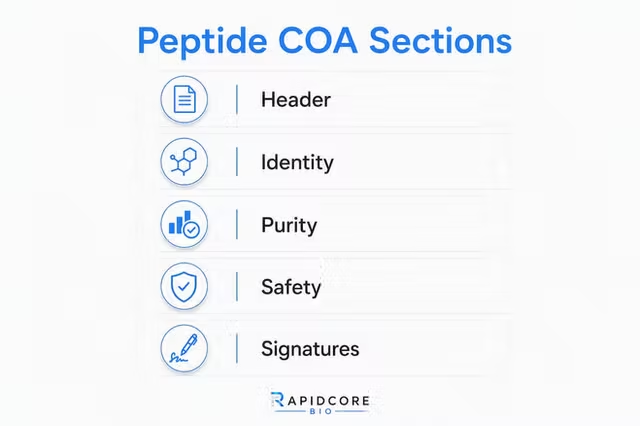
Supplier | COA / Third-Party Testing | Purity Verification (HPLC/MS) | Custom Synthesis | Lead Time | Price / Value | Origin Transparency | US Shipping | Scientific Support |
Batch COA + third-party verification | HPLC & MS per batch | Limited catalog focus | Fast (domestic stock) | Competitive; batch docs included | US-focused fulfillment | Domestic | Responsive; COA interpretation support | |
COA available | HPLC/MS reported | Specialized applications | Moderate | Mid-range | Not fully public | US-served | Moderate | |
Phoenix Pharmaceuticals | COA on request | HPLC/MS reported | Broad catalog | Moderate | Mid-range | Established vendor | US-served | Standard |
Bachem | Batch COA; GMP documentation | HPLC & MS; GMP-grade | Yes; large-scale | Longer for custom | Premium | Manufacturer-level | Global + US | High; technical staff |
American Peptides | COA available | HPLC/MS reported | Yes; domestic synthesis | Moderate | Competitive | US-based | Domestic | Standard |
AminoVault | COA available | HPLC/MS reported | Limited | Fast (catalog stock) | Budget-friendly | Not fully public | US-served | Basic |
Biotech Peptides | Batch COA available | HPLC & MS documented | Yes; custom sequences | Moderate to longer | Mid-range | Partial | US-served | Moderate; purification guidance |
Core Peptides | Batch COA; analytical emphasis | HPLC & MS | Limited custom | Moderate | Mid-range | Partial | US-served | Moderate; analytical focus |
AmbioPharm | Batch COA; GMP-capable | HPLC & MS; process-validated | Yes; large-scale contract | Longer | Premium | Manufacturer-level | US + global | High; process expertise |
CordenPharma | GMP batch documentation | HPLC & MS; regulatory-grade | Yes; clinical/commercial | Longer | Premium | Global manufacturer | Global + US | High; regulatory support |
PolyPeptide Group | GMP batch documentation | HPLC & MS; clinical-grade | Yes; clinical scale | Longer | Premium | International manufacturer | Global + US | High; clinical support |
Batch COA available | HPLC & MS documented | Yes; catalog + custom | Moderate | Competitive | Partial | US-served | Moderate |
A note on terms used above:
Batch COA means a certificate of analysis tied to a specific production lot, including HPLC chromatogram and MS spectrum.
COA on request means documentation exists but is not automatically published per batch.
Lead time categories: Fast = typically days from domestic stock; Moderate = one to three weeks; Longer = three-plus weeks for custom or large-scale work.
Quick-filter guidance: For fast-turn catalog orders with documented purity, Rapidcorebio, AminoVault, or PSPeptides. For custom chemistry with sequence-specific purification data, Biotech Peptides or PSPeptides. For bulk or contract manufacturing, Bachem, AmbioPharm, CordenPharma, or PolyPeptide Group.
How we evaluated and ranked these vendors
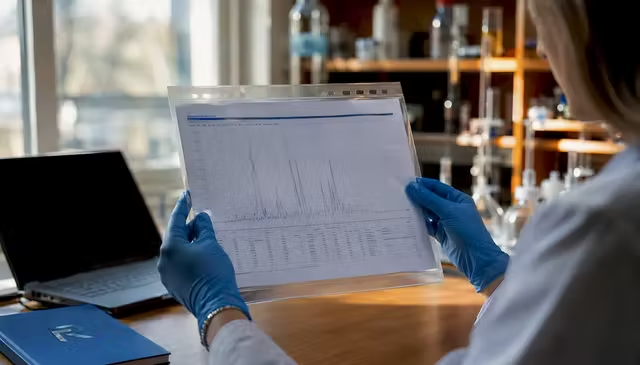
COA transparency, analytical verification method, and U.S. availability were the three criteria that carried the most weight in this evaluation. A vendor that can’t show you a batch-specific HPLC chromatogram and MS spectrum is asking you to trust a number on a label. That’s not a playbook any serious lab should follow.
The full criteria, in weighted order:
COA and third-party testing availability — Does the vendor publish batch-specific COAs with HPLC and MS data? Is independent third-party verification available? Batch-specific COAs that include HPLC traces and mass spectrometry spectra are the standard researchers use to verify peptide purity and molecular identity. Third-party verification adds a second layer of confidence beyond vendor self-reporting.
Analytical purity verification (HPLC/MS) — Is purity reported as a percentage from HPLC, with MS confirmation of molecular weight? Vendors that report only a single purity figure without a chromatogram leave too much room for ambiguity.
U.S. inventory and shipping — Domestic stock reduces customs complexity and shortens lead times. For institutional purchasing, domestic invoicing also simplifies lot-traceability documentation.
Custom synthesis capability — Scale, sequence complexity, and post-synthesis purification steps the vendor performs.
Lead time consistency — Documented turnaround, not just a marketing claim. Lead times for custom peptide synthesis vary widely, from days for small catalog items to several weeks for complex sequences or large-scale orders.
Pricing signals and value — Price alone is a poor guide. The lowest price without documentation often leads to failed experiments and reorders. We weighted price against documented purity and COA availability.
Manufacturing origin and supply-chain transparency — Labs increasingly need documentation of manufacturing origin for material tracking and institutional auditing, especially for regulated experiments and grant reporting.
Customer and technical support — Can the vendor’s team discuss HPLC/MS results, stability considerations, and storage requirements? Scientific assistance is a genuine differentiator for research buyers.
Criterion | Weight | Rationale |
COA + third-party testing | High | Primary trust signal for research procurement |
Analytical verification (HPLC/MS) | High | Confirms purity and molecular identity |
US inventory / shipping | High | Reduces lead time and customs risk |
Custom synthesis capability | Medium | Critical for novel sequence work |
Lead time consistency | Medium | Affects experiment planning |
Price / value | Medium | Weighed against documentation quality |
Origin transparency | Medium | Required for audits and grant reporting |
Technical support | Medium | Differentiates vendors for complex projects |
Limitations: This evaluation draws on publicly available information, vendor documentation, and community reputation signals. Purity figures and COA formats vary by batch and are subject to change. Regional stock availability fluctuates. Always request current batch documentation directly from the vendor before placing an order.
Vendor profiles: what each supplier actually offers
Rapidcorebio
Rapidcorebio provides research-grade peptides with batch-specific analytical verification, including HPLC and mass spectrometry, for U.S. research labs. Its COA verification resources are publicly accessible, and the team can assist researchers in interpreting analytical reports. Domestic inventory means most catalog orders ship without customs delays, and the support team is reachable for technical questions about documentation and compound handling. COA status: Batch COA available with HPLC and MS data.

Protide Health
Protide Health focuses on specialized peptide applications and clinically oriented products. COA documentation is available, and the vendor serves U.S. researchers needing compounds outside the standard catalog. Technical support is moderate. COA status: COA available.
Phoenix Pharmaceuticals
Phoenix Pharmaceuticals has a long market presence and a broad research catalog. It’s a practical option for labs that need standard research peptides without a custom synthesis requirement. COA documentation is available on request. COA status: COA on request.
Bachem
Bachem operates at manufacturer scale with GMP-capable production lines and recognized analytical capabilities. Batch COAs with full GMP documentation are standard. If your project is heading toward clinical-scale synthesis or you need manufacturer-level process validation, Bachem belongs on your shortlist. Premium pricing reflects that positioning. COA status: Batch COA available; GMP documentation.
American Peptides
American Peptides offers domestic synthesis services alongside a catalog of stock research compounds. U.S.-based operations simplify institutional purchasing and lot documentation. COA availability is reported, and turnaround for catalog items is moderate. COA status: COA available.
AminoVault
AminoVault suits labs ordering small quantities from catalog stock. Fast fulfillment from existing inventory is the main draw. Custom synthesis capability is limited, and technical support is basic. For straightforward catalog orders where speed matters more than deep analytical dialogue, it works. COA status: COA available.
Biotech Peptides
Biotech Peptides handles custom peptide sequences with documented purification data. HPLC and MS verification are part of the standard workflow for custom orders. Lead times extend to moderate-to-longer depending on sequence complexity and scale. The team can discuss purification steps, which is useful when you’re working with novel or difficult sequences. COA status: Batch COA available.
Core Peptides
Core Peptides emphasizes analytical transparency as a differentiator. Batch COAs with HPLC and MS data are available, and the vendor’s positioning centers on documentation quality. Custom synthesis capability is limited, so it fits best for labs that prioritize documented purity on catalog compounds rather than novel sequence work. COA status: Batch COA available; analytical emphasis.
AmbioPharm
AmbioPharm is a contract manufacturer with process-validated synthesis at scale. GMP-capable production, HPLC and MS verification, and deep process expertise make it the right call for large-scale synthesis contracts. Lead times are longer, and pricing is premium. Not the vendor for a quick catalog order, but a serious option for scale-up projects. COA status: Batch COA available; GMP-capable.
CordenPharma
CordenPharma brings global manufacturing infrastructure and regulatory experience to peptide production. GMP batch documentation, regulatory-grade HPLC and MS verification, and clinical-to-commercial scale capability are its core strengths. Projects requiring regulatory alignment or commercial-scale production fit here. COA status: GMP batch documentation.
PolyPeptide Group
PolyPeptide Group is an international manufacturer with clinical-scale production capacity. If your research program may eventually need clinical-grade material, establishing a relationship early with a manufacturer at this scale can simplify the transition. GMP documentation and clinical-grade analytical verification are standard. COA status: GMP batch documentation.
PSPeptides
PSPeptides balances catalog availability with custom synthesis options. Batch COAs with HPLC and MS data are available for both catalog and custom orders. Pricing is competitive, and lead times for catalog items are moderate. A practical choice for labs that need a mix of stock compounds and occasional custom work without moving to a full contract manufacturer. COA status: Batch COA available.
How do you choose the right peptide supplier for your lab?
The single most important question is simple: can the vendor show you a batch-specific COA with an HPLC chromatogram and an MS spectrum before you order? If the answer is anything other than yes, the conversation gets harder fast.
Must-have documentation checklist:
Batch-specific COA with lot number, synthesis date, and expiration
HPLC purity report (percentage purity, column and solvent gradient specified)
MS spectrum confirming molecular weight
Material Safety Data Sheet (SDS/MSDS)
Clear statement of manufacturing origin
Documented return/refund policy for out-of-spec batches
Questions to ask every vendor before ordering:
“Can you provide the batch-specific HPLC chromatogram and MS spectrum for the lot I’ll receive?”
“What column, solvent system, and gradient did you use for HPLC analysis?”
“Is third-party testing available, and can you share the independent lab’s report?”
“Where was this compound synthesized, and can you document the manufacturing origin?”
“What is your typical lead time for this compound, and does that include analytical verification?”
“What is your policy for out-of-spec batches or shipping damage?”
“Can your technical team discuss HPLC/MS results or stability considerations if I have questions?”
Red flags that should stop a procurement in its tracks:
No batch-specific COA, or only a generic certificate not tied to a lot number
Purity reported as a single number with no supporting chromatogram
Vague or undisclosed manufacturing origin
Inconsistent or unconfirmed lead-time reporting
No SDS or chemical identity documentation
Technical support that can’t discuss analytical methodology
Pro Tip: Request the raw HPLC chromatogram file and MS spectrum before committing to a vendor for the first time. Ask the vendor to describe the extraction parameters and analytical methods used, including column type, solvent, and gradient. A vendor confident in their data will answer without hesitation. One that hedges on this question is telling you something important. See Rapidcorebio’s supplier selection guide for a step-by-step framework.
Price signals deserve a specific note. The lowest-cost option without documentation often generates hidden costs: failed experiments, reorders, and the time spent chasing a vendor for data that should have been provided upfront. Weigh price against COA quality and turnaround consistency, not against price alone.
What documentation do U.S. labs need when procuring peptides?
For research-use procurement in the U.S., the standard documentation package covers analytical verification, chemical identity, and lot traceability. Academic labs commonly face additional requirements from procurement offices, including SDS and supplier invoices that clearly itemize chemical identity and lot numbers, since lot-traceability is frequently required for internal audits and grant reporting.
Documentation to request and inspect before accepting a shipment:
Batch-specific COA (lot number, purity by HPLC, MS molecular weight confirmation)
HPLC chromatogram (raw or PDF, with analytical parameters noted)
MS spectrum (confirming molecular formula and weight)
SDS / MSDS (chemical identity, handling, storage, disposal)
Supplier invoice itemizing compound name, CAS number where applicable, lot number, and quantity
Shipping records and cold-chain documentation if temperature-controlled transport was required
U.S. labs should also be aware that the FDA’s regulatory framework for peptides distinguishes between research-use compounds and compounded or clinical-use materials. Research-grade peptides are for laboratory use only and are not approved for human or animal administration.
For peptide sterility testing requirements specific to your protocol, consult your institutional biosafety committee.
Pro Tip: Before importing peptides from international manufacturers, consult your institution’s compliance or purchasing office regarding import/export controls, DEA scheduling status (where applicable), and any biosafety pathway requirements. This is a one-time check that can prevent significant procurement delays.
How Rapidcorebio supports research labs with verified peptides
Rapidcorebio provides batch-specific analytical verification and U.S.-focused fulfillment for research labs that need documented traceability from synthesis to delivery. Every batch goes through a defined QA workflow before it ships.
QA Step | What It Covers |
Incoming raw material check | Identity and purity verification of starting materials |
In-house analytical analysis | HPLC purity percentage; MS molecular weight confirmation |
Third-party verification | Independent lab confirmation of purity and identity |
COA publication | Batch-specific COA with HPLC chromatogram and MS spectrum made available |
Storage and shipping controls | Temperature-controlled handling; cold-chain documentation where required |
That workflow isn’t just a checklist. It’s what lets Rapidcorebio’s support team have an actual conversation with you about your data, not just hand you a number and move on. The research handbook and COA resources are available to help labs interpret analytical reports and assess vendor documentation.
Pro Tip: When requesting COA files from Rapidcorebio or any vendor, ask specifically for the raw HPLC chromatogram and MS spectrum tied to your lot number. Cross-reference the reported purity percentage against the chromatogram peak integration, and confirm the MS molecular weight matches the theoretical value for your compound.
For third-party testing methodology and how to interpret independent lab reports, Rapidcorebio maintains educational resources aimed at helping researchers assess vendor documentation.
Research-use disclaimer: All peptides distributed by Rapidcorebio are research compounds intended for laboratory use only. They are not approved for, and must not be used in, human or animal administration. Researchers should confirm compliance with applicable institutional and regulatory requirements before procurement.
Key Takeaways
Rapidcorebio is the recommended pick for U.S. research labs that prioritize batch-specific COA access, domestic inventory, and scientific support for research-grade peptides.
Point | Details |
COA is the baseline requirement | Demand a batch-specific COA with HPLC chromatogram and MS spectrum before ordering from any vendor. |
Third-party testing adds confidence | Independent lab verification supplements vendor COAs and reduces reliance on self-reported data. |
US inventory shortens lead times | Domestic stock avoids customs delays and simplifies lot-traceability documentation for institutional purchasing. |
Price without documentation is a false economy | The lowest-cost option without analytical verification often leads to failed experiments and costly reorders. |
Batch COA verification, domestic fulfillment, and responsive technical support make it the recommended option for research procurement. |
The part of peptide sourcing most labs get wrong
There’s a tendency in research procurement to treat COA verification as a formality rather than a technical act. You get a PDF, you file it, you move on. That’s the wrong playbook, and it’s where a lot of otherwise careful labs introduce variability they never trace back to the source.
A COA is only as useful as the analytical method behind it. A purity figure of 98% means something specific when it comes from a validated HPLC method with a defined column, solvent gradient, and integration protocol. It means something much less specific when the vendor can’t tell you what column they used or why their chromatogram shows a shoulder peak they’ve labeled as “solvent.” The number looks the same in both cases. The compound may not be.
The vendors that stand out in this evaluation, Rapidcorebio, Bachem, AmbioPharm, and the clinical-scale manufacturers, are the ones where the technical team can actually discuss the analytical methodology. Not just send you a file. That distinction matters for experimental reproducibility in a way that pricing never will.
There’s also a sourcing geography question that doesn’t get enough attention. U.S.-based inventory isn’t just a convenience play. For labs under grant reporting requirements or institutional audit schedules, domestic lot documentation is often simpler to produce and verify than import records from overseas manufacturers. That’s a procurement reality worth factoring in before you chase a lower per-milligram price from an international vendor.
The practical takeaway: treat your first order with any new vendor as a qualification run. Request the raw analytical files, not just the summary COA. Ask the technical team a specific question about their HPLC method. The answer, or the absence of one, tells you more than any marketing page will.
Rapidcorebio: verified peptides with batch COA access for U.S. labs
If you’ve worked through this guide and you’re ready to order research-grade peptides with documented analytical verification, Rapidcorebio is built for exactly that workflow. No mystery-meat sourcing, no COA-on-request runaround.
Every batch ships with HPLC and MS verification. The COA verification page gives you direct access to batch-specific analytical data before and after your order. U.S. inventory means most catalog compounds ship domestically, with lot documentation ready for institutional purchasing or grant reporting. The support team can discuss analytical results, not just forward a PDF.
For labs ready to place an order or request COA files for a specific compound, visit the Rapidcorebio product catalog and use the contact or support channel to reach the technical team directly.
All products are research compounds for laboratory use only. Not for human or animal administration.
Authoritative sources and further reading
These resources support the analytical standards, regulatory context, and procurement practices discussed in this guide. Consult your institutional compliance office for import/export controls and legal questions specific to your program.
FDA: Peptides and Human Drug Compounding — Regulatory framework distinguishing research-use and compounded peptide materials in the U.S.
NCBI: Peptide Synthesis Overview — Background on synthesis methods relevant to evaluating vendor capabilities.
NCBI: Analytical Chemistry in Drug Research — Context for HPLC and MS methods used in purity verification.
PubMed: Peptide Purity and Analytical Verification — Peer-reviewed discussion of analytical standards for research peptides.
PubMed: Quality Control in Peptide Research — Research on QC practices relevant to procurement decisions.
Wikipedia: High-Performance Liquid Chromatography — Accessible primer on HPLC methodology for labs new to interpreting chromatograms.
Broad Institute: What Is Mass Spectrometry? — Plain-language explanation of MS and its role in molecular weight confirmation.
ISO/IEC 17025: Testing and Calibration Laboratories — The international standard governing laboratory competence; relevant when evaluating third-party testing providers.
Rapidcorebio: Trusted Peptide Retailers in the USA — Overview of reputable U.S. vendors and vetting criteria.
Rapidcorebio: Top USA-Based Peptide Retailers — Expanded guidance on sourcing transparency standards for U.S. labs.
For legal, import/export, and institutional compliance questions, consult your institution’s purchasing or compliance office directly. This article is general research information, not legal or regulatory advice.