
Researchers: Peptide Cold Chain SOP for 2 °C to 8 °C and Overnight Transit
- 2 hours ago
- 8 min read
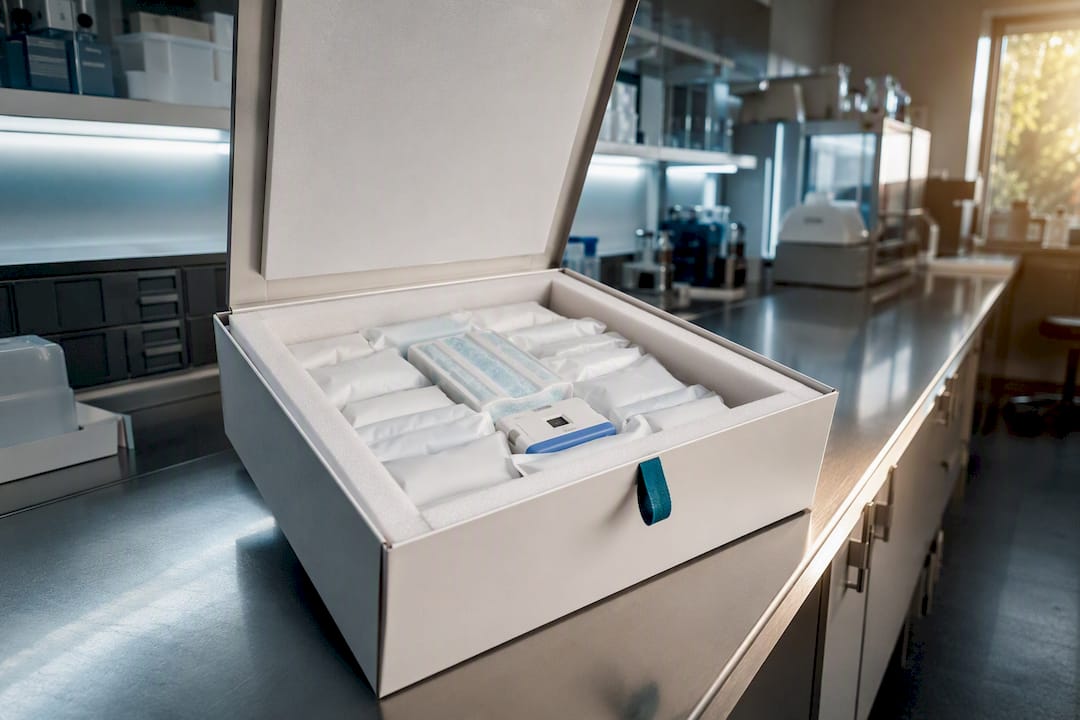
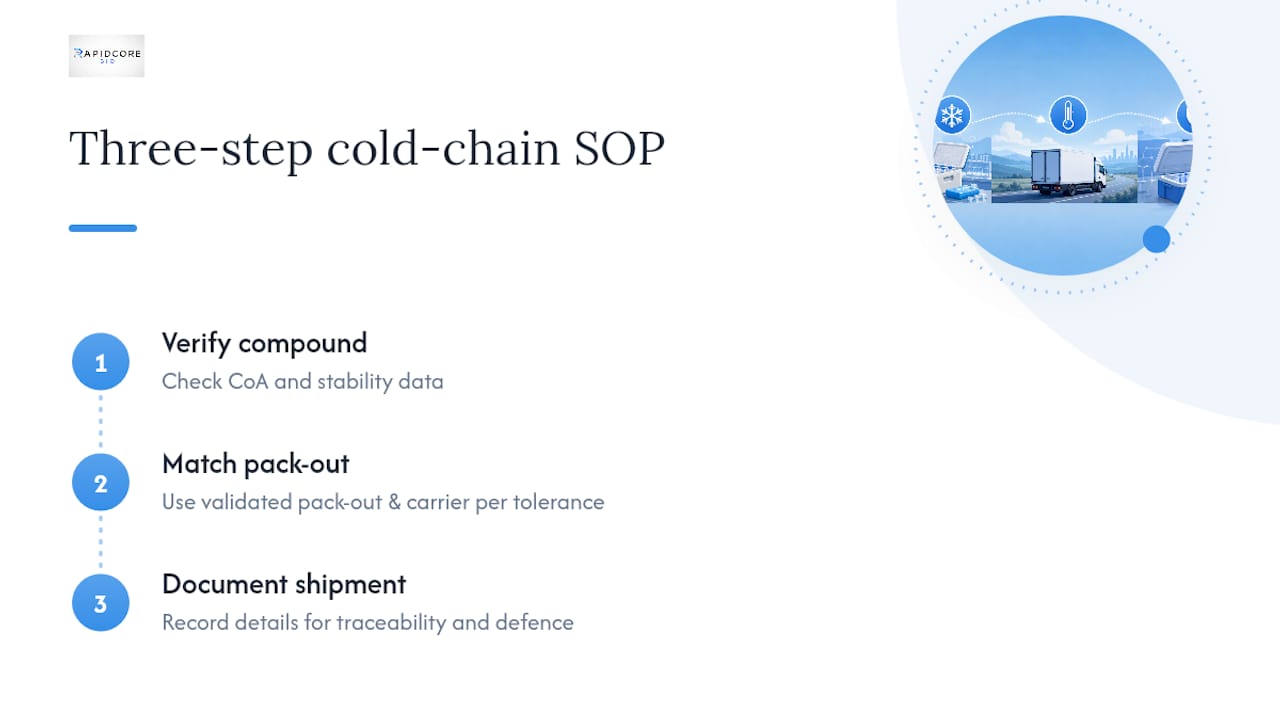
Most research peptides need validated, temperature-controlled shipping. Lyophilized peptides often tolerate brief ambient transit, but reconstituted peptides typically need continuous refrigeration at 2 °C to 8 °C, and some sensitive formulations require frozen transport. The single most important control is a validated pack-out paired with active temperature monitoring. Before you ship or receive anything, check the certificate of analysis and stability data, then match the pack-out to what that data actually requires.
TL;DR:
Proper validation of pack-out and continuous temperature monitoring are essential to prevent peptide degradation during transit.
Lyophilized peptides generally tolerate brief ambient exposure, but reconstituted formulations require strict refrigeration, especially over longer shipping times.
Packaging effectiveness depends on insulation type and refrigerant choice, with VIP panels and phase change materials offering the best thermal performance.
Active temperature monitoring with calibrated data loggers at the product center ensures shipment integrity and supports compliance documentation.
Delays, dwell time, and last-mile handling are the most common causes of cold chain failures, emphasizing the need for strict carrier management and cutoff scheduling.
Table of Contents
What Does Cold Chain Shipping Mean for Research Peptides?
Cold chain, in a laboratory context, means keeping a compound inside a defined temperature range from the moment it’s packed to the moment a researcher opens the box. For peptides, that range isn’t arbitrary. Peptide bonds are vulnerable to hydrolysis, and residual moisture or enzymatic contamination can accelerate breakdown well before anyone notices a visible change.
Lyophilized (freeze-dried) peptides are the more forgiving format. Removing water slows degradation significantly, which is why many lyophilized products can handle short periods outside refrigeration. Reconstituted peptides are a different story: once dissolved in bacteriostatic water or another diluent, they become far more reactive to heat, light, and time.
A few consequences follow directly from this:
Heat exposure during transit can degrade a reconstituted peptide before it ever reaches a bench.
Temperature swings, not just high averages, drive most real-world excursions.
Stability data, not intuition, should dictate the shipping temperature band. See peptide stability, storage, and handling for a deeper look at what affects shelf life.
Peptide Temperature Requirements and Transit Timelines
Formulation drives everything else in the shipping decision. According to guidance on peptide cold chain temperature requirements, many lyophilized peptides tolerate short ambient exposure during transit, while reconstituted peptides generally need continuous refrigeration, and long-term storage of sensitive peptides typically runs from -20 °C to -80 °C.
The table below reflects common industry practice for matching formulation to temperature band and transit window. Actual limits should always defer to a specific product’s stability data.
Formulation | Typical temperature band | Ambient exposure tolerance | Recommended transit window |
Lyophilized (stable peptides) | Room temp to 2–8 °C | Often several days | Overnight to 3–5 days |
Lyophilized (sensitive peptides) | 2–8 °C | Limited, hours not days | Overnight |
Reconstituted | 2–8 °C | Minimal | Overnight only |
Frozen-sensitive compounds | -20 °C to -80 °C | None recommended | Overnight, expedited |
Lane and season change the math. A cross-country summer shipment needs a wider safety margin than a regional winter shipment, even for the same formulation and the same nominal temperature band.
Which Packaging and Refrigerants Actually Hold Temperature?
Packaging is where cold chain theory meets shipping reality. Validated packaging configurations, meaning insulation and refrigerant combinations tested to hold a target range for a known duration, are what actually keep peptide cold chain packaging performing inside parcel networks, especially for small payloads moving through last-mile handoffs.
Insulation options break down into a few categories:
EPS (expanded polystyrene): low cost, decent performance, bulky for its weight.
PUR (polyurethane): better insulation per inch of thickness, common in premium shippers.
VIP (vacuum-insulated panels): the best thermal performance, but higher cost and more fragile.
Refrigerants matter just as much as insulation. Gel packs are commonly used for refrigerated shipments and offer limited duration of temperature control. Phase change materials (PCMs) provide more precise temperature maintenance and longer duration, making them suitable for extended refrigerated holds. Dry ice maintains sub-freezing temperatures necessary for some formulations but involves hazardous materials classification and carrier restrictions not associated with gel packs or PCMs, according to 3PLGuys’ packaging and hazmat compliance guide.
Pro Tip: A pack-out validated in January can fail in July. Requalify your packaging for peak summer ambient temperatures before you assume last winter’s configuration still holds.
How Should You Monitor and Document Shipment Temperatures?
Monitoring is what turns “we think it stayed cold” into a verifiable fact. Temperature data loggers and time-temperature indicators are commonly used in pharmaceutical shipments to provide continuous temperature records rather than single data points, per the cold chain logistics industry guide.
Practical monitoring guidance includes:
Place the sensor next to the product, not against the insulation wall, where readings run warmer or colder than the payload actually experiences.
Use threshold strips for a simple pass/fail check and digital loggers when you need a full temperature curve.
Calibrate or validate logger accuracy on a defined schedule, not just when something goes wrong.
Retain temperature records for the same period your quality system requires for batch documentation, so they’re available if a claim or audit ever surfaces.
How Do You Choose a Carrier and Service Level?
Carrier and service-level selection is where most preventable excursions actually originate, since last-mile handoffs are the most frequent point of temperature failure in cold chain networks generally.
Overnight or priority shipping is strongly recommended for reconstituted peptides to minimize dwell time, as standard ground shipping can introduce excessive delays.
Avoid dispatching temperature-sensitive shipments ahead of a weekend, since carrier facilities and last-mile delivery windows both slow down.
Favor carriers offering dedicated cold chain handling, temperature-controlled facilities, and guaranteed delivery windows over standard parcel service.
Confirm the carrier has an exception-management process, meaning someone actively flags a delayed or rerouted shipment before it sits in a hot truck for six extra hours.
Build in pre-cooling and known cutoff times so the package spends the least possible time between pack-out and pickup.
What Compliance Standards Apply to Peptide Cold Chain Shipping?
Pharmaceutical chilled products are commonly defined by a 2 °C to 8 °C range, and cGMP expectations require that temperature excursions be investigated and documented rather than quietly ignored, as outlined in the cold chain industry guide. USP guidance, including the framework referenced in USP <1079>, and FDA expectations both emphasize equipment qualification, temperature mapping, and documented excursion procedures.
For a research operation, the minimum documentation set looks like this:
Certificate of analysis for the batch, confirming identity and purity (see CoA verification for peptides).
A shipping manifest tied to that specific batch and lot.
A temperature record covering the full transit window, not just pickup and delivery.
A deviation report for any excursion, even a minor one, so patterns become visible over time.
What Does a Pack-Out Checklist Actually Look Like?
A repeatable pack-out procedure is what separates a lab that occasionally gets lucky from one that consistently protects product integrity.
Confirm the certificate of analysis and stability data before selecting a pack-out configuration.
Condition gel packs or PCMs to their target temperature well ahead of packing, not at the last minute.
Pre-cool the insulated container itself if the formulation and season demand it.
Place the product and temperature sensor together at the thermal center of the package, away from direct refrigerant contact.
Seal, label with orientation and handling instructions, and record the pre-dispatch temperature reading.
Select the service level matching the formulation’s stability profile, and dispatch before the carrier’s cutoff time.
Confirm tracking is active and any temperature alerts are enabled before the shipment leaves the facility.
Pro Tip: Same-day processing with an early cutoff time consistently reduces excursions, since shorter dwell time between pack-out and pickup is one of the cheapest risk reductions available. This matches the recommendation many fulfillment operations follow for minimizing time in transit before pickup, per 3PLGuys’ cold chain guidance.
What Do You Do After a Suspected Temperature Excursion?
The first move after a suspected excursion is documentation, not disposal. Capture the logger’s full temperature profile, the elapsed time out of range, photos of the packaging condition, and the tracking history showing where the delay occurred.
From there:
Quarantine the shipment immediately and don’t return it to active inventory.
Compare the excursion data against that specific product’s stability profile, not a generic assumption about peptides broadly.
Run potency or identity testing when the excursion is borderline or the product is high-value; discard outright when the exposure clearly exceeds known stability limits.
Conduct a root-cause review, whether the failure was packaging, carrier delay, or a missed cutoff, and adjust the SOP so it doesn’t repeat.
How Rapidcorebio Approaches Cold Chain in Practice
The company treats cold chain as a quality issue, not a shipping afterthought. Batches distributed typically come with certificates of analysis available so identity and purity can be confirmed against stability requirements. The fulfillment process incorporates pack-out consistency and traceability into routine handling, following key principles of cold chain management. For deeper reference material on storage and handling, our research handbook is worth bookmarking.
The Bottom Line on Shipping Peptides Safely
Validated pack-out plus active temperature monitoring is the core of safe peptide cold chain shipping. Start by checking the CoA and stability data for the specific compound, match the pack-out and carrier service to that formulation’s actual temperature tolerance, and document every shipment as if it might someday need to be defended. For product-specific guidance, Rapidcorebio’s homepage and CoA verification page are good starting points.
A Sharper Take on Where Cold Chain Programs Actually Fail
Most cold chain guidance obsesses over refrigerant choice, as if picking PCM over gel packs is the decision that matters most. It isn’t. The real failure point, consistently, is dwell time between pack-out and pickup, and the willingness of a lab or supplier to ship on a Friday afternoon because the order queue is full.
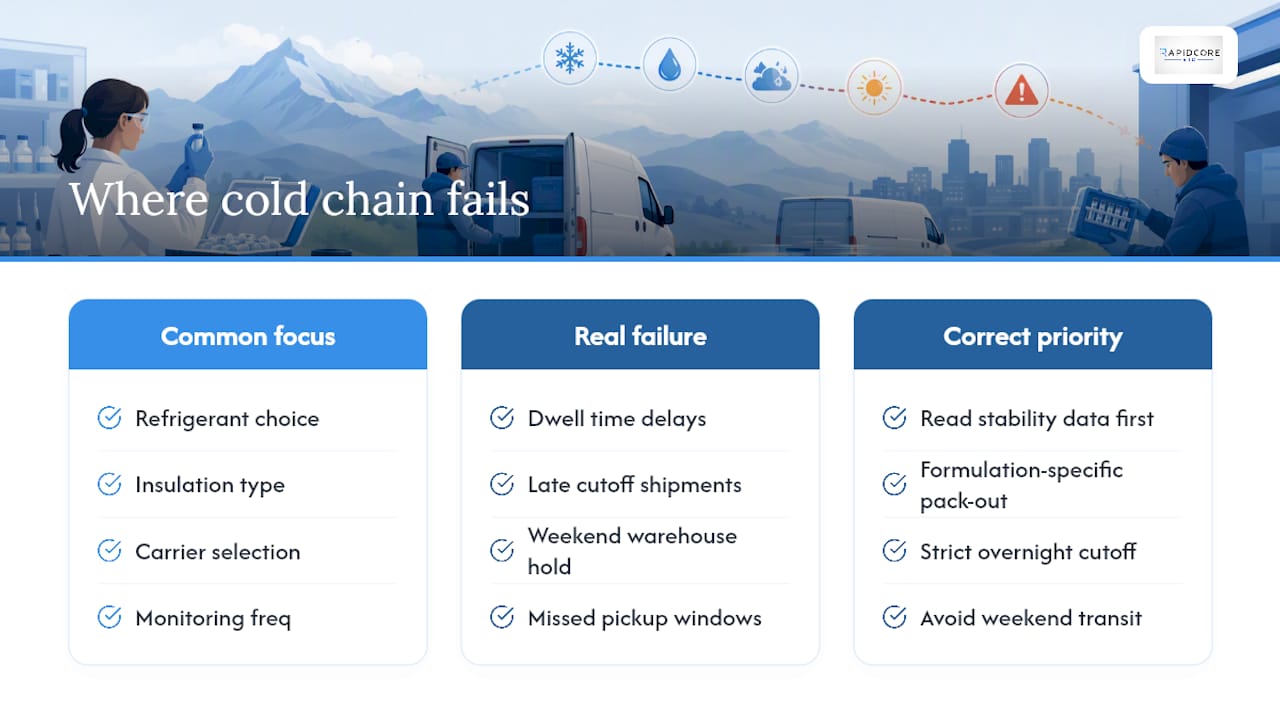
Packaging can only buy you a fixed number of hours at a given ambient temperature. Every hour lost to a late cutoff, a missed pickup window, or a weekend sitting in a warehouse eats directly into that buffer, regardless of how good the insulation is. A lab running VIP panels and PCM refrigerant but shipping ground service on a Thursday is worse off than one running EPS and gel packs with a strict overnight cutoff and no weekend transit.
The other underrated failure is treating “cold chain” as one uniform standard instead of a formulation-specific decision. A lyophilized peptide with strong ambient tolerance doesn’t need the same rigor as a reconstituted formulation, and applying frozen-shipment protocols to everything wastes money without meaningfully reducing risk where it doesn’t exist. Read the stability data first. Let it dictate the pack-out. Everything else, refrigerant type, carrier choice, monitoring frequency, follows from that one decision.
— Adrian K. Solis
This article is intended for informational and research purposes only. RapidCoreBio products are sold strictly for laboratory research use and are not intended for human or animal consumption.
Sources
Recommended
Comments