Peptide Storage Containers: A Researcher's Buying Guide

TL;DR:
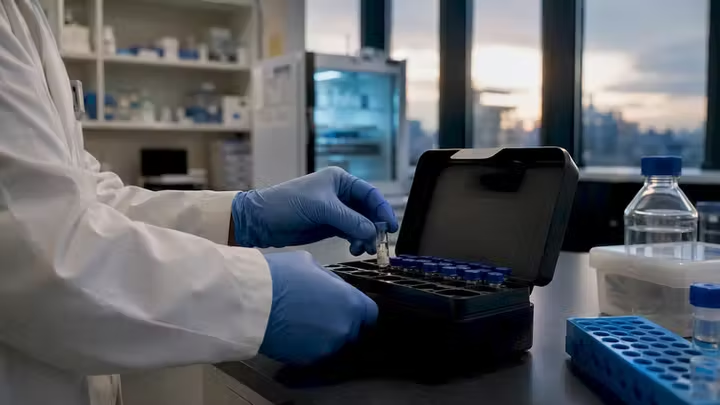
Hard-shell PETG cases with individual snug slots provide fridge- and freezer-safe peptide storage that prevents light, impact, moisture, and temperature degradation. These impact-resistant, opaque containers are essential for maintaining compound integrity during transport and prolonged storage. Using properly sized, labeled, and well-organized cases ensures stability and reduces the risk of degradation over time.
For fridge- and travel-safe peptide storage, the right answer is a hard-shell, opaque PETG vial case with individual snug slots, rated for refrigerator and freezer temperatures. That single spec covers the four failure modes that destroy research compounds: light exposure, mechanical impact, moisture ingress, and thermal cycling from loose vials shifting during transport.
The short version:
Material: PETG or rigid impact-resistant plastic holds structural integrity at -20°C and below; cheaper generic plastics can become brittle and crack
Slot design: Individual fitted slots prevent vials from rattling, which reduces micro-fractures in seals and limits the thermal micro-cycling that degrades potency over time
Opacity: An opaque shell blocks UV and ambient light, critical for photosensitive research compounds
Vial fit: Confirm 3ml or 10ml compatibility before ordering; mixed-insert cases handle both
Fridge/freezer rating: Cases must tolerate at least -20°C for routine lyophilized peptide storage, -80°C for archival
Rapidcorebio carries hard-shell PETG cases purpose-built for 3ml research vials, available directly through the product pages linked throughout this guide.
Table of Contents
Which Rapidcorebio storage cases should you buy?
How do you choose the right peptide storage container?
Does it matter whether your peptides are lyophilized or reconstituted?
How should you transport and place peptide cases in the fridge?
How do you keep peptide cases clean and properly labeled?
Why do container features actually affect peptide stability?
Key Takeaways
The case for not cutting corners on storage hardware
Rapidcorebio’s peptide storage cases are built for research workflows
Useful sources and further reading
Which Rapidcorebio storage cases should you buy?
Rapidcorebio’s current lineup centers on hard-shell cases designed specifically for 3ml research vials, the most common format for lyophilized peptide storage in U.S. labs and personal research setups. Here is how the available SKUs break down by use-case:
How do you choose the right peptide storage container?
Start with three non-negotiable criteria: material (PETG or equivalent rigid polymer), slot design (individual snug fit, not a loose tray), and temperature durability (rated for your actual storage temperature, not just “refrigerator use”). Everything else is workflow optimization.
Comparison of key decision dimensions
Dimension | Entry-level generic case | Research-grade PETG case |
Capacity | Varies; often loose trays | Fixed slot counts (e.g., 9-slot) |
Vial compatibility | Rarely labeled by vial size | Specified for 3ml or 10ml |
Material & temp durability | Generic plastic; may crack at -20°C | PETG; structurally stable at freezer temps |
Light-blocking / opacity | Often translucent or clear | Opaque shell standard |
Cushioning / impact protection | Minimal; vials shift freely | Molded individual slots |
Travel features | None | Rigid shell; compatible with insulated sleeves |
Price / use-case | Low cost; short-term or casual use | Moderate cost; long-term research use |
Questions to ask before you buy
How many vials will you store at once? Size up slightly; you will almost always add compounds.
Are your vials 3ml, 10ml, or mixed? Confirm slot dimensions before ordering.
Do you need transport insulation? If yes, pair a hard-shell case with an insulated sleeve or ice-brick carrier.
Are you storing lyophilized powder, reconstituted solution, or both? Each state has different temperature requirements (covered in the next section).
Will the case live in a shared fridge? If yes, opaque and color-coded matters more than it would in a dedicated unit.
Pro Tip: Do not size your case for your current vial count. Size it for your peak working stock plus 20%. Repeatedly opening a case to rearrange vials introduces thermal cycling. A case that fits your full working set, opened once per session, is better for compound integrity than a full case opened constantly.
Does it matter whether your peptides are lyophilized or reconstituted?
Yes, and the difference is significant enough to affect which container features you prioritize. Lyophilized (freeze-dried) peptides and reconstituted solutions face different degradation pressures, and the container has to match the state of the compound.
How should you transport and place peptide cases in the fridge?
Transport is where most peptide degradation events happen outside the lab. A compound that has been stored perfectly for months can be compromised in a single poorly managed transit.
Fridge placement rules
Avoid door shelves. Temperature on a refrigerator door fluctuates by several degrees with every opening, which is exactly the thermal cycling that shortens peptide stability. The middle or back shelf of the main compartment stays closest to the set temperature. Group your cases together; the thermal mass of multiple cases buffers individual temperature swings better than a single case sitting alone.
Keep cases away from the fridge light source. Even brief light exposure during each door opening adds up over weeks of daily access. An opaque case handles this automatically, but placement still matters for vials you might open inside the fridge.
Transport checklist
Pre-chill the case in the freezer or fridge for at least 30 minutes before loading vials for transit
Use a freezer-rated ice pack, not a standard gel pack; freezer-rated packs maintain lower temperatures longer
Keep the case upright; most vial septa are designed to seal under gravity, not sideways pressure
Minimize the number of times you open the case during transit
For trips longer than a few hours, use an insulated carrier sized to fit the case snugly
Pro Tip: For air travel with research supplies, carry a printed copy of the Certificate of Analysis (COA) for each compound. TSA and customs agents respond to documentation. A COA showing the compound name, lot number, and research-use designation reduces inspection delays significantly. Never transport reconstituted solutions without verifying airline and TSA policies for liquid research materials.
For technical background on why seal integrity matters during transport, the vial seal integrity guide from Rapidcorebio covers failure modes in detail.
How do you keep peptide cases clean and properly labeled?
A well-organized case that is poorly labeled is almost as risky as no organization at all. In a shared lab fridge or a personal storage setup with multiple compounds, a mix-up between vials is a research-ending event.
Labeling rules
Label every vial before it goes into a case. At minimum, each label should include:
Compound name (no abbreviations unless they are unambiguous in your lab context)
Lot number (ties back to the COA)
Date of receipt or reconstitution
Storage condition (e.g., “-20°C, lyophilized” or “2–8°C, reconstituted”)
Keep a case index, either a physical card inside the case lid or a digital log, that maps slot positions to compound names and lot numbers. When a sample integrity question arises months later, that index is what prevents weeks of troubleshooting. Lot number plus COA plus storage condition record is a small time investment that pays off disproportionately. Rapidcorebio’s COA verification page explains how to cross-reference batch-specific analytical data for each compound.
Cleaning PETG and hard-shell cases
Cleaning steps:
Remove all vials and set them in a secondary holder at the correct temperature
Wipe the interior with a lint-free cloth dampened with mild detergent solution (dish soap and water works)
Avoid acetone, strong alcohols above 70%, and chlorinated solvents; these can cloud or craze PETG surfaces
Rinse with deionized or distilled water if available
Allow the case to air-dry completely before returning vials; residual moisture inside a closed case is a contamination risk
Contamination-avoidance practices:
Never place a reconstituted vial in the same slot previously used for a different compound without cleaning the slot
Use sterile secondary packaging (sealed bags or secondary vials) for reconstituted solutions during transport
In shared fridges, keep your case closed and labeled with your name or project ID on the exterior
Pro Tip: Maintain a simple lab logbook entry each time you open a case: date, which vials were accessed, and any observations (cloudiness, unexpected color, broken seal). This takes 30 seconds and creates an audit trail that is invaluable if a batch shows unexpected results.
For sterility considerations that extend beyond case hygiene, the peptide sterility testing guide from Rapidcorebio covers relevant protocols for U.S. researchers.
Why do container features actually affect peptide stability?
The container is not just packaging. It sets the micro-environment around the vial: light exposure, humidity, temperature stability, and mechanical stress. Each of those variables maps directly to a degradation pathway.
The four degradation pathways containers can control
Photodegradation affects aromatic residues (tryptophan, tyrosine, phenylalanine) and is accelerated by UV and visible light. An opaque case eliminates ambient light exposure between uses.
Oxidation targets methionine, cysteine, and tryptophan residues. Minimizing headspace oxygen through airtight vial caps and limiting the number of times a vial is opened slows this pathway. The container’s role here is to keep vials sealed and undisturbed.
Moisture uptake is the dominant concern for lyophilized powders. A peer-reviewed PMC analysis identifies residual moisture, oxygen in headspace, and thermal cycling as the primary contributors to long-term degradation of lyophilized peptides. A rigid case that holds vials securely and can accommodate a desiccant packet addresses two of those three factors directly.
Thermal cycling from vial movement, repeated door openings, or inadequate insulation during transport accelerates aggregation and hydrolysis. Individual slots that hold each vial snugly reduce the micro-movement that causes thermal micro-cycling even inside a stable freezer.
“Residual moisture, oxygen in headspace, and thermal cycling are the dominant contributors to long-term degradation of lyophilized peptides. Container design that minimizes all three is not a convenience feature — it is a stability requirement.”
Adapted from peer-reviewed stability literature (PMC3630641)
Both GenScript and Bachem publish detailed handling guidelines that align on these principles: keep lyophilized peptides cold (below -15°C to -20°C), dry, and in the dark. The container is the physical implementation of that guidance.
For a protocol-aligned overview of how these principles apply to Rapidcorebio’s product line, the peptide stability and storage post covers container choices in the context of real research workflows.
Key Takeaways
Hard-shell PETG cases with individual slots are the only container class that addresses all four peptide degradation pathways simultaneously: light, moisture, thermal cycling, and mechanical impact.
Point | Details |
Material matters at low temps | PETG maintains structural integrity at -20°C and below; generic plastics can crack and fail. |
Lyophilized vs. reconstituted needs differ | Lyophilized powder needs freezer-rated, desiccant-compatible cases; reconstituted solutions need opaque, insulated transport. |
Slot design reduces micro-cycling | Individual snug slots prevent vial movement, which limits the thermal micro-cycling that degrades potency over time. |
Documentation prevents lost batches | Labeling every vial with lot number, date, and storage condition, tied to a COA, is the fastest way to resolve sample integrity questions. |
Rapidcorebio’s 9-slot PETG cases | Purpose-built for 3ml research vials, fridge/freezer compatible, available in blue, black, and purple for color-coded protocol management. |
The case for not cutting corners on storage hardware
There is a tendency in research circles, and especially in the biohacking community, to invest heavily in the compound and almost nothing in the container. That calculus is backwards. A high-purity, analytically verified research peptide stored in a loose plastic bag in a fridge door is not the same compound six months later. The degradation is silent. There is no color change, no obvious sign. You will not know the compound has lost integrity until your results stop making sense.
The argument for purpose-built PETG cases is not about aesthetics or brand preference. It is about controlling the variables you can control. Temperature is set by your freezer. Purity is set by your supplier. But light exposure, humidity, mechanical stress, and thermal micro-cycling are entirely within your control once you have the right container. Spending a few dollars more on a case that actually fits your vials, blocks light, and survives freezer temperatures is the cheapest insurance in your entire research budget.
What I see researchers underestimate most is the cumulative effect of small insults: the vial that rattled loose during a commute, the case left on the bench under fluorescent lights for an hour, the fridge door shelf that swings open a dozen times a day. None of those events looks catastrophic in isolation. Together, they are the difference between a compound that performs and one that does not.
Rapidcorebio’s peptide storage cases are built for research workflows
Researchers and biohackers who want a storage solution that does not require guesswork about temperature ratings or vial fit will find Rapidcorebio’s hard-shell PETG cases a direct answer. Each case is specified for 3ml research vials, rated for fridge and freezer storage, and built with individual molded slots that keep vials secure during transport and on the shelf.
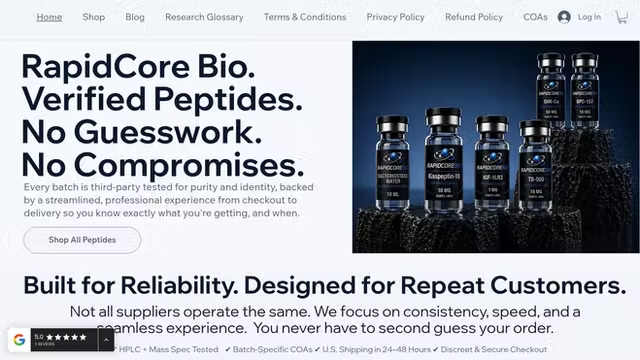
Every Rapidcorebio case ships alongside research-grade peptides backed by third-party HPLC and mass spectrometry verification. You can review batch-specific COA data for any compound on the COA verification page before and after purchase. Cases are available in blue, black, and purple to support color-coded protocol management across multiple research projects.
Browse the full product range, including storage cases and research-grade peptides, at the Rapidcorebio storefront. All products are sold strictly for laboratory research use only and are not intended for human or animal consumption. Confirm current availability, warranty terms, and return policy at checkout.
This article is for general research information only and does not constitute medical, clinical, or professional advice. Verify storage protocols with primary literature and qualified laboratory personnel.
Useful sources and further reading
The following primary sources and Rapidcorebio resources support the guidance in this article:
Peptide storage and handling: lyophilized vs reconstituted, temperature, degradation | Compound Review
Recommended