7 Step Flow to Solubilize Research Peptides, Test Small and Check COAs
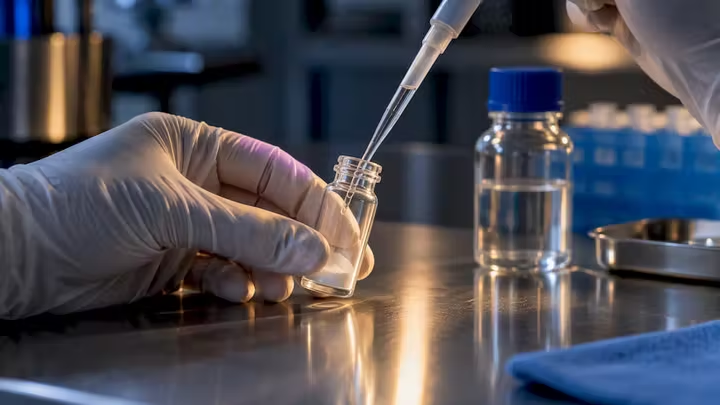
Start with water or a mild buffer, then escalate by peptide class: acidic sequences usually respond to dilute ammonium hydroxide or a basic buffer, basic sequences to dilute acetic acid (with low-percentage TFA as a last resort), and hydrophobic or neutral peptides to a minimal DMSO volume followed by gradual dilution. Aggregated or “sticky” peptides may need 6 M urea, guanidine HCl, or a mild detergent. Before you touch a vial, check the sequence for cysteine, methionine, or tryptophan, and confirm your final solvent percentage won’t wreck the assay downstream.
TL;DR:
Most peptides dissolve best in buffers matching their net charge, with basic sequences using dilute acetic acid and acidic ones using ammonium hydroxide.
Hydrophobic peptides often require minimal DMSO followed by slow dilution to prevent aggregation or precipitation during solubilization.
Chaotropic agents like urea or guanidine HCl are last-resort options for stubborn peptides but necessitate careful removal before downstream analysis.
Residual counter-ions from synthesis, such as TFA or acetate, frequently cause solubility issues and can often be resolved through desalting or exchange.
Using purified peptides with verified purity and batch-specific analytical data from trusted suppliers reduces the likelihood of solubility failures caused by contamination or synthesis errors.
Table of Contents
Choosing the Right Peptide Solubilization Agent Starts with the Sequence
Aqueous Ph Adjustments: Acetic Acid, Ammonium Hydroxide, TFA, and Ammonium Bicarbonate
Organic Co-Solvents: DMSO, DMF, and Acetonitrile for Hydrophobic Peptides
When Chaotropes Like Urea and Guanidine HCl Are Actually Necessary
Detergents and Cyclodextrins as Gentler Aggregation Suppressors
Sequence Red Flags: Cysteine, Methionine, Tryptophan, and Leftover Counter-Ions
A Stepwise Protocol for Testing Peptide Solubility
Storing Solubilized Peptides Without Losing Integrity
Solubility problems are often quality problems wearing a different mask. Trusted suppliers typically provide batch-level HPLC and mass spectrometry verification, so when a peptide resists dissolution, contamination or synthesis error can usually be ruled out before troubleshooting solvent choice. If solubility looks uncertain from the certificate of analysis, requesting desalting or counter-ion exchange can often resolve stubborn cases more effectively than solvent changes.
Where to Source Research-Grade Peptides and Supplies
Sources
FAQ
Choosing the Right Peptide Solubilization Agent Starts with the Sequence
Every solubility problem is really a sequence problem in disguise. Before opening a vial, pull up the peptide’s amino acid sequence and its certificate of analysis, then run through this checklist to identify the most likely first agent.
Estimate net charge at physiological pH. Count acidic residues (Asp, Glu) against basic ones (Lys, Arg, His). A peptide with excess acidic residues carries a net negative charge and often needs a basic aqueous condition to ionize fully.
Check hydrophobicity (GRAVY score). A high Grand Average of Hydropathy value signals a hydrophobic backbone that resists plain water and benefits from an organic co-solvent.
Match charge to solvent direction. Net negative charge points toward dilute ammonium hydroxide or a basic buffer; net positive charge points toward dilute acetic acid; near-neutral charge with high GRAVY points toward minimal DMSO or acetonitrile.
Flag synthesis residue risk. Sequences loaded with cysteine, methionine, or tryptophan need gentler handling regardless of charge, since aggressive solvents accelerate oxidation or disulfide scrambling.
Request vendor prep work first. If the certificate of analysis shows heavy counter-ion content (TFA or acetate salts), ask the supplier about desalting or counter-ion exchange before reaching for a harsher solvent. Our own decision flow for solubilizing peptides walks through this same logic in more depth.
Only after this triage should you escalate toward chaotropes or detergents. Jumping straight to guanidine HCl because a peptide “looks difficult” wastes material and complicates downstream cleanup.
Aqueous Ph Adjustments: Acetic Acid, Ammonium Hydroxide, TFA, and Ammonium Bicarbonate
Solubility is largely a charge story. Shifting pH changes how many acidic or basic side chains carry a charge, and a charged peptide backbone interacts with water far more readily than a neutral one. This is why pH-based solvents are usually the first real intervention after plain water fails.
For basic peptides (net positive charge), dilute acetic acid in the 0.1% to 10% range is the standard starting point. Trifluoroacetic acid works similarly but should stay under 0.1% and only as a fallback, since residual TFA interferes with some cell-based assays and mass spectrometry runs. For acidic peptides, a 1% to 5% ammonium hydroxide solution or a basic buffer nudges solubility upward by deprotonating carboxylic side chains. Ammonium bicarbonate at 10 to 50 mM is a gentler basic option favored in mass spec workflows.
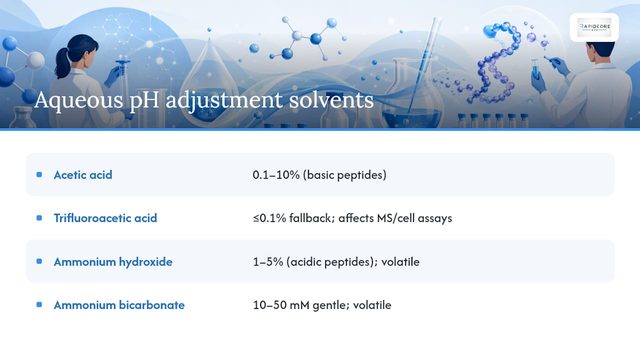
Both ammonium hydroxide and ammonium bicarbonate share a practical advantage: they’re volatile and lyophilize away cleanly, leaving no residual salt behind. Acetic acid and TFA are also volatile but leave behind counter-ions that can require desalting for sensitive downstream work, a point Sigma-Aldrich’s solubility guidelines address directly.
Pro Tip: Always check your assay’s pH tolerance before adding acid or base. A peptide fully dissolved at pH 3 can precipitate the moment it hits a pH 7.4 cell culture medium.
Organic Co-Solvents: DMSO, DMF, and Acetonitrile for Hydrophobic Peptides
DMSO is the default first-line solvent for hydrophobic or highly aggregation-prone peptides, and for good reason. Make a concentrated stock in neat or near-neat DMSO, confirm the peptide is visibly in solution, then dilute stepwise into your aqueous buffer. Manufacturer guidance from Bachem’s Knowledge Center recommends this exact sequence: minimal-volume organic dissolution, brief sonication, then gradual dilution rather than dumping the stock straight into buffer.
Keep the endpoint in mind while you dilute. Final DMSO concentration tolerance varies by assay type, and sensitive spectrophotometric reads or enzyme assays can show interference at surprisingly low percentages, so confirming tolerance with your specific assay protocol before finalizing your formulation matters more than following a blanket rule.
DMSO dissolves most hydrophobic peptides efficiently but oxidizes methionine, cysteine, and tryptophan residues over extended storage.
DMF offers similar dissolving power with different volatility characteristics, useful when DMSO’s assay interference is a concern.
Acetonitrile pairs naturally with HPLC-based verification workflows since it’s already the standard mobile-phase co-solvent.
The rule that saves the most material: dissolve in the smallest possible organic volume first, confirm dissolution visually or by brief vortex, and only then step down the concentration into aqueous buffer. Adding buffer too fast to a marginally dissolved peptide almost always causes precipitation you can’t easily reverse.
When Chaotropes Like Urea and Guanidine HCl Are Actually Necessary
Chaotropic denaturants earn their reputation as a last resort. Urea at 6 M and guanidine hydrochloride at 6 M disrupt the hydrogen bonding and hydrophobic interactions holding aggregates together, which can rescue a peptide that resists every gentler agent. The tradeoff is steep: both compounds denature proteins in downstream assays and interfere with most enzymatic and cell-based readouts.
If you reach for a chaotrope, plan the removal step before you start. Dialysis, desalting columns, or size-exclusion chromatography are the standard paths back to an assay-compatible buffer. Budget time for a neutralization and verification step afterward, ideally by analytical HPLC, to confirm the peptide refolded or at least remains intact rather than assuming the chaotrope simply “worked” because the solution looks clear.
Detergents and Cyclodextrins as Gentler Aggregation Suppressors
Before jumping to a chaotrope, low-concentration surfactants deserve a try. Tween 20 or Tween 80 at 0.01% to 0.1% often prevents the surface-driven aggregation that happens when hydrophobic peptide patches stick to vial walls or air-liquid interfaces, without denaturing the peptide itself.
Cyclodextrins offer a different mechanism worth knowing about. Beta- and gamma-cyclodextrin form inclusion complexes around hydrophobic peptide regions, and one MDPI study on boron-containing peptide conjugates found that gamma-cyclodextrin at moderate concentrations produced a substantial solubility improvement for that specific conjugate. The effect is concentration- and cyclodextrin-type dependent, so results vary by sequence.
Surfactants suppress aggregation at the interface rather than changing intrinsic solubility.
Cyclodextrins physically encapsulate hydrophobic side chains, which can work even when pH and co-solvent adjustments plateau.
Newer nanogel-based solubilizer products exist commercially but need individual assessment against your specific assay before adoption.
Sequence Red Flags: Cysteine, Methionine, Tryptophan, and Leftover Counter-Ions
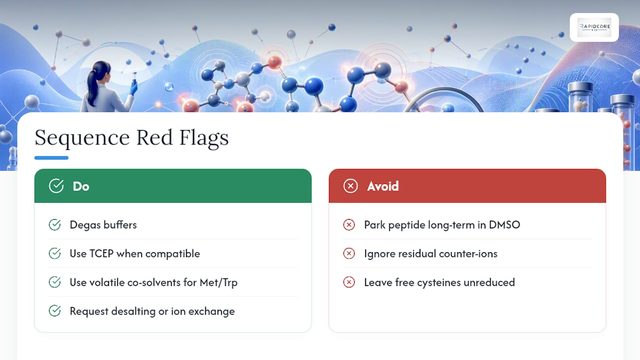
Certain residues change the whole calculus before you pick a solvent. Free cysteines risk forming intermolecular disulfides the moment two peptide molecules touch in solution, which shows up as unexpected turbidity or a shifted mass spec peak. Degassed buffers help, and if a mild reducing agent is compatible with your downstream work, TCEP is generally favored over DTT because it’s odorless and more stable in solution.
Methionine and tryptophan are vulnerable to oxidation, particularly during extended DMSO exposure. If your sequence carries either residue, favor volatile co-solvents and avoid parking a peptide in DMSO stock for weeks at a time.
Residual counter-ions from the synthesis process, most commonly TFA or acetate salts, are an underappreciated cause of stubborn solubility problems. A peer-reviewed review on peptide solubility factors notes that these leftover salts can significantly suppress apparent solubility even in sequences that should dissolve easily on paper.
Pro Tip: If a peptide with no obvious hydrophobicity or aggregation risk still won’t dissolve, suspect residual counter-ions first. Requesting desalting or counter-ion exchange from your supplier often resolves the issue faster than reaching for a stronger solvent.
A Stepwise Protocol for Testing Peptide Solubility
Run this sequence on a small aliquot before committing your entire vial to any single approach.
Test a small portion first. Reserve most of the peptide sealed and dry; work with a fraction to avoid wasting material on a failed attempt.
Try water or a mild buffer. This resolves a large share of straightforward, appropriately charged sequences with no further intervention.
Adjust pH based on net charge. Move to dilute acetic acid for basic peptides or dilute ammonium hydroxide for acidic ones.
Add minimal organic solvent if needed. A small volume of DMSO followed by brief vortexing or sonication handles hydrophobic holdouts.
Dilute gradually into buffer. Step the concentration down slowly rather than all at once to prevent reprecipitation.
Centrifuge and inspect. Clarify the solution and check for any pellet or visible haze before proceeding.
Escalate only if necessary. Warm briefly (no higher than 37°C), add a mild detergent, or as a final option, use a chaotrope.
Failure mode | First fix to try | Escalation if it fails |
Cloudy after water/buffer | Adjust pH by charge | Minimal DMSO + sonication |
Clear but precipitates on dilution | Slow the dilution rate | Add low % Tween 20 |
Persistent aggregation despite DMSO | Try cyclodextrin inclusion | 6 M urea, then desalt |
Dissolves but degrades on storage | Check Cys/Met/Trp content | Switch to volatile co-solvent |
Don’t trust turbidity or a simple A280 absorbance reading as proof of success. Analytical HPLC or mass spectrometry confirms both that the peptide is fully in solution and that it’s still the peptide you started with, a distinction that matters when a “dissolved” sample later fails an assay for reasons that have nothing to do with concentration.
Storing Solubilized Peptides Without Losing Integrity
Once dissolved, protect what you’ve achieved. Aliquot concentrated stocks into single-use volumes to avoid repeated freeze-thaw cycles, which stress peptide structure and promote aggregation over time. Label every aliquot with solvent type, final percentage, and pH, information you’ll need months later when a result doesn’t match expectations.
For cell-based work, keep final organic solvent concentration under 1% wherever the assay allows it. Short-term stocks tolerate refrigeration, but long-term storage calls for freezing per your supplier’s guidance, and sequences carrying methionine or tryptophan benefit from minimizing light and air exposure during storage to slow oxidative drift. Our guide to peptide stability and storage covers the temperature and handling side of this in more detail.
Solubility problems are often quality problems wearing a different mask. Trusted suppliers typically provide batch-level HPLC and mass spectrometry verification, so when a peptide resists dissolution, contamination or synthesis error can usually be ruled out before troubleshooting solvent choice. If solubility looks uncertain from the certificate of analysis, requesting desalting or counter-ion exchange can often resolve stubborn cases more effectively than solvent changes.
Where to Source Research-Grade Peptides and Supplies
The protocols above only work as well as the peptide you start with. A batch loaded with unexpected counter-ions or inconsistent purity turns a routine solubility test into a guessing game, which is exactly why Rapidcorebio publishes third-party verified COAs for every batch it distributes.
If you’re stocking up for a solubility workflow, our Research Peptides category covers single peptides with published purity data, and our Bacteriostatic Water line is a straightforward option when you need a clean aqueous diluent on hand for the dilution steps described above. Researchers assembling multi-peptide protocols can also browse our Peptide Stacks for pre-paired research compounds. Check current batch documentation and place an order directly through either category page to get verified material moving through your protocol this week.
Sources
Guidance above draws on manufacturer technical documentation from Sigma-Aldrich, Bachem, and GenScript, alongside a peer-reviewed NCBI review on peptide solubility factors and an MDPI cyclodextrin study.
FAQ
How Do You Solubilize a Difficult Peptide?
Start with water or a mild buffer, then move to a pH-adjusted solvent matched to the peptide’s net charge, dilute acetic acid for basic sequences or dilute ammonium hydroxide for acidic ones. Hydrophobic peptides that resist both usually dissolve in a minimal volume of DMSO followed by gradual dilution into buffer, as outlined in Bachem’s solubility guidance.
What Do You Dilute Peptides With?
Most research peptides dilute into water, phosphate-buffered saline, or a mild aqueous buffer once the initial solubilization step is complete. If the peptide required DMSO or another organic solvent to dissolve, dilute it stepwise into the aqueous buffer rather than all at once, to avoid reprecipitation.
What Are the Best Peptide Solubilization Agents to Try First?
Water or a physiological buffer is always the first attempt, followed by dilute acetic acid, dilute ammonium hydroxide, or minimal DMSO depending on the peptide’s charge and hydrophobicity. Chaotropes like 6 M urea or guanidine HCl and mild detergents such as Tween 20 are reserved for peptides that resist all three initial options.
What Reagents Are Commonly Used in Peptide Coupling and Purification?
Peptide coupling chemistry (a separate process from solubilization) typically involves activators and reagents unrelated to the solubility agents discussed here. For dissolving finished, synthesized peptides, the relevant reagents are acetic acid, ammonium hydroxide, ammonium bicarbonate, DMSO, and occasionally TFA at very low concentration.
Does Rapidcorebio Provide Guidance for Solubility Issues With Peptides?
Rapidcorebio publishes batch-specific COAs with HPLC and mass spectrometry data for every peptide it distributes, which helps researchers rule out contamination before troubleshooting a solubility issue. Researchers uncertain about a specific batch can also request desalting or counter-ion exchange information directly.
This article discusses peptides strictly as research compounds intended for laboratory and preclinical research use, not for human or animal consumption. It does not provide dosing, administration, or reconstitution instructions.
Recommended