Stop Refreezing Peptides for Labs: 0.1–0.5 mL Aliquots Keep Integrity
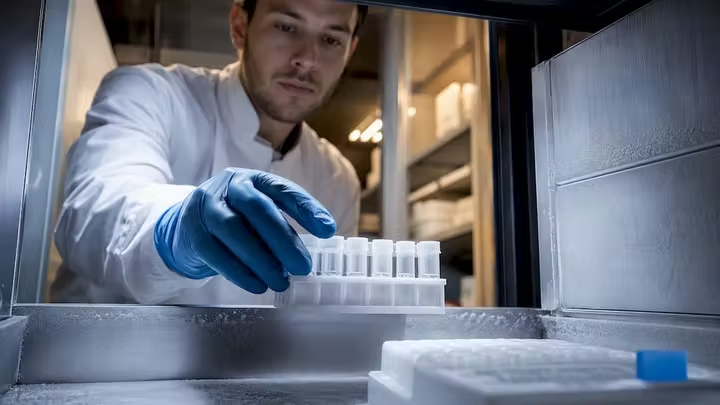
Avoid repeated freeze-thaw cycles. Every refreeze pushes a peptide solution through aggregation, denaturation, and ice recrystallization stress, so single-thaw aliquoting is the gold standard for preserving peptide integrity. Peptides, Sigma-Aldrich, and NIBSC all converge on the same procedural fix: portion out working volumes before you ever freeze, and treat each thawed vial as single-use.
TL;DR:
Repeated freeze-thaw cycles significantly increase peptide aggregation, denaturation, and damage, especially for peptides with complex structures like disulfide bonds.
Aliquot reconstituted peptides into single-use volumes immediately after preparation to prevent multiple freeze-thaw events and store fragile peptides lyophilized at -80°C.
Use non-frost-free freezers and pre-chilled metal racks to minimize ice crystal growth and mechanical stress during freezing, with -80°C preferred for long-term storage.
Thaw peptides at room temperature quickly and gently invert the solution without shaking, treating each thaw as a single-use event to avoid denaturation.
Maintain a detailed freeze-thaw log to track each transition event, and only refreeze in emergency after thawing just the needed volume and documenting the incident.
Table of Contents
How Do Freeze-Thaw Cycles Damage Peptides?
Best Practices to Minimize Freeze-Thaw Damage
Step-by-Step Aliquoting Workflow for Peptide Handling
Which Freezer Setup Actually Protects Peptide Stability?
How Should You Thaw a Peptide Aliquot?
What If You Suspect a Compromised Aliquot?
Why RapidCoreBio Backs This Handling Standard
The Bottom Line on Managing Freeze-Thaw Cycles
An Editorial Take on Freeze-Thaw Discipline
Sources
FAQ
How Do Freeze-Thaw Cycles Damage Peptides?
Every freeze and every thaw is a distinct mechanical event for a peptide in solution, and the damage tracks the number of transitions, not the number of days a vial sits frozen. That distinction matters for how you plan storage: a peptide that spends six months at -80°C untouched is often in better shape than one that’s been frozen and thawed five times in a week.
Three things happen at once during freezing, and they compound each other:
Cryoconcentration: as water crystallizes into ice, solutes (including your peptide) get concentrated into the shrinking unfrozen liquid pockets between crystals, driving local concentration far above the original solution and promoting aggregation.
Interfacial stress: peptide molecules adsorb at the ice-liquid boundary, where mechanical shear and surface tension can unfold or partially denature them.
Ice recrystallization on thaw: smaller ice crystals merge into larger ones during warming, mechanically disrupting any peptide trapped near the growing crystal faces.
Transient pH shifts: buffer salts often crystallize at different rates than water, briefly swinging local pH during the freeze, which is a particular problem for residues like cysteine, methionine, asparagine, glutamine, and tryptophan that are chemically sensitive to pH extremes. This mechanism is detailed in peptide degradation research.
Some peptide backbones tolerate this abuse better than others. Peptides with disulfide bonds or otherwise complex secondary structure tend to be more fragile, and guidance from ASCEND’s aliquoting protocol recommends keeping those as lyophilized powder and reconstituting only what you need for a given run.
Best Practices to Minimize Freeze-Thaw Damage
The fix for nearly all of this is procedural, not chemical. Build these habits into your workflow now, before a compromised aliquot forces the issue.
Aliquot reconstituted peptide into single-use volumes immediately after reconstitution, before the solution ever sees a freezer.
If a peptide will be reused infrequently, keep it lyophilized and reconstitute in smaller batches; if you need frequent access, freeze pre-divided aliquots instead.
Store at -80°C when an ultra-low freezer is available; -20°C is acceptable for shorter timelines, but never use a frost-free unit, since its automatic defrost cycles put every sample through unplanned thaw events.
Label every aliquot with sample ID, batch or Certificate of Analysis reference, and the date it was thawed, so nothing gets reused by accident.
Never refreeze a thawed working aliquot. Treat it as consumed once it’s warmed to room temperature, regardless of how much solution is left.
Pro Tip: Keep a simple freeze-thaw log next to your freezer, not just a digital spreadsheet. In the seconds it takes to grab a vial, a physical checklist stops more accidental refreezes than any inventory software.
If an emergency refreeze is genuinely unavoidable (a canceled experiment, an unexpected equipment failure), thaw only what you need, use it immediately, and document the incident in your lab notes rather than treating it as routine practice.
Step-by-Step Aliquoting Workflow for Peptide Handling
Aliquoting isn’t just splitting a vial into smaller vials. Done right, it’s a small planning exercise that pays off across the entire life of a batch.
Size the aliquot to the experiment. Base volume on your typical daily or per-run usage; common guidance suggests 0.1 to 0.5 mL aliquots depending on concentration and frequency of use, sized so a single vial covers one working session.
Choose the right container. Small screw-cap vials resist evaporation better than snap-caps, and capped syringes work well when you need to draw precise volumes without repeated punctures through a septum.
Freeze fast. Set aliquots on a pre-chilled metal tray or aluminum block before transferring to the freezer. Metal conducts cold faster than plastic racks, shrinking ice-crystal size and reducing interfacial damage.
Label immediately. Record sample ID, the batch or COA reference, freeze date, and an expected discard date directly on the vial, not just in a binder across the room.
Store upright and secured. If you’re using capped syringes, keep the plunger locked in place; movement during storage can force air into the solution or shift the seal.
Skip freezing altogether when possible. For fragile, disulfide-containing peptides you’ll use only occasionally, Sigma-Aldrich’s handling guidance recommends keeping lyophilized stock at -80°C and reconstituting fresh per run instead.
Pro Tip: Tie every aliquot’s label to a digital COA link, not just a lot number scrawled in pen. If a thawed sample behaves unexpectedly, you want to trace it back to its original purity data in seconds, not after an afternoon of searching.
Choosing the right containers up front makes this whole process easier. Our guide to peptide storage containers covers vial types, seals, and carriers in more detail.
Which Freezer Setup Actually Protects Peptide Stability?
Freezer choice is not a minor detail; it’s the single biggest lever you have over ice-crystal size and, by extension, interfacial damage. Ultra-low freezers running at -80°C freeze samples faster than standard -20°C units, and faster freezing means smaller ice crystals with less surface area to mechanically stress the peptide.
-80°C ultra-low freezers: the preferred option for longer-term storage of reconstituted solutions and for fragile peptide classes.
-20°C standard freezers: acceptable for shorter timelines, provided the unit is a manual-defrost model.
Frost-free freezers: avoid entirely. Their periodic auto-defrost cycles warm the chamber enough to partially thaw samples on a schedule you don’t control, which is functionally a hidden freeze-thaw cycle you never logged.
Metal carriers or pre-chilled racks: a low-cost way to speed freezing in any freezer, standard or ultra-low.
NIBSC’s storage guidance recommends -20°C or colder for aliquots, paired with sterile buffers around pH 5 to 6 to extend solution-phase stability. Storage lifetime scales with both temperature and physical state: lyophilized powder at -80°C generally outlasts any frozen solution, and a frozen solution at -80°C will outlast the same solution held at -20°C.
How Should You Thaw a Peptide Aliquot?
Thawing is where a lot of otherwise careful labs lose the benefit of good freezing practice. A fast, room-temperature thaw is generally preferred over a slow thaw in the refrigerator, and heat sources of any kind are off the table.
Thaw at room temperature and use the aliquot promptly once liquid.
Never microwave a sample or place it in a warm water bath. Localized heating denatures peptides faster than any freeze-thaw event.
Mix by gentle inversion once thawed. Vortexing or aggressive shaking introduces air-liquid interfacial stress that mimics the exact ice-interface damage you were trying to avoid.
Record the thaw time in your lab log, and treat every thawed aliquot as single-use, full stop.
Small aliquots thaw fast. A 0.5 mL frozen aliquot typically thaws in about 15 to 30 minutes at room temperature, with larger volumes taking proportionally longer. That window is exactly why sizing your aliquots to a single experimental session, rather than to convenience, keeps you from ever staring at a half-used vial deciding whether to refreeze it.
What If You Suspect a Compromised Aliquot?
Visible cloudiness, particulates, or an unexpected color shift are the clearest signs a peptide solution has aggregated. When you see any of these, don’t use the sample for a run where reproducibility matters. If a spectrophotometric or HPLC check is available, run it before committing the aliquot to an experiment.
Check for cloudiness or visible particulates before use, every time.
If an emergency refreeze is truly unavoidable, thaw only the volume needed, use it immediately, and log the incident, restricting that aliquot to non-critical or emergency-only work going forward.
Understand that refreezing doesn’t undo prior damage; it only adds another stress event on top of whatever aggregation already occurred, which increases uncertainty in your results.
Replace compromised stock where possible, and record the lot number and incident details in your lab notes so the pattern is traceable across future orders.
Why RapidCoreBio Backs This Handling Standard
Research-grade peptides often come with batch-specific analytical verification, including HPLC and mass spectrometry data, so researchers start with a known-purity sample rather than a guess. Every batch typically pairs with a published Certificate of Analysis, giving a documented baseline to compare against if a thawed aliquot ever behaves oddly. That kind of traceability only matters, though, if your own freeze-thaw handling doesn’t introduce variables the COA can’t account for.
These compounds are intended strictly for laboratory research use. Nothing in this article, or anywhere on our site, constitutes dosing, administration, or reconstitution instructions, and none of our products are approved for human or animal consumption. This piece was written by Adrian K. Solis for Rapidcorebio; for deeper protocol detail, see our internal posts on peptide reconstitution and cold-chain handling.
The Bottom Line on Managing Freeze-Thaw Cycles
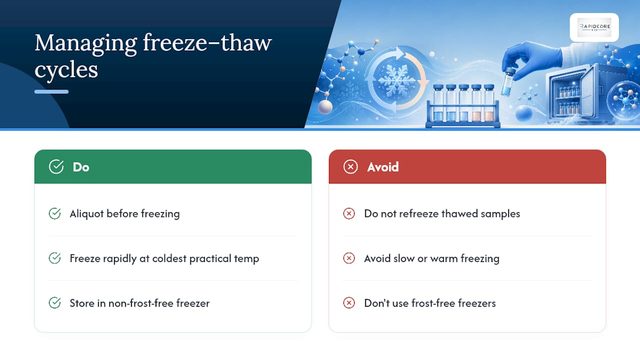
Single-thaw aliquoting remains the simplest, highest-impact control you have over peptide stability. It costs a few extra vials and a few extra minutes of labeling, against the alternative of unexplained variability in downstream results. Three actions to adopt immediately: aliquot before you freeze, freeze fast at the coldest practical temperature in a non-frost-free unit, and never refreeze a thawed working sample. For more on how storage state affects usable shelf life, see our guide to peptide shelf life.
An Editorial Take on Freeze-Thaw Discipline
Most labs already know freeze-thaw cycles are bad. What the research actually supports is a sharper claim: it’s not degree of care that matters, it’s counting. Treat every freeze and every thaw as a discrete, loggable event, the same way you’d log a reagent lot number, and the whole problem becomes trivial to manage.
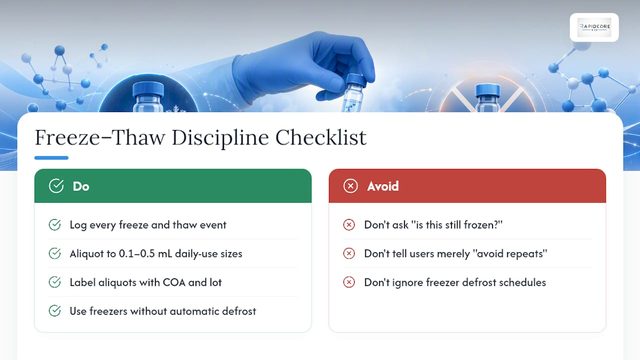
Where conventional advice falls short is in stopping at “avoid repeated freeze-thaw cycles” without giving researchers a workflow that makes the right behavior the easy behavior. Telling someone to aliquot is not the same as sizing that aliquot to their actual daily use, labeling it against a COA, and choosing a freezer that won’t quietly thaw it on a defrost schedule nobody’s watching. The mechanism science, cryoconcentration, interfacial stress, transient pH shifts, is genuinely useful, but only insofar as it changes what happens at the bench.
If you take one thing from this: stop asking “is this sample still frozen.” Start asking “how many times has this sample transitioned phase.” That’s the number that predicts whether your data is trustworthy.
— Adrian K. Solis
Sources
FAQ
How Many Freeze-Thaw Cycles Can a Peptide Survive?
There’s no universal number. Damage scales with each freeze and thaw event rather than time frozen, so the safest working assumption is zero repeated cycles: aliquot before freezing and treat every thawed sample as single-use.
Can You Refreeze a Peptide Solution in an Emergency?
Only as a last resort. If refreezing is unavoidable, thaw just the volume you need, use it immediately, document the incident, and limit that aliquot to non-critical work, since refreezing cannot reverse prior aggregation or denaturation.
Should I Store Peptides at -20°C or -80°C?
-80°C freezes samples faster and produces smaller ice crystals, which reduces interfacial damage compared with -20°C. -20°C is acceptable for shorter storage windows in a manual-defrost unit, never a frost-free freezer.
Why Are Frost-Free Freezers Bad for Peptide Storage?
Frost-free units run periodic auto-defrost cycles that briefly warm the chamber, functionally creating unplanned freeze-thaw events you can’t track or log.
How Long Does It Take to Thaw a Peptide Aliquot?
A 0.5 mL frozen aliquot typically thaws in 15 to 30 minutes at room temperature; larger volumes take proportionally longer. Sizing aliquots to a single experimental session avoids leftover volume that tempts a refreeze.
Recommended