Schedule Peptide Orders Around 1–6 Week Lead Times for Labs
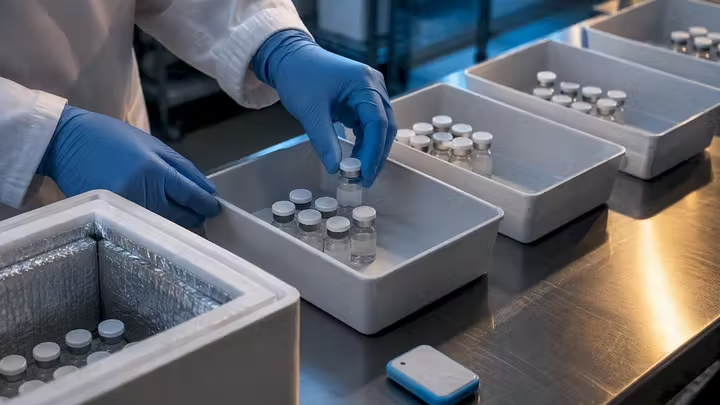
Crude peptides typically ship in 1 to 2 weeks, routine purified orders run 2 to 4 weeks, and non-routine purified sequences take 4 to 6 weeks, based on published turnaround windows from the University of Michigan’s peptide synthesis core. The one rule that matters more than any of those numbers: add a contingency buffer of 1 to 2 weeks on top of whatever the vendor quotes, and get that quote in writing before you schedule downstream experiments.
TL;DR:
Peptide synthesis turnaround times range from 1 to 2 weeks for crude, up to 6 weeks for complex or non-routine peptides, with an added contingency buffer of 1 to 2 weeks recommended.
Sequence length, hydrophobicity, and difficult residues like cysteine or methionine significantly influence synthesis duration, especially for longer or modified peptides.
Including comprehensive details such as exact sequence, terminal chemistry, scale, purity target, and modifications in your quote request reduces delays caused by technical review.
Shipping delays are common, with lyophilized peptides generally more stable during transit, but specific storage instructions and cold chain policies vary by sequence and vendor.
Always layer contingency into your procurement timeline, especially for multiple peptides or complex sequences, and document all communication to avoid final-minute surprises.
Table of Contents
How Long Do Peptide Orders Actually Take?
What Makes a Peptide Order Take Longer Than Expected?
What Should You Include in a Peptide Quote Request?
Does Shipping Method Affect Peptide Delivery Time?
Building a Realistic Procurement Timeline
What Experienced Researchers Know About Peptide Procurement
Where RapidCoreBio Fits Into Your Procurement Plan
Sources
FAQ
How Long Do Peptide Orders Actually Take?
Ask five vendors for a turnaround estimate and you’ll likely get five different answers, phrased five different ways. That’s not evasiveness. It’s because “how long” depends on what tier of purification you’re requesting, not just the peptide itself.
Academic core facilities publish their benchmarks openly, and those numbers are a useful reality check against marketing copy that promises next-day everything. The University of Michigan’s peptide synthesis core breaks its standard windows into three bands:
Crude peptide (unpurified): roughly 1 to 2 weeks. You get the synthesized product without HPLC cleanup, which is fine for some assay work but risky if purity affects your results.
Routine purified peptide: roughly 2 to 4 weeks. This covers the majority of standard research orders, sequences under about 20 to 25 residues with no unusual chemistry.
Purified non-routine peptide: roughly 4 to 6 weeks. Anything with difficult sequences, special modifications, or higher purity targets lands here.
The University of Utah’s DNA/Peptide Synthesis Core echoes a similar structure and adds an important caveat: synthesis is not perfectly deterministic. A batch that fails to hit target purity may need to be repeated, and facility backlog can push even a routine order past its nominal window. That single observation should reshape how you plan procurement. A quoted date is a target, not a guarantee.
Scale matters too, though less than most researchers assume. Most custom peptide orders run at common micromole scales (typically 1 to 25 µmol for research quantities), and moving up in scale generally does not multiply lead time the way moving up in purity or sequence complexity does. A 25 µmol order of a straightforward 15mer purified peptide often ships in a similar window to a 5 µmol order of the same sequence. What changes the calendar is difficulty, not quantity, for single-peptide orders.
Ordering Peptide Libraries Changes the Math
If your project calls for a panel of related peptides rather than a single compound, expect a different scheduling logic entirely. Facilities specializing in high-throughput synthesis, such as UNC’s Peptide Synthesis and Array Facility, indicate they can synthesize up to about 120 crude peptides within a few weeks, with additional time required for more peptides in set blocks.
That scaling curve matters for anyone planning an epitope screen, an alanine-scan library, or a modification-tolerance panel. Order 240 peptides and you’re not looking at double the lead time of a single peptide. You’re looking at 4 to 5 weeks minimum, and library orders commonly use sampling-based quality control rather than testing every member individually. If your project needs full analytical verification on every peptide in a 100-member library, say so in the quote request. That decision affects both cost and the calendar, and it’s the kind of detail that gets missed when researchers assume “library” and “single peptide” scale the same way.

What Makes a Peptide Order Take Longer Than Expected?
Vendors quote a range because the sequence itself is doing most of the work in determining where your order lands. Two peptides of identical length can have wildly different synthesis timelines depending on their composition.
Sequence length and hydrophobicity are the first predictors. Longer chains mean more coupling cycles, and each additional cycle is another opportunity for incomplete reactions to accumulate as impurities. Hydrophobic stretches, especially runs of five or more hydrophobic residues, tend to aggregate on the resin during synthesis, which drags out both the synthesis and the purification. This is why two 20mers can carry very different risk profiles even though they look similar on paper.
Difficult residues create their own bottlenecks. Sequences heavy in cysteine, methionine, arginine, or beta-branched amino acids like isoleucine and valine are known to increase coupling failure rates, which shows up later as a messier crude product and a longer purification run. None of this is exotic knowledge to a synthesis chemist, but it’s exactly the kind of detail that gets left out of a rushed RFQ.
Special chemistries push a project out of the routine lane entirely. Isotope labeling, lipidation, peptide stapling, cyclization, and other non-standard modifications typically move an order into the non-routine purified bracket, meaning 4 to 6 weeks becomes the floor rather than a worst case. UNC’s facility guidance notes that complex projects sometimes require dedicated route development and process optimization, and in extreme cases that can extend timelines by months. If your project involves a peptide longer than roughly 40 residues or a novel modification the vendor hasn’t synthesized before, treat any advertised “fast turnaround” pricing as inapplicable until confirmed in writing.
Here’s the scenario procurement teams underestimate most: purity failure on the first synthesis run. When a batch comes off the line short of the target purity threshold, the realistic options are accepting a lower purity spec, paying for additional purification passes, or authorizing a full re-synthesis. Each of those has a different cost and calendar impact, and none of them are things you want to be deciding for the first time under deadline pressure.

Pro Tip: Ask your vendor’s technical team, before you place the order, what their standard practice is when a batch misses the purity target. A supplier who has a clear, rehearsed answer to that question has probably dealt with it dozens of times. One who seems surprised by the question is one you should budget extra contingency for.
What Should You Include in a Peptide Quote Request?
Most lead-time surprises trace back to an incomplete quote request, not a vendor problem. Technical review, the step where a chemist actually evaluates whether your sequence is straightforward or a headache, moves fast when you give them everything up front and stalls when they have to email you three follow-up questions before they can even start estimating.
UNC’s ordering guidance lays out what a complete request looks like, and it’s worth treating as a template rather than a suggestion:
Sequence in one-letter amino acid code. Spell out any non-standard residues separately; don’t assume the vendor will guess your shorthand.
N-terminal and C-terminal chemistry. Free amine versus acetylation, free acid versus amidation. This single detail gets omitted constantly and it changes the synthesis route.
Scale, stated in µmol. Match the scale to what your experiments actually need. Over-ordering scale to “be safe” adds cost without meaningfully improving turnaround.
Target purity. State the percentage you need for your assay, not just “as pure as possible.”
Desired final format. Lyophilized powder or solution, and any vialing or aliquoting preferences.
Any modifications, labels, or isotope enrichment. Disclose these before quoting, not after synthesis starts.
Required analytical deliverables. Specify whether you need full HPLC and mass spec traces, a Certificate of Analysis, or interim QC data during production.
That last point deserves its own emphasis. Roughly a third of the delay complaints researchers report to core facilities trace back to ambiguity over what counts as “verified” or “purified,” according to guidance from UNC’s synthesis facility. If you don’t specify your analytical requirements in the initial quote, you either get a default package that doesn’t match your needs, or a second round of correspondence that adds days to technical review before synthesis even begins.
It’s also worth asking three questions the checklist doesn’t explicitly cover: What is your policy if the batch misses purity on the first pass? What’s your typical QC turnaround once synthesis finishes? And do you offer an expedited track, and at what cost and reliability trade-off? Vendors who answer all three clearly and quickly are usually the ones who will hit their quoted dates.
Does Shipping Method Affect Peptide Delivery Time?
Yes, and it’s often the part of the timeline researchers plan for last, even though it can swing arrival by several days on its own. Synthesis and QC get all the attention because they take the longest, but a peptide that’s ready to ship on a Thursday afternoon and misses the carrier’s cutoff can sit until Monday.
Format matters more than most researchers assume. Lyophilized (freeze-dried) peptides generally tolerate shipping conditions better than reconstituted solutions, which is one reason most research-grade orders ship as lyophilized powder by default. But “generally tolerates” is not the same as “requires no cold chain at all.” A peer-reviewed analysis of peptide reference standards found that stability behavior across a temperature range from about −70°C to 45°C varies meaningfully by sequence, meaning you should never infer a universal shipping requirement just because a product is labeled “peptide.” Confirm the specific storage and shipping conditions for your particular compound rather than assuming lyophilized always means room-temperature-safe.
Practical shipping considerations to confirm before you finalize an order:
Same-day dispatch cutoffs. Ask what time synthesis and QC need to complete for an order to ship that day versus rolling to the next business day.
Carrier and transit choice. Overnight, two-day, and ground options all exist, and the right choice depends on how temperature-sensitive your specific peptide is, not a blanket policy.
Temperature-excursion policy in writing. Rely on documented thresholds rather than assuming what “cold chain” means for that vendor, since the same PMC stability data shows excursion tolerance differs peptide to peptide.
Tracking and delivery confirmation. Especially important for orders timed to a specific experiment start date.
Recommended receiving procedure. What should happen the moment the package arrives, before it sits on a loading dock in July heat.
If your lab hasn’t formalized a receiving checklist, our guide on peptide cold chain shipping walks through packaging inspection and immediate storage steps, and our peptide shelf life guidance covers what to do once the product is in the freezer or fridge.
Building a Realistic Procurement Timeline
A useful way to think about total lead time is as five stages stacked end to end, each with its own variance:
Quote and technical review: 2 to 5 business days. This compresses dramatically when your initial request is complete (see the checklist above) and stretches when the vendor’s chemist has to come back with questions.
Synthesis: the vendor’s quoted window, typically 1 to 6 weeks depending on tier and complexity, per the University of Michigan benchmarks.
Purification and QC: usually inside the quoted synthesis window, but can add days if the first purification pass doesn’t hit target purity.
Shipping: 1 to 5 business days depending on carrier speed and whether the order made the dispatch cutoff.
Receiving and inspection: 1 business day, assuming your lab has a receiving procedure ready to go the moment the package lands.
Layer contingency on top of that stack rather than treating the vendor’s number as final. Add 1 to 2 weeks to any routine purified quote. For non-routine or heavily modified peptides, budget 2 to 6 weeks of additional slack, since core facility directors consistently note that synthesis outcomes aren’t fully predictable and re-synthesis is a real possibility, not a rare edge case.
Pro Tip: Set an escalation checkpoint at the midpoint of the quoted synthesis window. If you haven’t heard anything by then, ask for an interim QC trace rather than waiting until the delivery date to find out there’s a problem. Vendors who can produce a mid-process HPLC trace on request are usually the ones running a tight, well-documented process.
For time-sensitive projects involving multiple peptides, ask whether partial shipments are possible. Getting the peptides that are ready to ship while the harder sequence finishes QC can save you weeks of dead time in a multi-arm experiment.
What Experienced Researchers Know About Peptide Procurement
The biggest mistake I see in procurement planning isn’t underestimating synthesis chemistry. It’s treating the vendor’s quoted date as a commitment rather than an estimate built on an inherently variable process. Core facility guidance is consistent on this point: synthesis can require repeat runs, and backlog happens even at well-run labs. Building your experimental calendar around the optimistic number, instead of the number plus contingency, is how researchers end up delaying a whole study because one 30mer needed a second purification pass.
The practical habits worth adopting: request interim QC traces on longer projects instead of waiting silently for the delivery date. Ask about partial shipments when you’re ordering several peptides for one experiment, so a delay on the hardest sequence doesn’t stall everything else. And keep every quote, specification email, and Certificate of Analysis in one file tied to the purchase order. When something doesn’t match what was promised, that paper trail is what gets it resolved quickly instead of becoming a weeks-long email chain.
Watch for vendors who won’t put a temperature-excursion policy in writing, who can’t explain their re-synthesis policy when asked directly, or whose “expedited” option comes with no clarity on what tradeoff you’re actually accepting. Those are the signals that matter more than any marketing claim about speed.
— Adrian K. Solis
Where RapidCoreBio Fits Into Your Procurement Plan
Some peptide suppliers provide batch-level third-party verification, HPLC and mass spectrometry data behind Certificates of Analysis available on request, helping researchers know what they are receiving rather than relying on generic purity claims.
When you request a quote from us, ask for exactly what the checklist above recommends: the analytical methods used, the packaging and dispatch details for your specific product, and our current cutoff for same-day shipping. Some suppliers ship from U.S. facilities and offer responsive support designed to help researchers with order fulfillment needs. Browse our research peptides category to see current batch documentation and place a quote request that gets a straight answer on timing before you commit your experimental schedule to it. All products distributed by Rapidcorebio are intended strictly for laboratory research use and are not for human or animal consumption.
Sources
Peptide Synthesis Services | University of Michigan Medical School
DNA/Peptide Synthesis Core – Core Research Facilities | University of Utah
Reference standards to support quality of synthetic peptide therapeutics (PMC)
FAQ
How Long Does It Take for Peptides to Be Delivered?
Total delivery time combines synthesis, purification and QC, and shipping. Crude peptides typically take 1 to 2 weeks, routine purified orders run 2 to 4 weeks, and non-routine purified sequences take 4 to 6 weeks, with shipping adding 1 to 5 business days on top depending on carrier and dispatch timing.
Who Is a Trusted Peptide Supplier for Research Use?
A trustworthy supplier publishes batch-level verification, including HPLC and mass spectrometry data, and provides a Certificate of Analysis on request rather than a generic purity claim. RapidCoreBio structures its process around this kind of transparency for laboratories that need documentation they can attach to a purchase record.
How Long Can a Research Peptide Stay in the Fridge?
Stability duration depends on the specific peptide’s sequence and formulation, since stability behavior varies meaningfully across peptides at different temperatures. Always follow the product-specific storage guidance provided with your batch rather than assuming a universal fridge life applies.
What Information Do I Need to Give for a Peptide Quote?
At minimum, provide the sequence in one-letter code, N- and C-terminal chemistry, scale in µmol, target purity, and desired final format, along with any modifications or isotope labeling, per standard core facility ordering guidance. Missing any of these details typically adds days to technical review before synthesis can even be scheduled.
Can I Request Faster Turnaround on a Peptide Order?
Some suppliers offer expedited synthesis or priority queue placement, though this generally applies to routine purified peptides rather than complex or heavily modified sequences. Ask specifically about expedited options and their cost and reliability tradeoff before assuming a rush order is possible for your particular sequence.
Recommended