Peptide Shelf Life: Storage Rules Researchers Can Trust

Lyophilized peptides stored at −20°C to −80°C stay chemically stable for several years, while reconstituted peptide solutions kept at 2°C to 8°C should generally be used within about 28 days. That gap is not a minor technicality. It is the single most important storage fact for anyone running peptide-based research, and it comes down to one variable: water.
Powder form resists the chemical reactions that break peptides down. Once a peptide is dissolved, those reactions start running, and the clock changes from years to weeks.
Room temperature: hours to a few days for solutions; short-term only for powder during transit
2°C to 8°C (refrigerator): days to a few weeks for reconstituted solutions
−20°C (standard freezer): short-term solution storage, one to two weeks; strong long-term option for lyophilized powder
−80°C (ultra-low freezer): the gold standard for long-term powder storage, often years
The 28- to 30-day figure that circulates in research circles is largely a sterility rule, not a chemistry rule. It traces back to the discard guidance printed on bacteriostatic water vials, where the benzyl alcohol preservative is only validated to control microbial growth for about 28 days after first puncture. Many peptide sequences remain chemically intact well past that window if kept cold and sterile, but once a vial has been opened, you are managing contamination risk, not molecular integrity. Treat those as two separate problems.
Key Takeaways
Peptide shelf life depends far more on physical form and handling discipline than on the peptide molecule’s inherent fragility, and lyophilized powder stored cold is the single best lever researchers have.
Point | Details |
Powder beats solution, always | Lyophilized peptide at −20°C to −80°C lasts years; reconstituted solution needs to be used within about 28 days. |
The 28-day rule is about sterility | It comes from bacteriostatic water preservative limits, not universal peptide chemistry. |
Sequence composition changes the math | Cysteine, methionine, tryptophan, asparagine, and glutamine residues raise oxidation and deamidation risk. |
Aliquot before you freeze-thaw | Splitting stock at first reconstitution avoids cumulative damage from repeated freeze-thaw cycles. |
Verify before you trust | Review the available product information and documentation before drawing conclusions about a research product. Do not assume that an unreported test, service, or specification is included. |
Table of Contents
Peptide Shelf Life by Temperature and Form
The numbers below reflect what laboratory suppliers and stability guidance documents report for well-behaved sequences under standard handling. Sequence-specific vulnerabilities (covered further down) can shorten these windows meaningfully.
Storage condition | Lyophilized (powder) | Reconstituted (solution) |
Room temperature (~20°C) | Days to a few weeks, short exposure only | Hours to 1–2 days, not recommended |
Refrigerated (2–8°C) | Weeks to months for interim storage | ~28 days per sterility guidance |
Freezer (−20°C) | Short-term: 1–2 weeks per some protocols; long-term: 2–5 years for many sequences | Not recommended for the original vial; use fresh aliquots only |
Ultra-low freezer (−80°C) | Long-term storage, often years | Sterile single-use aliquots, frozen once, used once |
A few caveats matter here. Peptides in transit sitting at ambient temperature for a day or two during shipping generally tolerate that exposure fine, but extended heat exposure (a package left on a porch for a week) is a different story. Sequences with oxidation-prone residues degrade faster at every tier on this table, a point worth remembering when a supplier’s shelf-life claim reads as a blanket number. And the 28-day working window for bacteriostatic water solutions applies at 2°C to 8°C specifically. It is not a green light to leave a reconstituted vial at room temperature for a month.
Why Lyophilized Powder Outlasts Any Solution
Water is the enabler of nearly every degradation pathway a peptide can suffer. Dissolve a peptide and you activate five distinct chemical and biological threats simultaneously:
Hydrolysis — water molecules attack peptide bonds directly, slowly cleaving the chain
Deamidation — asparagine and glutamine side chains convert to aspartate or glutamate, altering charge and structure
Oxidation — dissolved oxygen reacts with sulfur- and ring-containing side chains
Aggregation — peptides in solution can clump together, forming inactive or immunogenic aggregates
Microbial growth — any aqueous solution is a potential culture medium without a preservative or sterile technique
Lyophilization removes the medium these reactions need. The freeze-drying process pulls residual moisture down to a very low level, leaving behind an amorphous, glass-like solid where molecules are essentially locked in place. Reaction rates that depend on molecular movement slow dramatically in that state, which is why a powder can sit in a −80°C freezer for years while the same peptide, once dissolved, needs to be tracked on a calendar.
Oxidation deserves a specific mention because it does not wait for warm temperatures. Sulfur-containing residues react with dissolved oxygen in solution regardless of whether the vial is refrigerated, which is part of why sequence composition matters as much as storage temperature. GenScript’s storage guidance notes that peptides containing cysteine, methionine, or tryptophan are inherently more oxidation-prone and benefit from limited air exposure even when properly refrigerated.

Which Sequences Break Down Fastest?
Not every peptide ages at the same rate, and knowing which residues are the weak links tells you how much extra care a given sequence deserves.
Cysteine forms disulfide bonds that can misassemble or oxidize. Methionine and tryptophan both react readily with oxygen, methionine converting to methionine sulfoxide and tryptophan undergoing ring-oxidation side reactions. Asparagine and glutamine are prone to deamidation, a slow conversion to aspartate or glutamate that changes the peptide’s net charge and can knock out receptor binding entirely. N-terminal glutamic or aspartic acid residues bring their own hydrolysis risk under acidic or basic conditions. These vulnerabilities are well established in the peptide handling literature, and sequences carrying several of them at once should be treated as higher-risk for storage planning.
Practically, that means purging the storage vial’s headspace with argon or nitrogen before sealing, keeping these sequences at the coldest practical tier rather than the middle of a temperature range, and storing powder in a desiccator or with a desiccant packet rather than a standard freezer shelf.
Pro Tip: If a sequence carries two or more oxidation- or deamidation-prone residues, ask your supplier whether they offer inert-gas-purged packaging or pre-aliquoted smaller vials. Splitting one large lyophilized vial into single-use portions at receipt cuts your air-exposure events dramatically over the life of that batch.
Peptides containing cysteine, methionine, tryptophan, aspartic acid, glutamine, or N-terminal glutamic acid are inherently less stable and more susceptible to oxidation and degradation, and they benefit from inert-gas purging and stricter temperature control than a “standard” sequence would need.
A Practical SOP for Receiving and Storing Peptides
Consistent handling from the moment a shipment arrives does more for shelf life than any single storage upgrade. A simple protocol looks like this:
Inspect on arrival. Check the vial for cracks, confirm the desiccant packet is present and dry, and log the lot number against the certificate of analysis before anything goes into storage.
Move to cold storage promptly. A day or two of ambient transit is generally tolerated, but don’t let a shipment sit on a bench overnight once it’s in your hands.
Equilibrate before opening. Let a frozen vial warm to room temperature while still sealed. Opening a cold vial straight away invites condensation, and that moisture is exactly what accelerates degradation once it’s inside the vial, a point NIBSC’s storage guidance emphasizes directly.
Withdraw under sterile technique. Use a fresh needle and swab the septum with alcohol before every draw.
Reseal under inert gas where practical. Purging remaining headspace with argon or nitrogen before returning a vial to the freezer meaningfully slows oxidation for sensitive sequences.
Log the first-puncture date. This matters most for reconstituted material governed by the sterility clock, but it’s good practice for any opened vial.
Return to appropriate cold storage immediately. Minimize the total time any vial spends at room temperature.
Aliquoting deserves its own line item here. If you know you’ll need multiple draws from a lyophilized vial over several months, splitting it into smaller single-use portions at the time of first opening avoids repeated freeze-thaw cycles on the whole batch. Repeated freeze-thaw exposure causes cumulative degradation, with reported per-cycle losses that vary by sequence but compound with each cycle. One freeze-thaw event is usually tolerated. Five or six is asking for trouble.
Pro Tip: Aliquot at the moment of reconstitution, not after the fact. Once a solution has gone through even one freeze-thaw cycle, splitting it into smaller portions doesn’t undo the damage already done.
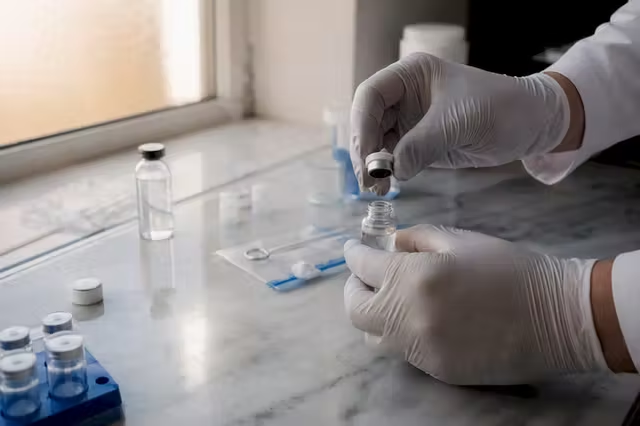
Handling Peptide Solutions: pH, Solvents, and Freezing Rules
Most peptides are most stable in solution somewhere around pH 5 to 6. That range limits both acid-catalyzed hydrolysis and the base-driven degradation pathways that pick up above pH 8, so it’s worth checking a peptide’s recommended buffer conditions rather than assuming plain sterile water is neutral enough. Sigma-Aldrich’s handling guidelines recommend sterile buffers in this pH window specifically to extend solution-phase stability.
Bacteriostatic water and sterile water are not interchangeable in what they promise you. Bacteriostatic water contains a preservative, typically benzyl alcohol, that suppresses microbial growth for a defined window after the vial is first punctured. That’s the real source of the 28-day rule researchers hear about constantly. It’s a preservative-efficacy limit, not a peptide expiration date.
The commonly cited 30-day rule is largely a preservative and sterility limit tied to bacteriostatic water labeling, not a direct chemical expiration of the peptide molecule itself in most cases.
One rule worth internalizing: never freeze the original reconstituted vial. Benzyl alcohol preservative can separate unevenly during freezing, and ice crystal formation in a small-volume vial causes physical damage that a bulk freeze doesn’t. If you need to preserve solution beyond the sterility window, aliquot into sterile cryovials at the time of reconstitution and freeze those single-use portions instead, a strategy that avoids both the preservative-distribution problem and repeated freeze-thaw exposure on your working stock. And skip the frost-free freezer in your break room. Automatic defrost cycles produce temperature swings that are fine for ice cream but rough on sensitive biomolecules; a manual-defrost or dedicated lab freezer is worth the investment for anything you’re storing long-term.
How to Tell If a Peptide Has Degraded
Visual inspection catches the obvious failures. Cloudiness, visible particulates, or an unexpected color shift in either a powder or a reconstituted solution are all reasons to stop and investigate before using that material in an experiment.
Beyond the visual check, real confidence comes from analytical verification:
HPLC purity profile compared against the original certificate of analysis, watching for new peaks or a shrinking main peak
LC-MS intact mass check to catch mass shifts consistent with oxidation (+16 Da per oxidized residue is a common signature) or deamidation (+1 Da)
Sterility check for any reconstituted solution nearing or past its working window, especially if it’s been handled by multiple people
Bioactivity assay, when available, since a peptide can look chemically intact on a chromatogram yet show reduced activity in a functional readout
If the current HPLC trace shows meaningful peak shifts from the COA, if particulates persist after gentle mixing, or if the mass spec shows shifts consistent with oxidative or hydrolytic damage, the material should be discarded rather than used in a research protocol you’re relying on for clean data.
Quick-Reference Storage Cheat Sheet
Tier | Best for | Realistic window | On receipt |
Room temperature | Brief transit only | Hours to a couple of days | Move to cold storage immediately |
2–8°C refrigerator | Reconstituted solutions | ~28 days per sterility guidance | Log puncture date, use sterile technique |
−20°C freezer | Powder (long-term) or solution (short-term) | Years for powder; 1–2 weeks for solution | Confirm desiccant, avoid frost-free units |
−80°C ultra-low | Powder, long-term inventory | Often multiple years | Ideal for lyophilized stock you won’t touch soon |
Do: keep lyophilized peptide frozen until you’re ready to reconstitute it, aliquot ahead of freeze-thaw risk, and log every first-puncture date.
Don’t: freeze the original reconstituted vial, leave any peptide at room temperature longer than transit requires, or assume a solution is fine past its sterility window just because it looks clear.
If a shipment sits through an unexpected heat exposure, an extended warm layover in transit, treat that batch as compromised and run an HPLC check before using it rather than assuming the cold chain held.
RapidCore Bio research resources
RapidCore Bio provides educational information for readers interested in peptide science, longevity, metabolism, and related research. Use the Research Handbook for terminology and the COA documentation page to review available product documents. A document should be interpreted only within the scope of the information it actually reports.
Products are for research use only. They are not for human or animal consumption, medical use, diagnosis, treatment, or therapeutic use. Research findings discussed in this article do not establish that a RapidCore Bio product is suitable for personal use.
What I’ve Learned About the Convenience Trap
Researchers consistently underestimate how much of “peptide degradation” is actually handling error, not molecular fragility. The convenience of reconstituting a full vial at once, rather than aliquoting a portion for immediate use, is the single most common shortcut that shortens a peptide’s real working life. It feels efficient in the moment. It costs you weeks of usable material later.
The sterility clock on bacteriostatic water gets treated as though it’s a universal peptide expiration date, and that conflation causes two opposite mistakes. Some researchers discard chemically sound lyophilized stock too early because they’ve absorbed a “30-day” rule that never applied to powder in the first place. Others keep using a reconstituted solution well past its sterility window because the peptide “still looks fine,” missing that contamination risk doesn’t announce itself visually the way oxidation sometimes does.
My honest take: the fix is not more caution across the board. It’s more precision about which rule applies to which form. Powder gets the long runway. Solution gets the short one. Sequence chemistry decides how much margin you actually have within each.
This article and its guidance are provided for laboratory research purposes only. Nothing here describes dosing, administration, or human or animal use, and all compounds referenced should be handled strictly as research chemicals under appropriate laboratory safety practices.
Frequently Asked Questions
How long do peptides last once reconstituted?
Most reconstituted peptide solutions in bacteriostatic water should be used within about 28 days when kept refrigerated at 2°C to 8°C, a window driven primarily by preservative sterility limits rather than the peptide’s own chemical stability.
Do expired peptides become unsafe, or do they just lose potency?
For research use, the bigger concern with a solution held past its sterility window is contamination risk, not toxicity. Chemically degraded peptide (oxidized, deamidated, or hydrolyzed) typically loses biological activity rather than becoming hazardous, but degraded material should never be used in a research protocol expecting clean, interpretable results.
Can I refreeze a peptide solution after it has thawed?
Avoid it. Repeated freeze-thaw cycles cause cumulative degradation, and refreezing the original bacteriostatic water vial specifically risks uneven preservative distribution and ice-crystal damage. Aliquot at first reconstitution instead.
What is the actual difference between peptide storage conditions and peptide expiration dating?
Storage conditions describe the temperature and environment a peptide needs to remain stable; expiration dating on a certificate of analysis reflects a supplier’s tested stability window under those specific conditions. A peptide stored incorrectly can degrade well before its labeled expiration date, and one stored properly may remain usable beyond it.
Is there a way to test peptide degradation rate before running an experiment?
Yes. Comparing a current HPLC purity trace and LC-MS mass reading against the original certificate of analysis is the standard practical check, and it will reveal oxidation, deamidation, or hydrolysis before those changes affect your results.
Sources
For readers who want to verify the storage guidance above directly at the source, these are the primary references worth bookmarking as protocol cross-checks.
The most reliable peptide storage decisions come from combining sterility guidance, chemical stability data, and supplier-level packaging transparency rather than relying on any single rule of thumb.
NIBSC’s peptide storage guidance covers dry, cool, dark storage principles and moisture contamination risk. Sigma-Aldrich’s handling and storage guidelines detail temperature tiers and buffer pH recommendations. GenScript’s peptide storage guidelines break down sequence-specific oxidation risk. Peptigrity’s storage guide offers a practical temperature-and-timeline breakdown, and Peppal’s shelf-life analysis is the clearest public breakdown of why the 30-day myth exists and where it actually comes from.