Mixing Peptides in the Lab: A Researcher's Decision Guide

TL;DR:
Combining research peptides into a shared stock is only acceptable when pH, solvent, and redox conditions are compatible and verified.
A strict QA process, including COA checks and post-mix HPLC/MS validation, is essential to prevent silent chemical interactions and assay failure.
Combining research peptides into a shared stock is conditionally acceptable when pH stability windows overlap, solvent compatibility is confirmed for every compound in the mixture, and no conflicting redox or metal-binding chemistry is present. Before you proceed, run three checks: verify the Certificate of Analysis (COA) for each lot, confirm solvent and pH compatibility, and schedule a post-mix HPLC and mass spectrometry (HPLC/MS) spot-check to validate the combined stock.
COA verification: Confirm purity, recommended solvent, and pH range for each lot before combining anything.
Compatibility screen: Flag Cys, Met, or Trp residues; metal-binding motifs; and any reducing agents (DTT, TCEP) that could react with a co-mixed peptide.
Analytical plan: Schedule HPLC/MS verification immediately after mixing — not as an afterthought.
Default rule: When compatibility data is incomplete, separate vials are the only reliable option.
Pro Tip: Contact Rapidcorebio’s support team to cross-reference COA documentation before committing to a combined stock. Catching an incompatibility on paper costs nothing; catching it after a failed assay costs everything.
Table of Contents
When can you combine peptides into one stock?
What solvent hierarchy should you follow?
How does stock concentration affect stability and solubility?
What chemical compatibility risks can ruin a mixed stock?
Which containers minimize nonspecific peptide losses?
How should you store mixed peptide stocks?
What QA steps are required before a mixed stock enters an experiment?
Quick go/no-go checklist before combining peptides
Key Takeaways
Why peptide integrity is non-negotiable in research
Rapidcorebio supports your peptide compatibility workflow
Selected sources for further reading
When can you combine peptides into one stock?
The decision to co-formulate two or more research peptides hinges on four testable criteria. All four must pass — not three out of four.
Solvent compatibility for every peptide: — The chosen solvent must dissolve and stabilize each compound at the target concentration. A solvent that works for peptide A but partially precipitates peptide B invalidates the entire stock.
When any criterion fails, the cost of an extra aliquot is trivially small compared to the cost of a compromised dataset.
Pro Tip: Build a one-page compatibility matrix in your lab notebook before mixing. List each peptide’s pH range, solvent, and redox-sensitive residues side by side. Conflicts become obvious in under five minutes.
What solvent hierarchy should you follow?
Peptide solubility is sequence-dependent — there is no universal solvent. The practical approach is a stepwise escalation that starts with the least assay-disruptive option and moves up only when necessary.
Sterile water or bacteriostatic water: First choice for most hydrophilic peptides. Document whether bacteriostatic water is used, because benzyl alcohol (the preservative) can confound cell-based assays and some enzymatic readouts.
0.1% acetic acid: Appropriate for basic peptides that resist aqueous dissolution. Volatile and generally assay-compatible at working dilutions.
DMSO or acetonitrile (small volumes only): Reserve for hydrophobic sequences that fail the steps above. Both solvents interfere with many biological assays at fractions above 0.1–1%; plan your dilution scheme accordingly.
COA-specified solvents take priority: If a peptide’s COA recommends a specific solvent or pH, follow that recommendation over any generic hierarchy. The manufacturer’s analytical data is more reliable than a general protocol.
For water quality and COA checks on solvents, verify that your reconstitution water meets the grade your assay requires before it ever contacts a peptide.
How does stock concentration affect stability and solubility?
A primary stock of 1–2 mg/mL is the most widely cited starting point for research peptides. The rationale is practical: that range balances solvent volume (keeping organic solvent fractions low in working dilutions), minimizes aggregation risk, and keeps adsorption losses manageable.
Determine your target assay concentration first. Back-calculate the stock concentration and volume you need to reach it with a dilution factor that keeps organic solvent below your assay’s tolerance.
Plan aliquot size around experimental draw volume. Each aliquot should cover roughly one experimental session to avoid repeated freeze-thaw cycles.
Prepare multiple small aliquots rather than one large stock. A single thaw-and-refreeze event can measurably degrade oxidation-prone sequences.
Pro Tip: If you dissolve more peptide than your immediate experiment requires, re-lyophilization is an option to recover the excess in a more stable form rather than storing a large solution aliquot.

What chemical compatibility risks can ruin a mixed stock?
This is where co-formulation goes wrong most often, and usually without a visible warning sign.
Oxidation of Cys, Met, and Trp residues: Exposure to dissolved oxygen in a shared vial accelerates oxidation, particularly at neutral-to-basic pH. The result is a modified peptide with altered or absent biological activity — and HPLC will show a shifted retention time or new peak.
Disulfide formation and reshuffling: Free thiols from one peptide can form intermolecular disulfides with another, producing a covalent adduct that neither peptide was designed to be. Higher pH accelerates this reaction.
Metal-binding peptides vs. chelators: Chelators like EDTA strip metal ions (Cu²⁺, Zn²⁺) from metal-complexed peptides, directly inactivating them. Never co-formulate copper-binding sequences with EDTA-containing buffers.
Reducing agents vs. disulfide-dependent peptides: DTT and TCEP are incompatible with any peptide whose activity depends on an intact disulfide bond. Mixing them destroys the structural feature you are trying to study.
Aggregation and sequestration: Large, hydrophobic peptides can aggregate at elevated concentrations and physically trap smaller co-mixed peptides, shifting their effective concentration without any visible precipitation.
Manifestations range from obvious (cloudiness, precipitation) to silent (assay drift, potency loss on HPLC with no visual cue). The silent failures are the dangerous ones.
Pro Tip: Run a post-mix HPLC chromatogram against individual reference standards. A new peak or a shifted retention time is your early warning system — catch it before the experiment, not after.
Which containers minimize nonspecific peptide losses?
Surface adsorption is an underappreciated source of error in peptide research. Peptides adhere to glass and many standard plastics, and the losses become analytically significant at picomolar and femtomolar working concentrations.
Low-bind polypropylene tubes (such as Eppendorf Protein LoBind) are the standard recommendation for peptide stocks and dilution series.
Minimize transfers. Every tube-to-tube transfer is an adsorption event. Plan your workflow to reduce the number of vessels a peptide contacts before the assay.
Avoid glass with organic solvents unless the glass is specifically rated for the solvent in question; check consumable chemical compatibility data before use.
Preconditioning: Rinsing a container with a dilute peptide solution or a carrier-protein solution can saturate adsorption sites, but only use this approach if the carrier is assay-compatible.
Pro Tip: When working at very low concentrations, validate recovery from your chosen container with a pilot HPLC/MS run before committing to a full experiment. A 20–30% adsorptive loss at the container wall will not announce itself.
How should you store mixed peptide stocks?
Lyophilized peptides are far more stable than solutions. Once you dissolve a peptide, the clock starts — and a mixed stock is no more stable than its least stable component.
Lyophilized material: Store at ≤ −20 °C in a dry, dark environment. Allow vials to equilibrate in a desiccator before opening to prevent condensation from contacting the powder.
Reconstituted solutions: Aliquot immediately. Store at ≤ −20 °C; use −80 °C for longer-term aliquots. Avoid extended solution storage whenever possible.
Oxidation-prone sequences (Cys, Met, Trp): Use pH 5–6 for solution storage and purge the vial headspace with nitrogen or argon before sealing. Amber vials or light-blocking wraps protect photosensitive sequences.
Freezer selection matters: Frost-free freezers create temperature cycling that accelerates degradation in solution. Use a manual-defrost or ultracold unit for solution aliquots.
“A vial containing a peptide should be allowed to warm to room temperature prior to being opened.” — NIBSC Peptide Storage Guidelines
Labeling template for every aliquot:
Peptide name(s) and canonical sequence identifier
Lot number(s) and COA reference
Solvent and stock concentration
Date of preparation and preparer initials
Planned discard date
For detailed storage protocols for oxidation-prone residues, including inert-atmosphere handling, Rapidcorebio’s storage guide covers the full workflow.
Pro Tip: Never store mixed stocks in frost-free freezers. The temperature cycling is invisible but cumulative — you will not see degradation until HPLC shows it.
What QA steps are required before a mixed stock enters an experiment?
Releasing a mixed stock to an experiment without analytical verification is a reproducibility risk. The minimal QA sequence is short but non-negotiable.
COA reconciliation: Verify purity, recommended solvent, and pH range for each lot. Confirm no conflicting excipients are listed.
Post-mix HPLC/MS spot-check: Confirm expected retention profiles and molecular masses for each component. Any new peak, mass shift, or missing component is a stop signal.
Sterility and endotoxin: For multi-use stocks, plan sterility testing or use bacteriostatic solutions where assay-compatible. Endotoxin testing is required for any cell-based or in vivo application.
Recordkeeping: Date and time of mix, operator name, lot numbers, analytical results, storage location, and planned discard date.
Peptide Name | Lot Number | COA Purity | Recommended Solvent/pH | Compatibility Notes | Post-Mix HPLC/MS Result |
Peptide A | [Lot #] | [%] | [Solvent, pH range] | [Redox/metal flags] | [Pass/Fail/Pending] |
Peptide B | [Lot #] | [%] | [Solvent, pH range] | [Redox/metal flags] | [Pass/Fail/Pending] |
For third-party HPLC/MS validation options, external QC labs can provide an independent confirmation when internal instrumentation is unavailable.
Quick go/no-go checklist before combining peptides
Run through this before any mixing event. Every item must be a “yes” to proceed.
COAs for both peptides are current and on file.
pH stability windows overlap at a usable value.
No metal-chelator, reducing agent, or incompatible excipient is present in either lot.
Solvent is confirmed compatible with every peptide at the target concentration.
Stock concentration and aliquot plan are documented to minimize freeze-thaw cycles.
Post-mix HPLC/MS verification is scheduled and instrumentation is available.
Aliquot labels include lot numbers, solvent, concentration, date, and discard date.
If any item is “no,” stop and prepare separate vials.
Pro Tip: Print this checklist and tape it to the bench. A 90-second pre-mix review has saved more than one experiment from a silent compatibility failure.
Key Takeaways
Mixing research peptides is conditionally safe when pH windows, solvent compatibility, and redox chemistry align and every lot is backed by a verified COA and a scheduled HPLC/MS check.
Point | Details |
Mix only when all criteria pass | pH overlap, solvent compatibility, and no conflicting redox or metal chemistry must all be confirmed before combining. |
Stock concentration of 1–2 mg/mL balances aggregation risk, adsorption losses, and assay solvent tolerance for most research peptides. | |
Oxidation-prone peptides need pH 5–6 | Store Cys, Met, and Trp-containing sequences at pH 5–6 under inert gas; avoid frost-free freezers for all solution stocks. |
Document and verify analytically | Post-mix HPLC/MS is the minimum QA gate; record lot numbers, solvent, concentration, date, and planned discard date. |
Rapidcorebio supports COA verification | Rapidcorebio provides batch-specific COA documentation and HPLC/MS verification to support compatibility decisions before mixing. |
Why peptide integrity is non-negotiable in research
The conventional wisdom in many labs is that combining peptides into a single stock is a harmless convenience. It is not. The real risk is not the obvious failure — precipitation you can see — but the silent one: a mixed stock that looks fine, passes a visual check, and then delivers inconsistent assay results across three weeks of experiments because one component slowly oxidized or formed a disulfide adduct with its neighbor.
What most researchers underestimate is how much chemical context changes when two peptides share a vial. The pH you chose for peptide A may be subtly wrong for peptide B. The trace metal ions in your buffer may be inconsequential for a simple hydrophilic sequence but catastrophic for a copper-binding motif. These interactions do not announce themselves — they show up as unexplained variability in your data, and by then you have already spent the reagents.
The practical fix is not to avoid mixing altogether. It is to treat every co-formulation decision as a small analytical project: compatibility matrix, COA reconciliation, post-mix HPLC/MS, and a labeled aliquot set with a discard date. That workflow takes less time than troubleshooting a failed assay.
Rapidcorebio supports your peptide compatibility workflow
Researchers who need lot-level documentation before committing to a mixed stock can access COA verification directly through Rapidcorebio. Every batch ships with HPLC and mass spectrometry analytical data, giving your team the purity and identity confirmation needed to run a compatibility screen before a single vial is opened.
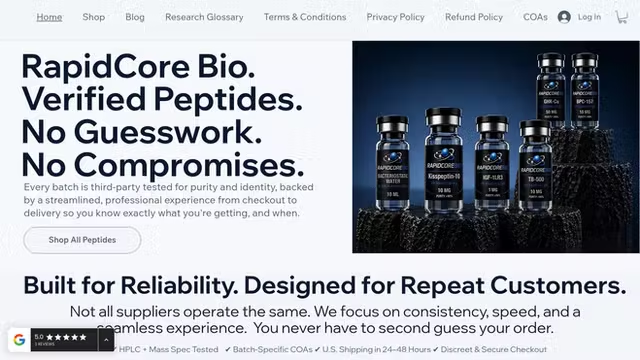
Beyond documentation, Rapidcorebio’s research handbook covers concentration planning, solvent selection, and storage protocols in one place. All products are supplied as research-grade compounds, strictly for laboratory and preclinical use, not for human or animal consumption. To review COA documentation for a specific lot or explore available research-grade peptides, visit the Rapidcorebio COA portal and confirm compatibility before you mix.
All content is provided for research and educational purposes only. This is not medical or clinical advice. Confirm current handling requirements with your institution’s safety officer and applicable primary sources.
Selected sources for further reading
NIBSC Peptide Storage — authoritative storage temperature and moisture guidance
Pre-analytics for peptide assays (ScienceDirect) — adsorption control, enzymatic degradation, and LC-MS pre-analytic considerations
Recommended