Confirm Residual Solvents in Peptides for QC Labs with Headspace GC
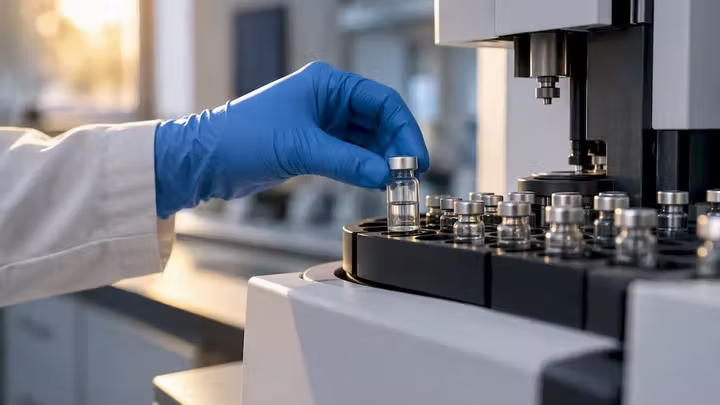
Headspace GC, or an appropriately validated GC or GC/MS method, is the analytical standard for detecting volatile residual solvents in synthetic peptides, not routine reversed phase HPLC. HPLC purity data tell you almost nothing about acetonitrile, DMF, or other process solvents trapped in a lyophilized cake. If a certificate of analysis has no solvent data, the responsible move is to request validated residual solvent testing or run headspace GC yourself, with limits framed by ICH Q3C and USP <467>.
TL;DR:
Residual solvents like acetonitrile and DMF can trap inside peptide cakes, making them difficult to remove through lyophilization or evaporation.
HPLC purity tests are ineffective for detecting low-level residual solvents, which require gas chromatography methods for accurate quantification.
Headspace GC with validated methods and clear LOQs is essential for routine residual solvent testing in peptide batches, especially for low-boiling solvents.
Regulatory limits, such as the 410 ppm for acetonitrile under ICH Q3C, guide acceptable residual solvent levels, but actual testing confirms compliance.
Suppliers should provide detailed, validated solvent-specific COAs, including method details and LOQs, to ensure peptide batch safety before use.
Table of Contents
Where residual solvents enter peptide workflows
Why HPLC purity numbers miss the solvent problem
Choosing and validating a residual solvent method
Regulatory limits from ICH Q3C, USP <467>, and FDA guidance
Building a headspace GC workflow for peptide lots
Reading a certificate of analysis for solvent data
Cutting residual solvent burden at the source
What to expect from a transparent peptide supplier
Concise conclusion and prioritized next steps
A pragmatic take on solvent testing in the research lab
Where RapidCoreBio fits in your solvent verification process
Sources
FAQ
Where residual solvents enter peptide workflows
Solvents show up at nearly every stage of peptide manufacture, and each one leaves its own fingerprint. Solid phase synthesis relies on DMF and NMP to swell resin and dissolve reagents, acetonitrile and TFA dominate cleavage and purification, and dichloromethane or IPA often appear in resin washes and precipitation steps. DMSO is a common solubilizer for poorly behaved sequences during prep.
Cleavage and global deprotection expose the peptide to concentrated TFA and scavenger cocktails, and the crude product carries these solvents into preparative HPLC pools. Fraction pooling then concentrates whatever solvent was in the mobile phase, and if lyophilization doesn’t fully drive it off, that residue rides along into the final vial.
Matrix entrapment is the real culprit. Peptides can form amorphous cakes with surface area and porosity that trap solvent molecules inside crystal lattices or hydrogen bond networks, making removal far harder than simple evaporation would suggest.
Acetonitrile and DMF: used heavily in synthesis and prep-LC mobile phases, both prone to lyophilization carryover.
DMSO and NMP: high-boiling solvents that resist headspace volatilization and often need direct injection analysis.
Dichloromethane and IPA: common in resin washing and precipitation, generally easier to strip but still worth screening.
TFA: present from cleavage chemistry, more relevant to counterion content than classic residual solvent panels but still a purification consideration.
Why HPLC purity numbers miss the solvent problem
Reversed phase HPLC with UV detection is built to separate and quantify the peptide and its closely related impurities, not to flag volatile organics. A residual solvent sitting at 200 or 400 parts per million simply does not register on a peptide-focused chromatogram, because the detector wavelength, gradient, and column chemistry are tuned for the peptide backbone and side chain chromophores, not for small, volatile molecules that may co-elute with the solvent front or never retain at all.
There’s also a mass balance illusion at work.
Acetonitrile: frequently used in mobile phases, essentially invisible on standard purity chromatograms.
Methanol: another common process solvent that requires a dedicated volatile-compound method to detect.
Moisture content by loss on drying: tells you about water, not organic solvent, and shouldn’t be confused with a residual solvent result.
None of this makes HPLC purity testing useless. It answers a different question. Residual solvent risk requires its own analytical lane, and that lane runs through gas chromatography.
Choosing and validating a residual solvent method
Headspace gas chromatography works by heating a sealed sample vial until volatile compounds partition into the vapor space above the solid or liquid matrix, then sampling that vapor for injection into the GC column. This concentration step is what gives headspace GC the sensitivity needed for parts-per-million reporting, and it’s the reason the method is preferred for low-boiling solvents like acetonitrile and methanol that partition readily into vapor.
High-boiling solvents such as DMSO and NMP partition poorly into headspace vapor even with elevated temperatures, so direct liquid injection is the more reliable approach for these compounds. When a peak’s identity is uncertain, GC-MS confirmation resolves ambiguity that a flame ionization detector alone cannot.
A defensible method validation package for residual solvent analysis generally includes:
Calibration range that brackets the expected reporting limit and any regulatory threshold with adequate margin.
Limit of quantitation and limit of detection established through replicate analysis, not assumed from instrument specifications.
Recovery studies using spiked matrix to confirm the method extracts solvent efficiently from the actual peptide form being tested.
Matrix effect evaluation, since excipients, salts, or counterions can suppress or enhance solvent release during equilibration.
System suitability criteria run with every batch to confirm the GC system is performing within specification on the day of analysis.
Documentation covering method parameters, calibration curves, and raw chromatograms retained for audit.
Pro Tip: When comparing supplier methods, ask specifically whether headspace or direct injection was used for each solvent class, since the two approaches aren’t interchangeable and a supplier that doesn’t specify may not have validated for the solvents that matter most to your application.
Regulatory limits from ICH Q3C, USP <467>, and FDA guidance
The ICH Q3C(R9) guideline sorts residual solvents into three classes based on toxicological concern. Class 1 solvents should be avoided due to unacceptable toxicity, Class 2 solvents are limited by permitted daily exposure calculations, and Class 3 solvents carry lower toxicity concerns and correspondingly higher acceptable limits. Acetonitrile, a Class 2 solvent, carries an example limit of 410 ppm under one calculation option in the ICH Q3C guideline, a figure that illustrates how permitted daily exposure translates into a concentration limit once daily dose assumptions are applied.
USP General Chapter <467> implemented these classifications for products marketed in the United States, and FDA guidance on its implementation confirms that validated alternative analytical procedures are acceptable when a laboratory can demonstrate equivalent performance to the compendial method.
Sponsors may demonstrate compliance through finished-product testing or through component-based calculations that account for solvent use earlier in the process, according to FDA’s MAPP on residual solvent acceptance criteria.
Reviewers apply a risk-based approach, and manufacturing history can support tighter or more relaxed acceptance criteria depending on documented solvent use, per the same FDA guidance.
Any method substituted for the compendial procedure needs its own validation package on file, not just a claim of equivalence.
One limit worth remembering: acetonitrile’s example permitted concentration of 410 ppm under ICH Q3C Option 1 illustrates how a permitted daily exposure value converts into a practical, testable concentration limit for a specific solvent class.
Building a headspace GC workflow for peptide lots
A residual solvent testing program lives or dies on sample handling details that are easy to overlook. Representative sampling from across a lot, consistent sample mass, and vial choice all affect whether the number you get reflects the batch or just one corner of it.
Sample selection: pull material from multiple points in a lot when powder homogeneity is uncertain, not just from the top of the container.
Headspace preparation: weigh accurately, add matrix modifiers such as salts when needed to improve solvent partitioning, and crimp vials consistently to avoid leakage during equilibration.
Equilibration: hold vials at a fixed temperature and time long enough for volatile solvents to reach vapor phase equilibrium, since undershooting either variable understates the result.
Calibration approach: internal standard calibration corrects for injection variability better than external calibration alone, particularly across a long batch sequence.
Reporting: express results in parts per million against sample mass, or convert to milligrams per day when a dosing context requires it, and state the method’s LOQ alongside every result.
Documentation: retain the method description, validation summary, and instrument output as part of the batch record, not as a separate file nobody can find later.
Pro Tip: Matrix effects are the most common reason a headspace method underreports. If a peptide contains nonvolatile excipients or counterions that trap solvent, longer equilibration or a higher bath temperature may be necessary to liberate it for accurate quantitation.
Reading a certificate of analysis for solvent data
A COA that actually addresses residual solvents states the method used, the limit of quantitation achieved, and either a per-solvent numeric result or a clear below-limit statement tied to that LOQ. Anything vaguer than that is a gap, not an assurance.
Red flag: no method named, since “tested for residual solvents” without a technique listed tells you nothing about sensitivity.
Red flag: no LOQ stated, because a “not detected” claim is meaningless without knowing the detection floor.
Red flag: a blanket purity statement standing in for solvent-specific data, which conflates two different quality axes.
Our peptide certificate of analysis guide walks through the fields a complete COA should include. When a document falls short, the next step is requesting method details directly from the supplier or arranging independent testing before the lot is used.
Cutting residual solvent burden at the source
Prevention beats detection when it comes to solvent load, and several practical levers exist at the process level. Choosing lower-toxicity solvents where a synthesis or purification step allows it reduces both the toxicological ceiling and the analytical burden downstream.
Solvent substitution: swapping a Class 1 or 2 solvent for a Class 3 alternative where the chemistry tolerates it lowers regulatory risk.
Lyophilization optimization: extended primary drying and appropriately staged shelf temperatures help drive off trapped solvent, though amorphous peptide cakes can still retain more than expected.
Greener prep-LC solvents: peer-reviewed work on dimethyl carbonate as an acetonitrile alternative in peptide downstream processing found that DMC and IPA mixtures allowed purification with residual DMC levels that, in one reported condition, reached 3,879 ppm, still within a 5,000 ppm Class 3 threshold described in that study.
Every substitution still requires its own revalidation, since a solvent’s partitioning behavior and lyophilization fate rarely map cleanly from one chemistry to another.
What to expect from a transparent peptide supplier
A supplier serious about quality control should be able to hand over more than a purity number. Look for named analytical methods, accredited laboratory partnerships, stated LOQs for each solvent tested, and a signed validation summary you can review before committing to a lot.
Method details and LOQ per solvent class, not a generic “passed testing” statement.
Laboratory accreditation or third-party verification supporting the reported data.
A clear channel for requesting batch-specific residual solvent results before purchase.
RapidCoreBio publishes COA verification resources and works with third-party testing partners so researchers can confirm what’s actually in a batch before it reaches the bench, rather than taking a supplier’s word for it.
Concise conclusion and prioritized next steps
Three actions reduce residual solvent risk immediately. First, confirm your supplier’s COA includes validated solvent data, or run headspace GC yourself. Second, adopt a documented headspace GC method with a clearly stated LOQ for routine incoming checks. Third, treat ICH Q3C and USP <467> limits as your baseline, escalating scrutiny whenever Class 1 or 2 solvents are in play.

A pragmatic take on solvent testing in the research lab
The most common mistake we see is treating HPLC purity as a stand-in for solvent safety. It isn’t. A quick win: spot-check a subset of lots with headspace GC and simply ask suppliers for their method details. Routine verification, kept on file, closes the gap fast.
— Adrian K. Solis
Where RapidCoreBio fits in your solvent verification process
Chasing down solvent data shouldn’t mean chasing down your supplier. RapidCoreBio publishes batch-specific COAs library and partners with third-party labs for independent testing, so the documentation is there before you need to ask twice.
Batch COAs may be available for review before ordering.
Third-party testing may support the reported data on certificates.
Batch-specific residual solvent results may be requested before purchase.
Browse research peptides with documentation built in, or check the full catalog at RapidCore Bio home to see how COA transparency is handled across every product line.
Sources
FAQ
What destroys peptides?
Heat, moisture, repeated freeze-thaw cycles, and oxidation are the most common causes of peptide degradation, alongside improper solvent exposure during synthesis or storage. Residual solvents themselves can also compromise stability if they interact with reactive side chains over time.
What are residual solvents?
Residual solvents are the volatile organic chemicals left over from synthesis, purification, or formulation steps, such as acetonitrile, DMF, or DMSO, that remain in trace amounts in a finished product. Regulatory frameworks like ICH Q3C classify them by toxicity and set exposure limits accordingly.
What is a residue in a peptide?
A residue in a peptide most often refers to an individual amino acid unit within the chain, but in a quality control context it can also mean a trace contaminant, such as a solvent or salt, left behind from manufacturing. The intended meaning usually depends on whether the discussion is about sequence chemistry or analytical purity.
How to tell if peptides are pure?
Purity assessment requires more than one analytical lens: HPLC for peptide-related impurities, mass spectrometry for identity confirmation, and headspace GC or direct injection GC specifically for residual solvents. A complete certificate of analysis should report results from each of these, with stated limits of quantitation, rather than a single purity percentage.
This article discusses peptides strictly as research compounds intended for laboratory use and does not provide dosing, administration, or reconstitution guidance. Findings referenced here come from published regulatory and peer-reviewed sources and should be verified against current guidance before use in any research protocol.
Recommended