RUO Labeling: Diagnostic Rules and Research Context

The exact wording that qualifies an in vitro diagnostic product for the FDA’s research-use exemption is: “For Research Use Only. Not for use in diagnostic procedures.” That phrase must appear prominently under 21 CFR 809.10©(2)(i), but printing it on a label is only the entry ticket. The FDA’s actual test is “objective intent.” If your marketing, sales channels, or technical support point toward clinical use, the label will not save you from a misbranding finding.
That single fact drives everything else in this guide. Compliance teams treat RUO status as a labeling decision when it is actually a business-practices decision.
“For Research Use Only. Not for use in diagnostic procedures.” This exact phrase is the only wording that satisfies the labeling exemption in 21 CFR 809.10©(2)(i).
If you manufacture or distribute IVD-related products, including research peptides, assay components, or lab reagents, take three actions this week:
Confirm the required RUO statement appears on both the immediate container and any outer packaging.
Audit your website, sales collateral, and support scripts for language implying diagnostic or clinical utility.
Identify and stop shipments to any account you know is using the product for patient testing.
Key Takeaways
RUO status depends far more on objective intent across marketing, sales, and support than on the label text itself, which merely opens the door to the exemption.
Point | Details |
Use the exact statement | Label must read “For Research Use Only. Not for use in diagnostic procedures,” per 21 CFR 809.10©(2)(i). |
Intent outweighs wording | FDA reviews marketing, websites, and support interactions, not just label text, to judge true intended use. |
Separate research and clinical channels | Segment sales, marketing, and technical support to avoid evidence suggesting clinical intent. |
Plan the IVD transition early | Design controls and validation under 21 CFR 820 take significant lead time before any clinical launch. |
Document everything | Review the available product information and documentation before drawing conclusions about a research product. Do not assume that an unreported test, service, or specification is included. |
Primary Sources for Regulatory Review
21 CFR 809.10 labeling exemption and the FDA RUO/IUO guidance document.
For ambiguous or high-risk scenarios, consult regulatory counsel or contact FDA directly before relying on informal interpretations.
Table of Contents
RUO Labeling Requirements Under 21 CFR 809.10 and FDA Guidance
The RUO exemption exists inside 21 CFR Part 809, the regulation governing IVD labeling. Section 809.10©(2)(i) carves out products still in the laboratory research phase, letting them skip full IVD labeling and premarket clearance, provided the required statement appears and the manufacturer’s actual conduct backs it up.
The FDA expanded on this with its 2013 guidance document, Distribution of In Vitro Diagnostic Products Labeled for Research Use Only or Investigational Use Only, issued jointly through the Center for Devices and Radiological Health (CDRH) and the Center for Biologics Evaluation and Research (CBER). The guidance clarifies that RUO/IUO labeling must match the manufacturer’s actual intended use, and that distributing a product for clinical diagnosis while it carries an RUO label constitutes misbranding.
The Agency’s concern, laid out in the Federal Register notice announcing the guidance, is that RUO/IUO labeling inconsistent with intended use can push unverified products into clinical settings where performance characteristics and manufacturing controls have never been validated.
Two enforcement hooks matter here:
Misbranding under 21 U.S.C. 352(a), which applies when labeling is false or misleading relative to actual use.
Adulteration risk, which surfaces when a product functioning as a clinical IVD lacks the manufacturing controls a cleared device requires.
Both CDRH and CBER can act on either theory depending on the product category involved.
Exact RUO Label Text, Placement, and Minimum Content
Copy this verbatim: “For Research Use Only. Not for use in diagnostic procedures.” No paraphrasing, no shortened versions like “RUO only,” and no burying it in fine print.
Per FDA’s IVD labeling requirements page, the statement needs to appear on the immediate container label and, where applicable, on outer packaging too. If a distributor repackages or relabels the product, that same statement travels with it.
Basic identity requirements under Part 809 do not disappear just because a product is RUO. Manufacturer name and place of business, lot or batch number, and net quantity of contents are still expected label elements.
Placement and formatting checklist:
Print the RUO statement in a font size comparable to other prominent label text, not buried below barcodes or regulatory boilerplate.
Place it on the front-facing panel of the immediate container when space allows; if not, place it where a reader inspecting the product will see it without turning the package.
Repeat it on outer shipping cartons if the immediate container’s statement is not visible through packaging.
Pro Tip: Add a short supplemental line, such as “For laboratory research use only. Not intended for human or animal diagnostic, therapeutic, or prophylactic use,” on technical data sheets and certificates of analysis. It reinforces intent documentation beyond the physical label itself.
How the FDA Judges Objective Intent Beyond the Label
Objective intent is the legal concept that determines whether a product’s real-world use matches its RUO label. The FDA does not stop at reading your packaging. It looks at the entire commercial picture, and the guidance is explicit that labeling alone cannot establish research-only status if other evidence points the other way.
Investigators and reviewers commonly examine:
Marketing copy and product descriptions, including claims about accuracy, sensitivity, or clinical performance.
Website content, landing pages, and search advertising.
Technical support interactions, especially any assistance with assay validation for clinical use.
Distribution and sales channels, particularly whether customers are hospital labs, reference labs, or physician offices.
Customer type and purchase history patterns.
Instructions for use that include clinical interpretation guidance.
Validation services offered to help a buyer bring a product into a clinical workflow.
Three actions reliably void RUO status even when the label is perfect. Publishing clinical sensitivity and specificity data on a product page. Helping a customer validate an assay for patient-result reporting. Selling almost exclusively to clinical laboratories rather than academic or industrial research groups. Any one of these can outweigh accurate label text, according to FDA’s own evidence-of-intent framework.
Pro Tip: Segment your organization the way FDA expects to see it segmented. Keep marketing, sales, and technical support scripts specific to research customers, and document that separation so it is defensible in an audit, not just assumed internally.
What Counts as Permitted Research Use vs. Prohibited Clinical Use
The line between legitimate RUO use and clinical misuse is about what the end user does with the result, not just what the product does.
Permitted research-stage activities generally include:
Assay development and analytical method optimization.
Biomarker discovery work that does not feed into patient care decisions.
Internal validation studies conducted purely to characterize a method.
Basic research into biological mechanisms, target identification, or comparative testing.
Prohibited activities that reveal clinical or diagnostic intent include:
Testing patient specimens where results influence diagnosis or treatment.
Issuing clinical reports or interpretive results to physicians or patients.
Marketing directly to clinical laboratories as a diagnostic solution.
Positioning the product as a replacement for a cleared or approved IVD.
A concrete boundary case: a lab uses an RUO-labeled reagent kit to optimize an internal method, refine cutoffs, and compare against a reference method. That is legitimate. The same lab later uses that kit’s results to generate a diagnostic report handed to a treating physician. That crosses the line, regardless of what the label says. Foreign manufacturers shipping RUO products into the U.S. should also confirm import and establishment registration obligations under 21 CFR 807.65, since RUO labeling does not automatically waive those requirements.
A Compliance Checklist to Preserve RUO Status
Regulatory teams that keep RUO status intact tend to run the same four control categories consistently, not sporadically.
Sales controls. Maintain an approved customer list, screen new accounts for clinical-lab indicators, and use contract language that explicitly forbids clinical diagnostic use of the product.
Marketing controls. Run separate RUO-specific website pages and collateral, ban clinical performance claims outright, and archive marketing snapshots periodically so you can prove what was published at any point in time.
Support and technical service controls. Train support staff to answer only research-appropriate questions, keep a separate escalation path for anything resembling clinical validation requests, and log training completion records.
Documentation and quality controls. Issue a certificate of analysis for every batch, maintain lot traceability, keep distribution records showing where products actually went, and run periodic internal audits comparing your customer base against your marketing claims.
Practical elements worth locking in now:
End-use attestation forms for new or high-risk accounts.
A documented process for flagging and halting sales to any customer discovered to be using the product clinically.
A quarterly marketing review cycle rather than a one-time compliance sweep.
When and How to Transition an RUO Product Into a Regulated IVD
Some products outgrow the RUO exemption because the market, or the manufacturer’s own ambitions, push toward clinical use. That transition is not a paperwork update. It is a fundamentally different regulatory posture.
Pathway options depend on device risk and existing predicates:
510(k) clearance for devices substantially equivalent to a legally marketed predicate.
De Novo classification for novel devices without a suitable predicate but with a favorable risk profile.
Premarket Approval (PMA) for higher-risk devices requiring full clinical evidence review.
The bigger shift happens inside the quality system. Under 21 CFR 820, a cleared IVD needs design controls, documented verification and validation, supplier qualification, and post-market surveillance obligations, none of which RUO-stage products are required to maintain. Industry commentary calls this jump the “compliance cliff”: companies routinely underestimate how much documentation and validation work separates an RUO reagent from a cleared diagnostic.
A practical planning sequence:
Run a gap assessment comparing current documentation against 21 CFR 820 design control requirements.
Build a formal analytical and clinical validation program before drafting any submission.
Prepare submission materials with input from regulatory counsel experienced in the specific device category.
Plan for post-market obligations, including complaint handling and adverse event reporting, before launch, not after.
Enforcement Risk When RUO Labeling Doesn’t Match Practice
The FDA’s toolkit for RUO violations includes warning letters, misbranding and adulteration findings, product seizures, recalls, and civil injunctions. A 2024 warning letter to Agena Bioscience shows how labeling and commercial practice together can trigger action even when the RUO statement itself was present.
If your company discovers misuse or receives an inquiry, move fast:
Halt sales to the affected account immediately.
Preserve all related records, including correspondence and marketing materials.
Loop in legal and regulatory counsel before responding to FDA.
Draft a corrective action plan addressing both the immediate issue and the underlying control gap.
Common Pitfalls That Quietly Erode RUO Status
Most RUO violations trace back to inconsistency rather than a single bad decision. A sales team posts clinical validation data on one product page while the compliance team insists nothing clinical is claimed anywhere else. A support rep answers a question about diagnostic cutoffs because it seemed harmless. A distributor accepts a large order from a hospital lab without asking why.
Best practices that hold up under scrutiny:
Keep organizational separation between research-focused and any clinical-adjacent business lines.
Script technical support responses so reps never improvise answers touching diagnostic interpretation.
Route all new marketing copy through a compliance review before publication.
Schedule periodic audits comparing actual customer behavior against your RUO customer profile.
Pro Tip: Preserve evidence proactively, not reactively. Save dated screenshots of your website and marketing pages every quarter; if intent is ever questioned, you want a paper trail showing consistent research-only positioning over time.
Pro Tip: Treat every new account application as a compliance checkpoint, not just a sales opportunity. A five-minute intake question about intended use can prevent a much longer FDA conversation later.
RapidCore Bio research resources
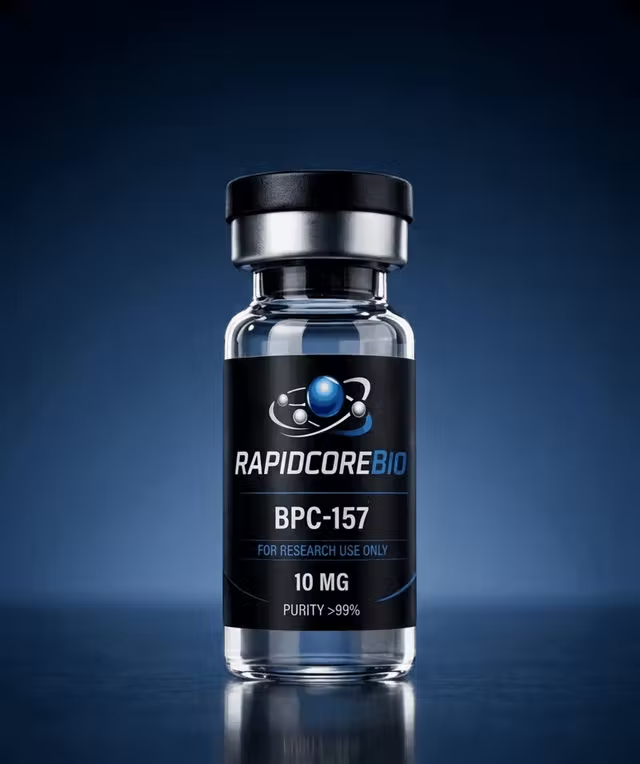
RapidCore Bio provides educational information for readers interested in peptide science, longevity, metabolism, and related research. Use the Research Handbook for terminology and the COA documentation page to review available product documents. A document should be interpreted only within the scope of the information it actually reports.
Products are for research use only. They are not for human or animal consumption, medical use, diagnosis, treatment, or therapeutic use. Research findings discussed in this article do not establish that a RapidCore Bio product is suitable for personal use.
Frequently Asked Questions
What is the exact RUO label statement the FDA requires?
“For Research Use Only. Not for use in diagnostic procedures.” This wording, specified in 21 CFR 809.10©(2)(i), must appear prominently on the immediate container and applicable outer packaging.
Does putting the RUO statement on my label guarantee the exemption applies?
No. The FDA also evaluates objective intent, meaning marketing, website content, technical support, and sales patterns must all be consistent with research-only use.
Can I offer validation support to a customer using my RUO product?
Only if that support stays within research-use boundaries. Helping a customer validate a product for clinical diagnostic reporting is evidence of clinical intent, regardless of label wording.
What triggers the transition from RUO to a regulated IVD?
Intending or knowingly allowing clinical diagnostic use triggers the need for IVD clearance or approval, typically through 510(k), De Novo, or PMA pathways, along with full 21 CFR 820 quality system compliance.
What happens if the FDA finds my RUO labeling inconsistent with actual use?
Consequences can include warning letters, misbranding or adulteration findings, product seizures, recalls, or civil injunctions, depending on severity and history.
This article is general information, not a substitute for advice from a qualified lawyer. Consult a qualified legal professional about your own circumstances before acting on anything here.