FDA Checklist for RUO vs IVD Compliance in U.S. Peptide Labs

In the United States, whether a product counts as Research Use Only (RUO) or as an In Vitro Diagnostic (IVD) comes down to one question: what is it actually intended to do? If test results will inform a diagnosis, guide treatment, or influence patient management, the product must meet IVD regulation requirements. If it stays inside a research protocol with no clinical reporting, RUO labeling applies. Labs that blur this line risk misbranding exposure, so the rule of thumb is simple: when in doubt, treat the material as IVD and pause until your quality team signs off.
TL;DR:
Using RUO reagents for clinical or diagnostic purposes can lead to regulatory violations if the product is promoted or used to inform patient management.
Labs must document the intended research-only purpose clearly in protocols and retain supporting procurement records to justify their use.
When an RUO component is incorporated into a report that influences patient care, the lab bears sole responsibility for validation and qualification.
A proper qualification process involves supplier evaluation, batch documentation, and training logs, regardless of the product’s label or manufacturer claims.
Reputable suppliers provide batch-specific certificates of analysis and shipping records but do not change the product’s regulatory status from RUO to IVD.
Table of Contents
RUO vs IVD: Definitions Every Lab Should Memorize
When RUO Testing Vs IVD Testing Gets Blurry
Lab Responsibilities When RUO Components End Up in an LDT
Labeling Rules and Regulatory Texts Worth Bookmarking
Procurement Checklist for RUO Materials
What a Transparent RUO Supplier Actually Adds to Your Compliance File
Where to Find Research-Grade Peptides With the Documentation You Need
Sources
FAQ
A Compliance Reality Check on RUO Sourcing
RUO vs IVD: Definitions Every Lab Should Memorize
The FDA defines an RUO product as an IVD still in its laboratory research phase, one that hasn’t cleared the bar for clinical use. Every RUO label must carry a specific statement: “For Research Use Only. Not for use in diagnostic procedures.” Investigational Use Only (IUO) is a close cousin, applied to devices being studied to establish performance before they can be marketed clinically. IVD, by contrast, is a regulatory category defined by function, not packaging: a product intended to inform diagnosis or patient management is an IVD, period.
Laboratory-developed tests (LDTs) complicate the picture further. An LDT built and run entirely in-house can still function as a clinical IVD if its results reach a treating physician, and the FDA’s risk-based oversight framework treats it accordingly.
Quick comparison for your SOP binder:
RUO: Research-phase only, no diagnostic claims, must carry the FDA warning statement.
IUO: Used in clinical investigations to gather performance data before marketing clearance.
IVD: Regulated device intended for diagnosis, screening, or monitoring patient health status.
LDT: Test designed and performed by one lab; becomes an IVD-type product once results reach clinical decision making.
When RUO Testing Vs IVD Testing Gets Blurry
Regulators don’t look at the label alone. They look at the “totality of circumstances,” meaning the FDA weighs labeling language, marketing claims, sales channels, and whether the manufacturer helped validate the product for a clinical assay. A reagent boxed as RUO can still draw scrutiny if the manufacturer’s sales team pitches it for diagnostic workflows or offers clinical validation support. That pattern of conduct, not the sticker on the vial, is what regulators evaluate.
Red flags labs recognize immediately:
A sales rep suggesting the reagent “works great” for a specific clinical assay.
Marketing material referencing patient outcomes or diagnostic accuracy.
A supplier offering to help validate the product specifically for clinical reporting.
Internal requests to report RUO-derived results directly into a patient chart.
The consequences aren’t abstract. Products distributed or promoted for clinical use while carrying research-only claims can trigger misbranding findings under FDA’s LDT oversight guidance, and adulteration charges follow when unapproved devices reach patient care.
Pro Tip: Write the protocol’s stated purpose and result-disposition rule before you ever place the order. That sentence, kept in your protocol file, becomes your strongest evidence of research-only intent if a regulator ever asks why you bought the material.
Lab Responsibilities When RUO Components End Up in an LDT
Buying an RUO reagent doesn’t transfer regulatory risk to the manufacturer. Once that component becomes part of a test you report clinically, the qualification burden sits with your lab. Peer-reviewed analysis of FDA’s LDT oversight framework confirms that internal validation and documentation don’t change the component’s underlying regulatory status. They just prove you did your homework.
Here’s the practical sequence:
Qualify the supplier. Evaluate manufacturing capability the way purchasing controls under 21 CFR §820.50 expect, even if the vendor isn’t itself IVD-cleared.
Build a documentation file. Keep certificates of analysis, lot traceability records, method verification data, and acceptance criteria on hand for every batch used in an LDT.
Track deviations and training. Log any out-of-spec result and confirm staff running the assay have documented competency.
Escalate early. Loop in your quality or regulatory affairs team the moment an RUO-sourced test starts generating results used for anything resembling patient management. An Investigational Device Exemption or IRB review may apply if you’re running a formal clinical investigation.
Labeling Rules and Regulatory Texts Worth Bookmarking
Three documents belong in every compliance SOP. First, 21 CFR §809.10 spells out exactly what an IVD label and package insert must contain: intended use statement, warnings, performance characteristics, and directions for interpretation. RUO labeling deliberately omits these clinical claims, which is precisely why the presence or absence of that language matters during an audit.
Second, 21 CFR Part 812 governs Investigational Device Exemptions. Some investigational IVD studies qualify for exemption from full IDE requirements; others, particularly those posing higher risk to subjects, require a full IDE application before you can proceed.
Third, keep the FDA’s RUO/IUO distribution guidance on file. It’s the single clearest articulation of how manufacturers and end users are expected to behave, and referencing it directly in your SOPs gives auditors a citation trail instead of a vague policy statement.
Confirm the exact label statement matches FDA’s required RUO language.
Check whether package insert claims cross into diagnostic territory.
Note IDE exemption criteria if you’re running an investigational study.
For a deeper walkthrough of how these label distinctions play out in purchasing decisions, see our guide to RUO labeling requirements.
Procurement Checklist for RUO Materials
Before you place an order, confirm the label text matches FDA’s RUO or IUO language exactly, request the certificate of analysis and any supplier QC statements, and document that the shipment is intended strictly for research use. This last point matters more than most labs realize. A supplier’s COA proves analytical identity, not clinical intent, so don’t lean on it as evidence of anything beyond purity and identity.
On receipt:
Verify lot identity against the packing slip and COA.
Run your own qualification testing before the material touches any workflow.
Document the permitted use and any restrictions directly in your SOP.
File purchasing records, decision logs, and training records that collectively demonstrate research-only intent.
Pro Tip: Store your procurement decision memo alongside the COA for each lot. If a reviewer ever questions why a reagent was purchased, that single memo answers the question faster than reconstructing intent after the fact.
Our research use only compliance guide walks through how to structure these SOP entries for a research-focused lab.
What a Transparent RUO Supplier Actually Adds to Your Compliance File
A supplier that provides batch-level third-party verification, published certificates of analysis, and clear U.S. shipping records gives your lab real material for supplier qualification. A supplier that provides batch-level third-party verification, published certificates of analysis, and clear U.S. shipping records gives your lab real material for supplier qualification.
None of that changes a product’s intended-use status, though. A clean COA proves identity and purity, not clinical eligibility. When you evaluate any peptide supplier, ask directly: can I access the COA for this specific lot, what is the scope of your technical support, and where does your assistance stop short of validation for clinical use? Straight answers to those three questions tell you more than any marketing page.
Where to Find Research-Grade Peptides With the Documentation You Need
Sourcing RUO materials shouldn’t mean gambling on undocumented lots or guessing at a supplier’s testing practices. Rapidcorebio distributes Research Peptides built for laboratory workflows, alongside Peptide Stacks for multi-compound protocols and bacteriostatic water for standard lab preparation needs.
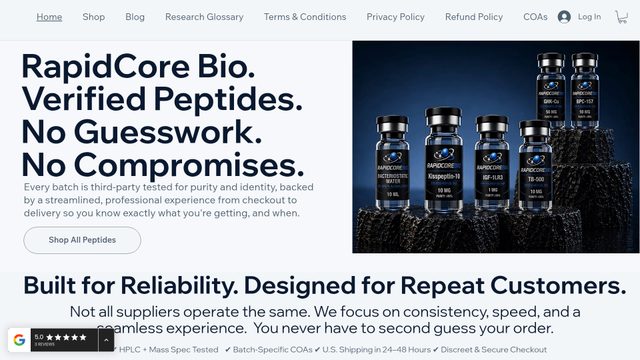
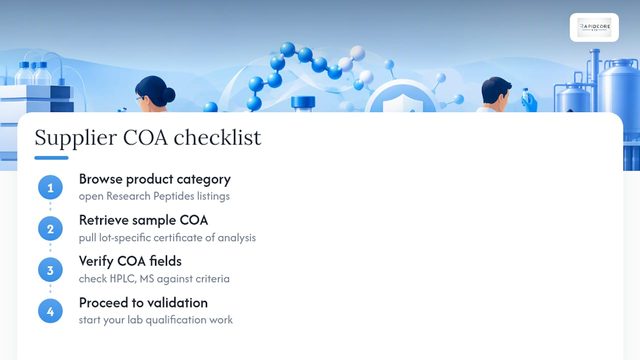
Every batch ships with published documentation, including HPLC and mass spectrometry verification, so your qualification file doesn’t start from zero. You can pull lot-specific certificates of analysis directly, cross-check them against your acceptance criteria, and move straight into your own validation work instead of chasing a supplier for basic paperwork. Rapidcorebio also maintains a peptide COA guide that walks through what each field on a COA actually verifies, useful reading before your next order lands.
If your lab is evaluating suppliers for an upcoming research protocol, start by browsing the Research Peptides category and pulling a sample COA to see how the documentation lines up with your own qualification checklist.
Research use disclaimer: All peptides and related products referenced in this article are intended strictly for laboratory research use. They are not for human or animal consumption, diagnostic use, or clinical application of any kind.
This article is general information, not a substitute for advice from a qualified doctor. Consult a qualified healthcare professional about your own circumstances before acting on anything here.
Sources
FDA LDT oversight framework and laboratory responsibilities (peer-reviewed analysis) | PMC
§ 809.10 Labeling for in vitro diagnostic products. | e-CFR / LII
FAQ
What Does RUO Mean on a Lab Product Label?
RUO means “Research Use Only,” a designation the FDA requires for IVD products still in their laboratory research phase. The label must include a clear statement indicating the product is not for use in diagnostic procedures, as required by FDA labeling regulations.
How Do I Know If a Product Should Be Treated as an IVD?
Ask what the results will be used for. If they’ll inform a diagnosis, treatment decision, or patient management, the product falls under IVD regulation regardless of how it’s labeled or marketed.
Can a Lab Use RUO Reagents in a Clinical LDT?
Yes, but the lab takes on full responsibility for qualifying the component, documenting supplier capability, and meeting quality-system obligations, as outlined in peer-reviewed analysis of FDA’s LDT framework. The reagent’s RUO status doesn’t disappear just because your validation data looks solid.
Does a Certificate of Analysis Change a Product’s Regulatory Status?
No. A COA documents identity and purity, which supports your qualification file, but it has no bearing on whether a product is legally an IVD or RUO. That determination rests entirely on intended use.
Does Rapidcorebio Sell IVD Products?
No. Rapidcorebio distributes peptides strictly for laboratory research use, with batch-specific documentation available through its Research Peptides category and COA resource page.
A Compliance Reality Check on RUO Sourcing
Most labs don’t get burned by a mislabeled box. They get burned by a slow drift: a validated assay that quietly starts feeding results into a clinical report, a sales call that nudges a reagent toward diagnostic language, a shortcut taken because the RUO material “performed just as well” as the cleared alternative. The FDA’s intended-use framework exists precisely because performance and legality are separate questions, and conflating them is where labs get into trouble.
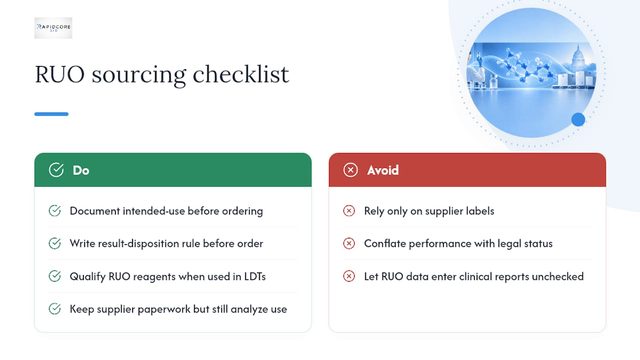
The conventional advice, buy from a reputable source and trust the label, isn’t wrong, but it’s incomplete. A reputable source gives you clean documentation. It doesn’t give you permission to skip the intended-use analysis, and it definitely doesn’t absolve your lab of the qualification work once that reagent enters an LDT. The paperwork and the legal status are two different things, and treating them as one is the single most common compliance mistake in RUO purchasing.
If there’s one habit worth building into every protocol, it’s writing down the result-disposition rule before the order goes out. That sentence, more than any supplier’s marketing claim, is what protects your lab when someone eventually asks why a reagent was purchased and what happened to the data it produced.
— Adrian K. Solis
Recommended