Ask for Raw MS and Lot COA Before Using IGF-1 LR3 in Labs

IGF-1 LR3 is a research-grade analog of human IGF-1, engineered with an Arg3 substitution and N-terminal extension that block IGF-binding protein attachment. That structural change extends receptor exposure and signaling duration far beyond native IGF-1, making it a useful reagent for studying IGF-1R activation in cell culture and muscle biology. It carries no FDA approval for human use and is sold strictly for laboratory research.
TL;DR:
IGF-1 LR3’s resistance to IGFBPs extends its circulation time and receptor signaling, making it more potent in cell and animal studies than native IGF-1.
Valid COAs must confirm the amino acid sequence, molecular weight, purity, and absence of endotoxins, with raw mass spectrometry data preferred for verification.
Storing lyophilized IGF-1 LR3 requires freezing and protection from moisture and light, while reconstituted samples must be handled carefully to prevent degradation.
The primary safety concern with IGF-1 LR3 is hypoglycemia resulting from cross-reactivity at the insulin receptor, with no human safety data or FDA approval supporting its use.
Sourcing from verified vendors that provide lot-specific COAs backed by HPLC and mass spectrometry ensures material authenticity, critical for research reliability.
Table of Contents
What Is IGF-1 LR3 Research Peptide and Why Does the Structure Matter?
Where Researchers Actually Use This Peptide
Checking a Vendor’s COA Before You Trust the Vial
Storing Lyophilized Vials Without Wrecking Your Data
Safety Signals and Regulatory Status Researchers Need to Plan Around
What Makes a COA Actually Trustworthy
Practical Takeaways for Your Next Protocol
A Note on Rigor and Reporting Standards
Sourcing Verified IGF-1 LR3 for Your Lab
Sources
What Is IGF-1 LR3 Research Peptide and Why Does the Structure Matter?
IGF-1 LR3 (Long Arg3-IGF-1) is an 83-amino-acid analog built from native human IGF-1 with two deliberate modifications: an arginine substitution at position 3 and a 13-amino-acid extension added to the N-terminus. Both changes target the same vulnerability in native IGF-1 biology: its rapid capture by IGF-binding proteins (IGFBPs), which normally regulate how much free ligand reaches IGF-1R at any given time.
Strip away IGFBP binding, and you get a molecule that lingers in circulation and keeps hitting the receptor. That is the entire premise behind LR3 as a research tool.
Arg3 substitution: alters a binding-protein contact site without disrupting receptor affinity
N-terminal extension: physically interferes with IGFBP docking
Net effect: dramatically reduced IGFBP affinity, longer free-ligand persistence in preclinical models
Downstream, LR3 activates IGF-1R as its primary target, with documented cross-activity at the insulin receptor. That dual engagement triggers two major cascades: PI3K/Akt, which drives protein synthesis and cell survival signaling, and MAPK/ERK, which governs proliferation.
Statistic Callout: Preclinical characterization work on IGF-1 variants shows that reduced IGFBP binding correlates with substantially enhanced biological potency relative to native IGF-1 in cell and animal models, a finding foundational to why researchers select LR3 over the wild-type peptide for extended-exposure protocols.
Where Researchers Actually Use This Peptide
IGF-1 LR3’s IGFBP resistance is not just a biochemical curiosity. It changes what the molecule is good for in an experimental design, and it explains why three research domains keep showing up in the literature.
Cell culture: LR3 is used as a serum-free media supplement in proliferation assays, where its resistance to binding-protein sequestration means lower effective concentrations produce sustained signaling compared to native IGF-1 in serum-containing systems.
Muscle biology: preclinical work applies LR3 to study satellite cell activation and to differentiate hypertrophy pathways from hyperplasia pathways, since sustained IGF-1R engagement gives investigators a longer signaling window to observe.
Bioprocessing: some production systems substitute LR3 for native growth factors where extended activity reduces the frequency of reagent replenishment during a culture run.
Here is the caveat every honest summary needs: this is a preclinical picture. There are no registered human clinical trials of IGF-1 LR3, and the evidence base is built almost entirely on cell culture and animal data. Anyone extrapolating findings to human physiology is working well past what the literature supports.
Checking a Vendor’s COA Before You Trust the Vial
A certificate of analysis is only as good as what it actually verifies. For IGF-1 LR3 specifically, identity confirmation matters more than usual, because published mass and sequence claims for the extension region have been inconsistently sourced across vendor documentation.
Here is what a COA needs to show before you should treat a lot as usable research material:
Stated amino acid sequence, matched against a citable reference, not a vendor’s internal claim
Calculated molecular mass, cross-checked against mass spectrometry output rather than assumed
HPLC purity chromatogram with a visible single dominant peak and stated percentage
Mass spectrometry identity confirmation, ideally with the raw spectrum available, not just a summary number
Endotoxin test result, particularly relevant for any downstream cell-based or in vivo work
Lot number and manufacturing date, so results can be tied to a specific production batch
One investigation into LR3 sourcing found that the molecular weight commonly cited across vendor pages has no consistent published origin, which means an unverified mass claim can pass as a specification when it is really just a copied number.
Pro Tip: Ask technical support directly for the raw MS spectrum and the theoretical mass calculation behind it, not just the summary purity percentage. A vendor that hesitates to produce either is telling you something about their internal QA.
Storing Lyophilized Vials Without Wrecking Your Data
Lyophilized IGF-1 LR3 is stable under the right conditions, but stability is conditional, not automatic. Store unopened vials frozen and protected from moisture and light. Once reconstituted, the peptide is far more sensitive to temperature cycling and time.
Keep lyophilized powder frozen until use; avoid repeated temperature swings during storage
Minimize freeze-thaw cycles on reconstituted material, since each cycle degrades peptide integrity
Aliquot reconstituted solution into single-use volumes rather than drawing repeatedly from one vial
Maintain aseptic technique and endotoxin control throughout handling
Log lot numbers, reconstitution dates, and storage conditions for every vial in your records
For the actual math behind concentration and dilution, consult a dedicated reconstitution reference rather than improvising, and see Rapidcorebio’s stability guidance for shelf-life specifics by peptide class.
Safety Signals and Regulatory Status Researchers Need to Plan Around
The clearest documented risk with IGF-1 LR3 is hypoglycemia, driven by cross-activity at the insulin receptor. Animal studies report this effect as both deeper and more prolonged with LR3 than with native IGF-1, a direct consequence of the analog’s extended systemic exposure.
Hypoglycemia has been documented in animal models and is mechanistically tied to insulin-receptor cross-activation, not IGF-1R alone
Prolonged IGF-1R activation raises theoretical concerns about proliferation signaling relevant to cancer biology, though evidence here remains limited and largely indirect
IGF-1 LR3 is not FDA-approved for any human indication and is labeled research-use-only by legitimate suppliers
The World Anti-Doping Agency prohibits IGF-1 and its analogs, a relevant fact for any research context that intersects with athletic testing.
In vivo protocols should include planned glucose monitoring and institutional review before work begins
Statistic Callout: Native rhIGF-1 (mecasermin, marketed as Increlex) carries an FDA-approved label with documented hypoglycemia risk under clinical supervision. LR3 is a distinct, unapproved molecule with no equivalent human safety record, and conflating the two is a common and consequential error in casual research discussions.
What Makes a COA Actually Trustworthy
A certificate of analysis is a claim, not proof, until it is backed by independent verification. Lot-specific testing matters because peptide synthesis batches vary. A COA tied to a specific lot number, rather than a generic product-level document, tells you the vial in your hand was actually tested.
Third-party HPLC and mass spectrometry confirm both purity and identity, catching truncated or mismatched sequences that purity alone can miss
Endotoxin testing is critical for any cell-based assay, since contamination can confound proliferation and viability readouts
Some vendors provide lot-specific COAs with HPLC and mass spectrometry verification for peptides, giving researchers documentation tied to the exact batch shipped
Check Rapidcorebio’s COA library before ordering to confirm current testing practices for the specific peptide and lot you need
Practical Takeaways for Your Next Protocol
IGF-1 LR3 is a legitimate research reagent for studying IGF-1R signaling, with reduced IGFBP binding as its defining trait. The biggest caveat remains the hypoglycemia risk documented in animal models and the total absence of human trial data.
[
](https://www.rapidcorebio.com/product-page/igf-1lr3-1mg/)
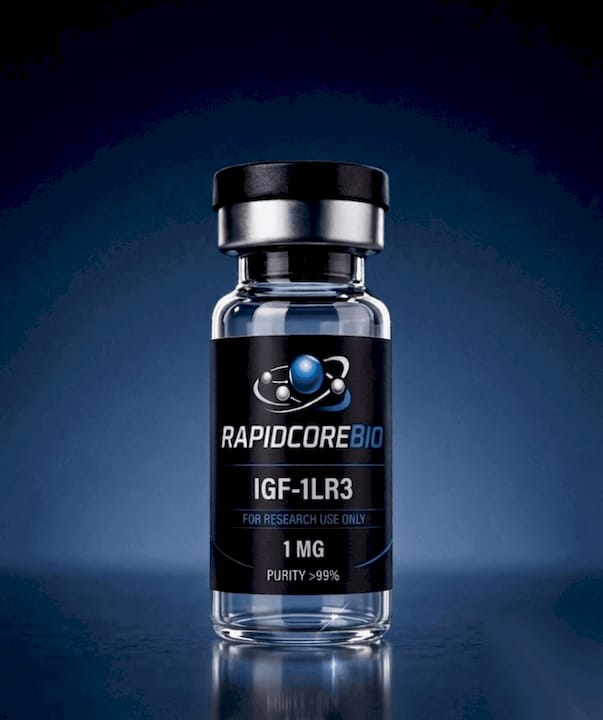
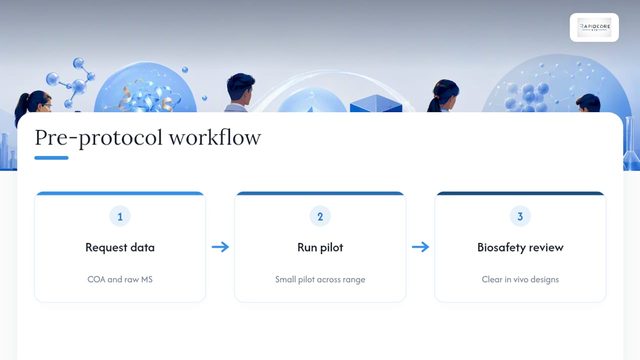
Before your next order: request the COA and raw MS data, run a small pilot at your intended concentration range, and clear in vivo designs through institutional biosafety review. Start with Rapidcorebio’s COA verification page and the reconstitution reference for operational details.
A Note on Rigor and Reporting Standards
Research on peptide analogs only advances when methods sections are honest about material sourcing. If you use IGF-1 LR3 in published work, include COA details, lot numbers, and verification method in your methods section, not just the supplier name.
The field would benefit from shared standards on what counts as adequate identity verification for reference peptides. Until that exists, the burden sits with individual researchers to demand raw data, not summary claims, from every vendor they use.
— Adrian K. Solis
Sourcing Verified IGF-1 LR3 for Your Lab
Rapidcorebio gives researchers a direct path to lot-verified IGF-1 LR3, without the guesswork that comes from unsourced mass claims and generic product-level documentation you’d find elsewhere.
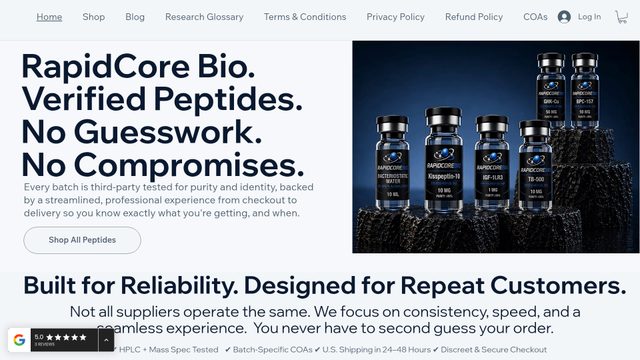
Every batch ships with a lot-specific certificate of analysis backed by HPLC and mass spectrometry testing, so you can confirm identity and purity before it touches your assay. If you’re weighing whether LR3 fits your experimental design, the research handbook covers background context, and the COA verification library lets you pull documentation for a specific lot before you commit budget to it. For assay-fit questions or documentation requests beyond what’s posted, Rapidcorebio’s technical support team can walk through specifics with you. If you’re ready to source material for your next protocol, the IGF-1 LR3 product page has current lot documentation available now.
This article is general information, not a substitute for advice from a qualified doctor. Consult a qualified healthcare professional about your own circumstances before acting on anything here.
Recommended