GxP Labs: 7 HPLC Data Integrity Controls to Prevent Failures

HPLC data integrity depends on preserving the raw chromatographic record and its complete audit trail, then reviewing only documented exceptions. The single most important control is technical: autointegration configured as the default, with manual reprocessing locked behind SOP-justified reason codes. Frameworks like ALCOA+ and ICH Q2(R2) back this up, and the sections below walk through the audit-trail checklist, review-by-exception process, and inspection-readiness steps that make it work.
TL;DR:
Regularly review the CDS project directly to identify reprocessing, manual integration, aborted injections, or method edits, rather than relying solely on report PDFs.
Ensure autointegration is the default setting and methods are locked with electronic signatures to maintain an immutable audit trail for all chromatographic data.
Document and justify manual integrations with SOP-approved reason codes, avoiding unexplained adjustments and reprocessing without documented causes.
Use review-by-exception with automated exception flags for critical events, focusing inspection efforts on manual edits, reprocessing, or exclusions that pose data integrity risks.
Integrate data integrity procedures into the broader quality management system, linking audit-trail findings to CAPA, change control, and training records to prevent systemic issues.
Table of Contents
What Does HPLC Data Integrity Actually Mean?
Core Technical Controls: Autointegration, Method Locking, and CDS Configuration
A Practical Checklist for Integration and Sequence Processing
Audit-Trail Review: Making Review-by-Exception Work
Common Pitfalls and Warning-Letter Lessons
Inspection Readiness: What to Produce When an Inspector Asks
RapidCoreBio Resources for Verifying Analytical Results
Impact of Laboratory Environmental Factors on HPLC Data Integrity
Integrating HPLC Data Integrity Into the Broader Quality Management System
The Data-Integrity Program Is a Business Process, Not a Software Setting
Verifying What You’ve Received: RapidCoreBio’s Educational Resources
Sources
FAQ
What Does HPLC Data Integrity Actually Mean?
Data integrity in chromatography isn’t a checkbox next to “software validated.” It’s the completeness, consistency, and accuracy of a dataset across its entire lifecycle, from injection to archived report. The raw electronic chromatogram, its metadata, and its audit trail are the authoritative record, not a printed PDF pulled from a chromatography data system (CDS) at the end of a run.
That distinction trips up a surprising number of labs. A printed report shows one integration. It doesn’t show the three prior integrations an analyst tried before landing on the one that passed. That’s why regulators keep coming back to the same question during inspections: can you show me the electronic audit trail, not just the summary report?
The industry-standard framework for this is ALCOA+: data must be Attributable, Legible, Contemporaneous, Original, and Accurate, plus Complete, Consistent, Enduring, and Available. It’s not new, but it’s still the backbone auditors use to structure findings, and it maps directly onto how a CDS handles chromatographic data.
Pro Tip: If your review process only involves opening the final PDF report, you’re not reviewing data integrity. Open the CDS project directly and check for reprocessing events, aborted injections, and integration-parameter edits nobody flagged.
Core Technical Controls: Autointegration, Method Locking, and CDS Configuration
Autointegration should be the default state for every validated method, not an option analysts toggle on and off. When a method’s integration parameters are locked and saved with the method itself, there’s no ambiguity about how a peak boundary was drawn. Chromatography guidance on GxP integration treats this as the baseline expectation, not an aspirational goal.
Manual integration isn’t banned outright, but it needs guardrails. A scientifically sound reason, documented in the SOP, an entry in the electronic record explaining why, and a reason code the CDS captures automatically. If your system lets analysts change a peak boundary with zero explanation required, that’s a control gap waiting to become a finding.
A compliant CDS setup typically includes:
Method locking with electronic signatures required for any parameter change
Change control that logs who modified a method, when, and why
Audit-trail entries for every injection: user ID, timestamp, integration edits, reprocessing events, and any aborted or excluded runs
No administrative ability to disable or truncate the audit trail
Industry recommendations echo the same point: integration settings should be method-specific rather than relying on a generic default, and reprocessing without a documented reason code is a red flag regardless of the outcome. This ties back to Computer System Validation (CSV) and GAMP 5 principles: your CDS vendor bears responsibility for building immutable audit-trail features, but your lab bears responsibility for configuring and enforcing them correctly. A validated system with disabled logging is still a non-compliant system.
A Practical Checklist for Integration and Sequence Processing
Sequence order matters more than most analysts realize. Processing system suitability and standards before samples isn’t just procedural tidiness. It confirms the method is performing correctly before you commit to interpreting sample results.
Run system suitability first. Confirm resolution, tailing, and reproducibility meet acceptance criteria before processing anything else.
Process standards next, using the locked method parameters, no manual tweaking mid-sequence.
Label every injection, including aborted or repeated runs, and preserve them all in the electronic record.
Document any exclusion with a specific reason code tied to a scientific or procedural justification, never “did not meet expectations.”
Save integration parameters with the method itself, including peak names and retention-time windows, so nothing depends on an analyst’s memory.
Train on a fixed cadence. Annual refreshers on manual-integration SOPs catch drift before it becomes habit.
Track KPIs monthly, specifically the frequency of manual integrations per analyst and the count of documented exceptions per method.
Teams that track that last item consistently spot problems early. A sudden spike in one analyst’s manual-integration rate is often the first visible sign of a training gap, not a conspiracy, but it’s worth investigating either way.
Audit-Trail Review: Making Review-by-Exception Work
Reviewing every single audit-trail entry for every injection isn’t realistic, and it isn’t what regulators expect. Review-by-exception is the accepted, risk-based approach: reviewers focus on the events that actually carry data-integrity risk rather than drowning in routine log entries.
The exception set should include manual integrations, reprocessing events, deletions or exclusions, method parameter edits, and any system-clock changes. These are the events that could hide or misrepresent a result, and they’re the events an inspector will ask about first.
Getting review-by-exception right depends on the CDS actually surfacing these events instead of burying them in a flat log. A well-configured system flags exceptions automatically, sometimes through a dashboard that color-codes runs needing review. Without that layer, reviewers face an unworkable volume of raw entries, and the review becomes a rubber stamp.
Define the exception criteria in a validated SOP before you rely on them
Assign review to someone independent of the original analysis, typically QA
Document who reviewed, when, what scope was covered, and what was found
Route any confirmed issue into your CAPA system, not a side conversation
Review frequency should scale with risk. High-risk methods (potency, impurity profiling) may need review after every batch; lower-risk methods might justify a longer interval, provided that interval is defended in your risk assessment.
Common Pitfalls and Warning-Letter Lessons
The patterns behind FDA findings are strikingly repetitive. FDA’s data integrity guidance documents recurring failure modes: audit trails disabled or left incomplete, reintegration performed until a result passes, and trial or test injections quietly omitted from the reportable sequence.
That last one deserves particular attention. Testing-into-compliance, where an analyst runs several injections and reports only the one that produces the desired number, is one of the most detectable forms of manipulation once investigators know what to look for, because a properly configured CDS preserves every injection whether or not it was reported.
Internal auditors should watch for:
Gaps in injection sequence numbers with no documented explanation
Reprocessing events clustered around specific analysts or specific problem methods
Audit-trail settings that show any period of being disabled or unavailable
Manual integrations with generic justifications like “improved peak shape” and nothing more specific
None of this is really a software problem. It’s a management problem. Systemic reintegration-to-pass behavior usually reflects pressure, quotas, deadlines, or a QA function that isn’t actually independent, more than it reflects a rogue analyst.
Inspection Readiness: What to Produce When an Inspector Asks
An inspector’s request is usually simple: show the complete electronic record, not a curated summary. Have these ready before anyone walks through the door.
A full project export: raw chromatograms, complete audit trails, and method version history
CSV documentation proving the CDS was validated per GAMP 5 principles
Evidence of review-by-exception, including reviewer sign-offs and dates
CAPA records and training logs tied to any prior data-integrity finding
Don’t scramble to reconfigure audit-trail settings or “clean up” old projects right before an inspection. That activity is itself detectable and reads far worse than an honest, documented history with a few resolved deviations.
RapidCoreBio Resources for Verifying Analytical Results
Solid internal controls answer half the question. The other half is confirming what a supplier’s Certificate of Analysis actually tells you. Rapidcorebio publishes educational material on interpreting chromatographic peak data and reviewing COAs, aimed at helping researchers understand what they’re looking at.
HPLC chromatogram interpretation walks through common peak-shape and integration issues
Our peptide Certificate of Analysis guide breaks down what each COA section should contain
Guidance on verifying purity versus reliability explains why independent verification matters
Third-party testing and batch-specific COAs provide important information about sourcing practice, but they are not regulatory approvals or certifications.
Impact of Laboratory Environmental Factors on HPLC Data Integrity
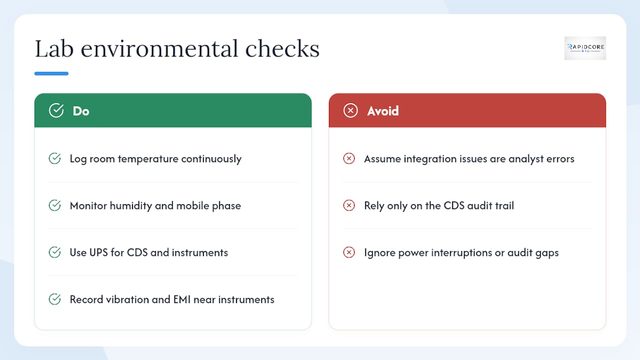
Temperature swings in a lab aren’t just a comfort issue. They shift retention times and can push a column outside its validated operating range, which then shows up as integration inconsistencies that have nothing to do with analyst behavior. A CDS will faithfully log a bad peak shape caused by a failing column oven exactly the same way it logs a genuine sample issue, so environmental drift can masquerade as a data-integrity problem when it’s actually an equipment problem.
Humidity affects mobile-phase stability and detector performance more than most labs account for in their risk assessments. Power fluctuations are a subtler threat: an uninterruptible power supply protecting the CDS server matters as much as one protecting the instrument, because a mid-run power interruption can corrupt a data file or create an audit-trail gap that looks identical to a deliberate deletion during a later review.
Vibration and electromagnetic interference from nearby equipment can introduce baseline noise that pushes automated integration algorithms to misidentify peak start and stop points. None of this is a data-integrity violation in the falsification sense, but it produces exactly the kind of anomaly an audit-trail reviewer needs to investigate and document, rather than dismiss. Environmental monitoring logs, room temperature, humidity, power quality, deserve a place next to your CDS audit trail in any serious data-integrity risk assessment, because an inspector who spots a pattern of “unexplained” integration issues will ask whether you ever checked the room the instrument sits in.
Integrating HPLC Data Integrity Into the Broader Quality Management System
HPLC data integrity can’t live in a silo owned by the analytical chemistry group. It has to connect to the same quality management system (QMS) that governs deviations, change control, CAPA, and training records, or it becomes an isolated technical exercise that inspectors will treat with suspicion.
A finding surfaced during audit-trail review by exception should flow directly into your existing CAPA process, using the same investigation rigor as an out-of-specification result. Treating a disabled audit trail as a minor IT glitch instead of a quality event is one of the fastest ways to turn a fixable issue into a systemic finding. Change control matters here too: any modification to CDS software, integration methods, or user-access permissions should go through the same change-control gate as a manufacturing process change, with documented risk assessment and approval.
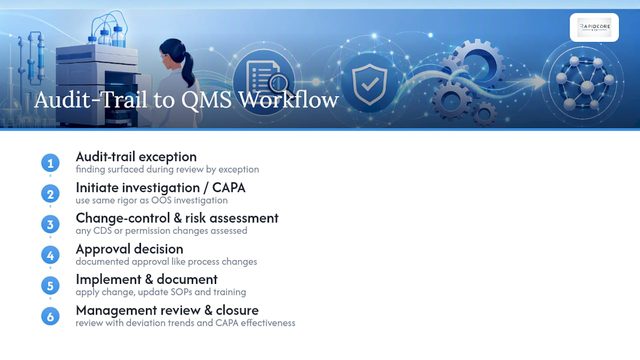
Training records tie the loop together. If your QMS tracks training on manufacturing SOPs but treats CDS and audit-trail training as an onboarding afterthought, that gap will surface the moment an inspector asks to see training documentation for the analyst who performed a questioned reintegration. Data integrity governance works best as one thread in your existing quality fabric, reviewed at management review meetings alongside deviation trends and CAPA effectiveness, not as a separate compliance program bolted on afterward.
The Data-Integrity Program Is a Business Process, Not a Software Setting
Locking down autointegration and audit trails solves the technical half of the problem. Data manipulation happens when SOPs are vague, training is thin, or management rewards speed over documented rigor. A risk-based program that pairs validated CDS controls with real human accountability outperforms any feature list a vendor sells you.
— Adrian K. Solis
Verifying What You’ve Received: RapidCoreBio’s Educational Resources
Configuring your CDS correctly is only useful if the material you’re analyzing is what it claims to be. Rapidcorebio offers a genuinely different route for labs that want a second layer of confidence: peptides shipped with batch-specific analytical verification, paired with educational resources that show researchers how to read that data for themselves.
Our COA verification resources walk through what a legitimate Certificate of Analysis should contain and how to cross-check it against your own instrument data, while our guide on chromatogram interpretation helps you spot the peak-shape and purity issues that matter before you commit a sample to a full study. These resources are educational and research-use only, not a substitute for your own validated CDS controls or a claim of regulatory certification. If you’re sourcing peptides for laboratory research and want batch-level documentation to check against your own analysis, browse research-grade peptides and start by reviewing the COA for the batch you’re considering.
Sources
FAQ
What are the five principles of data integrity?
ALCOA+ defines data as Attributable, Legible, Contemporaneous, Original, and Accurate, extended with Complete, Consistent, Enduring, and Available for full GxP compliance.
What are the FDA guidelines for HPLC data integrity?
FDA’s data integrity guidance expects complete audit trails, retention of every injection including trial runs, and documented justification for any manual reprocessing.
How do you analyze HPLC data for integrity issues?
Open the CDS project directly rather than relying on printed reports, then check the audit trail for reprocessing events, injection-sequence gaps, and undocumented manual integrations.
What are the four main types of data integrity?
Common categorizations cover physical, logical, entity, and referential integrity in database systems; in a GxP chromatography context, these translate into raw-data completeness, audit-trail accuracy, method-record consistency, and secure long-term storage.
Can autointegration alone guarantee HPLC data integrity?
No. Autointegration configured as the default reduces opportunities for manipulation, but it needs to be paired with SOPs, audit-trail review, and management oversight to be effective.
Recommended