BPC-157 Tissue-Repair Research: Signals, Models, and Limits
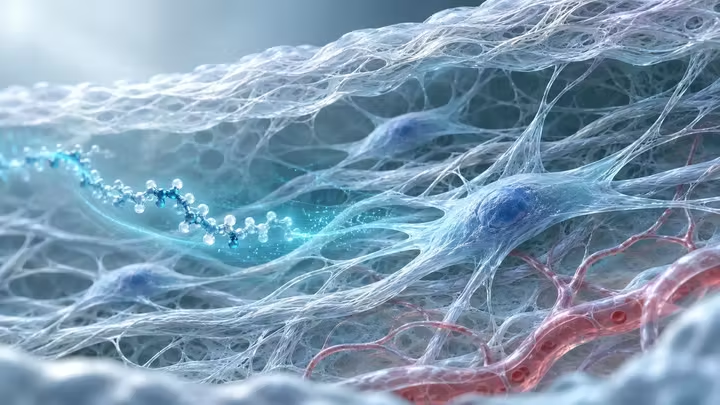
BPC-157 research spans cell behavior, vascular signaling, and animal injury models, each with different evidentiary limits.
BPC-157 is a synthetic 15-amino-acid peptide studied mainly in cell and animal models. Much of the discussion surrounding it uses broad words such as healing, recovery, and regeneration. Those words are not useless, but they become meaningful only when the model, tissue, measurement, and time point are identified.
The evidence does not describe one universal repair process. It describes several experimental signals that have been observed under specific conditions. Researchers have examined fibroblast survival and migration, endothelial signaling, blood-vessel formation, inflammatory markers, tendon structure, mechanical strength, and functional recovery. Each endpoint answers a different question.
Fibroblast migration is one piece of the repair sequence
Fibroblasts help build and organize extracellular matrix. In a 2011 study using rat tendon explants and cultured fibroblasts, BPC-157 exposure was associated with greater tendon-cell outgrowth, cell survival under stress, and fibroblast migration. The investigators also reported changes involving focal adhesion kinase and paxillin, proteins connected with cell attachment and movement.[1]
That finding supports a specific statement: BPC-157 affected fibroblast behavior in the tested systems. It does not establish that the same exposure repairs a human tendon. A cultured cell is removed from the mechanical loading, immune signaling, blood supply, and tissue architecture present in a living person.
Vascular findings require the same precision
Other studies have investigated angiogenesis and vascular signaling. A chick chorioallantoic-membrane experiment reported increased vessel formation after BPC-157 exposure.[2] A later endothelial-cell study connected pro-angiogenic activity with VEGFR2 signaling and downstream pathways involved in cell survival and migration.[3]
These results are biologically interesting because blood vessels supply oxygen and nutrients to injured tissue. Still, angiogenesis is not automatically beneficial in every context. Vessel growth can differ by tissue, injury type, timing, and disease state. A vascular signal is therefore a mechanism to investigate, not a general promise of faster recovery.
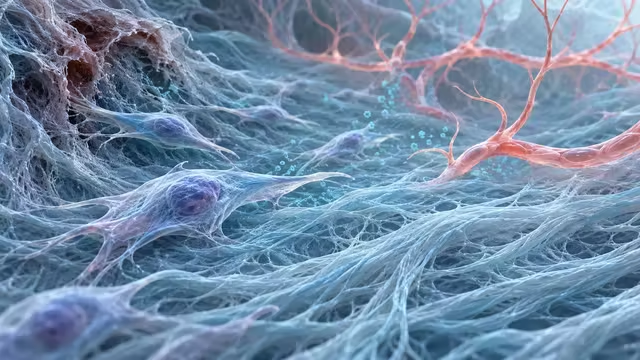
Fibroblast migration and microvascular signaling are related research questions, not proof of a clinical outcome.
Animal tendon models measure more than appearance
Rat Achilles-tendon studies have evaluated histology, biomechanical strength, functional scoring, and organization of the healing tissue. Some experiments reported improved mechanical or structural endpoints after BPC-157 treatment.[4] Animal models can show how multiple cell types and tissue systems respond together, which makes them more informative than a single cell assay.
They still have limits. Rodents heal on a different scale and timeline than humans. The induced injury, exposure route, dose, and rehabilitation conditions may not resemble a clinical situation. A positive rat result is evidence for continued study, not proof of a human outcome.
Human evidence remains very limited
Published human reports are small and weakly controlled. A 2024 pilot report evaluated BPC-157 in a small group with interstitial cystitis, and a 2025 intravenous safety report involved only two participants.[5][6] These publications can generate questions, but they cannot establish effectiveness, identify uncommon risks, or support broad conclusions about tissue repair.
Reliable human evidence would require a clearly defined population, standardized material, prespecified endpoints, an appropriate control group, adequate follow-up, and enough participants to detect both benefit and harm. It would also need to distinguish symptom change from structural healing.
How to read a BPC-157 claim
When a claim cites a study, ask four questions:
1. Was the experiment conducted in cells, an isolated tissue, an animal, or people?
2. What tissue and injury model were used?
3. Was the endpoint molecular, structural, mechanical, functional, or patient reported?
4. Does the conclusion stay within the limits of that model?
The strongest responsible summary is that BPC-157 has produced repair-related signals in several preclinical systems, including fibroblast, vascular, and tendon models. Those signals justify further investigation. They do not establish a general human healing effect.
Frequently asked questions
What does BPC-157 research commonly measure?
Studies have measured cell survival, migration, vascular signaling, histology, mechanical strength, inflammatory markers, and functional outcomes. These endpoints should not be treated as interchangeable.
Does a positive animal study prove that BPC-157 works in people?
No. Animal studies help test mechanisms and integrated tissue responses, but controlled human trials are needed to establish clinical safety or effectiveness.
Is angiogenesis the same as tissue healing?
No. Angiogenesis is blood-vessel formation. It may contribute to some repair processes, but healing also involves immune activity, matrix organization, mechanical loading, and tissue-specific remodeling.
What is the main evidence gap?
The largest gap is the absence of robust, well-controlled human trials using defined endpoints and standardized material.
Related RapidCore Bio resource
Read BPC-157: The Compound Everyone's Talking About but Almost Nobody Understands for additional background, then use the Advanced Peptide Research Handbook to review evidence levels and study design.
https://www.rapidcorebio.com/post/bpc-157-the-compound-everyone-s-talking-about-but-almost-nobody-understands
RapidCore Bio products are sold strictly for research use only. They are not intended for human or animal consumption, medical use, diagnosis, treatment, or therapeutic use.
Selected references
1. Chang CH et al. The promoting effect of pentadecapeptide BPC 157 on tendon healing involves tendon outgrowth, cell survival, and cell migration. 2011. https://pubmed.ncbi.nlm.nih.gov/21030672/
2. Sikiric P et al. Stable gastric pentadecapeptide BPC 157: novel therapy in gastrointestinal tract. Angiogenesis findings discussed in related experimental work. https://pubmed.ncbi.nlm.nih.gov/20388964/
3. Hsieh MJ et al. Therapeutic potential of pro-angiogenic BPC157 is associated with VEGFR2 activation and up-regulation. 2017. https://pubmed.ncbi.nlm.nih.gov/27847966/
4. Krivic A et al. Achilles detachment in rat and stable gastric pentadecapeptide BPC 157. 2008. https://pubmed.ncbi.nlm.nih.gov/18594781/
5. Small pilot report involving interstitial cystitis. 2024. https://pubmed.ncbi.nlm.nih.gov/39325560/
6. Small intravenous safety report. 2025. https://pubmed.ncbi.nlm.nih.gov/40131143/