Net Peptide Content: A Lab Researcher's Measurement Guide
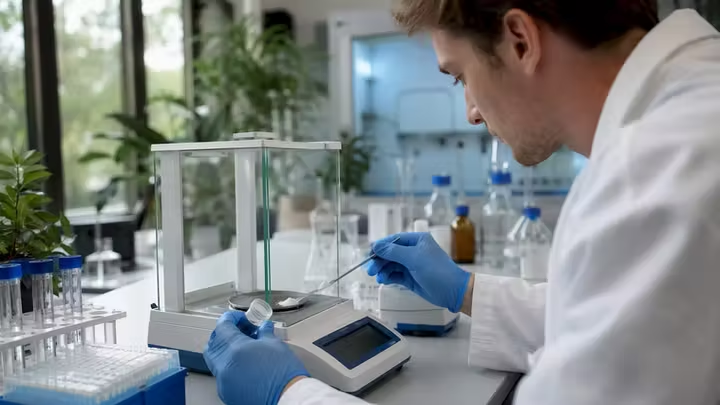

Net peptide content (NPC) is the percentage of a lyophilized peptide powder that is actual peptide mass, calculated as (peptide mass ÷ gross sample mass) × 100. According to AmbioPharm’s technical FAQ, NPC typically falls within a range that depends on sequence and salt form — meaning the vial you weigh may contain substantially less active compound than its label weight suggests. That gap has direct consequences for every concentration calculation you run.
The practical implication: if you weigh 1.0 mg of a peptide powder with 75% NPC and assume you have 1.0 mg of peptide, your working solution is already 25% off before you pipette a single microliter. Correcting for NPC before preparing experimental concentrations is not optional for reproducible work. The three methods most commonly used to establish NPC are elemental (CHN) analysis, amino acid analysis (AAA), and UV-based assays, and each should appear on a well-constructed Certificate of Analysis (COA) alongside chromatographic purity.
NPC formula: NPC (%) = (peptide mass / gross mass) × 100
Why it matters: NPC corrects for moisture, counterions, and non-peptidic residues that HPLC area% ignores
Primary determination methods: elemental CHN analysis, AAA, UV spectrophotometry (A214/A280)
COA expectation: method used, NPC value, salt form, HPLC purity, and reported uncertainty
Table of Contents
What actually reduces net peptide content below 100%
Analytical methods for measuring peptide content
How to calculate NPC and correct your experimental concentrations
How salt forms and counterions affect NPC — and how to convert
What a well-constructed COA should tell you about peptide content
Choosing the right NPC method for your lab’s constraints
Common pitfalls and how to validate your NPC results
How Rapidcorebio reports net peptide content on COAs
Key Takeaways
Why NPC verification should be non-negotiable in your lab
Rapidcorebio’s COA resources for peptide researchers
Useful sources and further reading
What actually reduces net peptide content below 100%
A peptide that reads 98% pure by HPLC area% can still carry an NPC of 70% or lower. Chromatographic purity measures relative peak area — it tells you how much of the UV-absorbing material is your target peptide, not how much of the total powder mass is peptide. Bachem’s QC knowledge hub makes this distinction explicit: NPC and purity are not equivalent, and both must be considered when preparing solutions of biologically active peptides.
Moisture and residual solvents are the most common culprits. Lyophilization removes bulk water, but peptides — especially hydrophilic sequences — reabsorb atmospheric moisture during handling and storage. Residual acetonitrile, TFA, or buffer components from HPLC desalting steps can also persist in the powder. When moisture content is uncertain, Karl Fischer titration provides a direct, moisture-specific measurement that lets you partition the water contribution from other non-peptidic mass. Proper vial seal integrity during storage directly limits how much moisture re-enters a lyophilized sample.
[
](https://www.rapidcorebio.com/product-page/bateriostactic-water-10ml/)
Counterions and salt forms are the second major factor, and they hit basic peptides hardest. Peptides synthesized by solid-phase methods are routinely purified by reversed-phase HPLC using TFA-containing mobile phases. TFA ions pair with basic residues (Arg, Lys, His) and remain in the final powder. Research on peptide purity standards documents that residual TFA can account for a significant fraction of total mass in peptides with multiple basic residues — a range large enough to make the difference between a working assay and a failed dose-response curve — highlighting the practical importance of accounting for salt forms. Acetate and HCl are common alternative counterions with lower molecular weights, which is why salt-exchange steps can meaningfully raise NPC.
Post-synthesis modifications add another layer of complexity. Phosphorylation introduces phosphate groups; glycosylation adds carbohydrate mass. Both increase the molecular weight of the modified peptide relative to the unmodified sequence, which changes the expected nitrogen-to-mass ratio used in elemental analysis. Peptide degradation products — oxidized methionines, deamidated asparagines, truncated sequences — contribute non-target mass that can bias UV-based measurements if they absorb at the same wavelength. Sigma-Aldrich’s technical note on peptide quantitation reinforces that HPLC purity alone does not account for these contributions, which is why combining NPC with HPLC area% gives a more complete picture of what you actually have.
Analytical methods for measuring peptide content
Choosing the right method depends on sample mass, required accuracy, and how fast you need results. Each approach has a distinct principle, practical floor, and set of limitations worth knowing before you request a COA or set up your own assay.
Elemental (CHN) analysis
Elemental analysis combusts the sample and measures total nitrogen. Because peptide bonds supply essentially all the nitrogen in a lyophilized peptide powder, NPC can be calculated directly from the nitrogen mass fraction using the peptide’s theoretical nitrogen content. Modern instruments such as the Elementar UNICUBE trace detect nitrogen at low microgram levels with short automated analysis times, making CHN a high-throughput option when you have many batches to screen. The main caveat: any non-peptidic nitrogen source (ammonium salts, nitrogen-containing excipients) will inflate the result.
Amino acid analysis (AAA)
AAA hydrolyzes the peptide to its constituent amino acids, then quantifies each residue by HPLC with UV or fluorescence detection. It is the reference method for absolute peptide mass fraction because it measures the actual building blocks rather than inferring mass from an indirect signal. The trade-off is time: hydrolysis typically requires 24 hours at 110°C, and the method consumes more sample than CHN. For publication-grade quantification or when a sequence contains unusual residues that complicate elemental calculations, AAA is the right call.
UV-based methods: Lunatic and NanoDrop
The Lunatic microfluidic spectrophotometer (Unchained Labs) and the NanoDrop (Thermo Fisher) both measure absorbance in small volumes — useful for MS-ready peptide workflows where sample conservation matters. A PMC study on quantitative peptide concentration measurement established a reliable dynamic range suitable for these instruments with a lower absorbance limit for reliable measurement. The Lunatic’s MS-peptide Quant application uses A214 (peptide bond absorbance), which works for most sequences regardless of aromatic residue content. A280 measurements, by contrast, depend on tryptophan and tyrosine content and fail entirely for sequences lacking those residues. Both instruments are fast and low-volume, but matrix effects from residual detergents or high-salt buffers can shift readings.
Statistic callout: The same PMC study identified 3 µg as an optimal injection mass for LC–MS/MS workflows in the tested setup, with a reliable injection window of 1.49–5.20 µg — a useful benchmark when planning Lunatic-guided injection planning.
LC-UV (microbore)
Microbore LC-UV separates the peptide from matrix components before quantification, which removes the matrix-interference problem that plagues direct UV reads. A ScienceDirect study on microbore LC-UV peptide quantification reported two linear calibration ranges with an LOQ effective for clean standards but raised when background contaminants are present. The method is non-destructive, so the eluate can be collected for downstream LC–MS. That combination of salt cleanup and quantification in a single run makes microbore LC-UV particularly valuable for small-sample proteomics workflows.
LC–MS peptide-quant workflows
When absolute accuracy is required and isotope-labeled internal standards are available, LC–MS-based quantification using isotopically labeled peptides as reference standards delivers the lowest measurement uncertainty. This approach is appropriate for biomarker assays, pharmacokinetic studies, and any context where the cost of an inaccurate concentration propagates into clinical or regulatory decisions. It requires more infrastructure and longer method development time than any of the options above.
Tryptophan fluorescence
For peptides containing tryptophan, intrinsic fluorescence offers a sensitive, non-destructive quantification route. A published ACS method demonstrated linearity over a range of total peptide amounts in a 96-well format, with reproducibility comparable to BCA assays and compatibility with common digestion buffers. The obvious limitation: sequences without tryptophan produce no signal.
Karl Fischer titration
Karl Fischer is moisture-specific and does not measure peptide content directly. Its role in NPC workflows is to isolate the water contribution so that elemental or UV results can be interpreted more accurately. When a sample has been stored under suboptimal conditions or when the sequence is highly hygroscopic, pairing Karl Fischer with CHN analysis gives you a cleaner partition of peptide mass versus water versus counterion mass.
Method | Principle | Typical sample mass | LOQ | Turnaround | Primary limitation |
CHN elemental | Combustion/N detection | Low µg range | Low µg N | Fast, automated | Non-peptidic N sources inflate result |
AAA | Hydrolysis + HPLC residue quant | Higher (mg range) | Low µg peptide | 24+ h hydrolysis | Time-intensive; larger sample needed |
UV A214/A280 (Lunatic, NanoDrop) | Absorbance | µL volume, ng/µL | 50 ng/µL (A214) | Minutes | Matrix effects; A280 sequence-dependent |
Microbore LC-UV | Chromatographic separation + UV | 30 ng–5 µg | 30–200 ng | 30–60 min | Background raises LOQ; requires HPLC |
LC–MS with isotope standards | MS/MS with labeled internal std | Low µg | Sub-ng | Hours to days | Infrastructure; method development cost |
Tryptophan fluorescence | Intrinsic fluorescence | 0.5–50 µg | ~0.5 µg | Fast | Requires Trp residue |
Karl Fischer | Electrochemical moisture titration | mg range | Moisture-specific | 30–60 min | Moisture only; not a standalone NPC method |
How to calculate NPC and correct your experimental concentrations
The Sigma-Aldrich technical note states the core formula clearly: absolute peptide mass = gross mass × NPC × (HPLC purity / 100). Here is how that plays out in a realistic bench scenario.
Calculate net peptide mass — Net peptide mass = 5.0 mg × 0.78 × 0.97 = 3.78 mg of active peptide. Without the NPC correction, you would have assumed 4.85 mg — a 28% overestimate.
For a detailed walkthrough of peptide reconstitution calculations, including unit conversions and stock preparation steps, that resource covers the practical bench math in full.
How salt forms and counterions affect NPC — and how to convert
A peptide’s salt form is not cosmetic. A basic peptide with four lysine residues purified as the TFA salt carries four TFA counterions (MW 114 g/mol each), adding 456 g/mol of non-peptidic mass per molecule. If the free-base peptide weighs 2,000 g/mol, the TFA salt form weighs roughly 2,456 g/mol — meaning only about 81% of the salt’s mass is peptide. That is a direct NPC reduction, and it explains why research on peptide purity standards documents TFA contributing 10–40% of total mass for basic sequences.
Converting to free-base equivalents requires knowing the counterion identity and the number of basic residues. The COA should state the salt form explicitly. If it does, the conversion is:
Free-base peptide mass = reported mass × [MW(free base) / MW(salt form)]
When the COA provides a free-base equivalent directly, use that figure for molarity calculations rather than the gross weight. If it does not, request it — or ask the supplier to report TFA content by 19F-NMR or HPLC-ELSD, both of which can quantify counterion mass fraction directly.
COA checklist for salt form and counterion reporting:
Salt form stated (TFA, acetate, HCl, or free base)
Counterion identity confirmed by analytical method (19F-NMR or HPLC-ELSD for TFA)
Free-base equivalent mass provided or calculable from MW data
NPC determination method listed alongside the NPC value
What a well-constructed COA should tell you about peptide content
A COA that lists only HPLC purity is not sufficient for quantitative experimental work. Purity versus reliability in analytical verification is a distinction that matters every time you prepare a working solution from lyophilized powder.
A complete COA for NPC reporting should include:
Molecular weight — of both the salt form and the free-base peptide
For methods sections in publications, the recommended phrasing is: “Peptide concentrations were corrected for net peptide content (X%, determined by [method]) and chromatographic purity (Y% by RP-HPLC area%), yielding an active peptide mass fraction of Z%.” That single sentence gives reviewers everything they need to assess your concentration accuracy. Third-party peptide testing practices explain when independent verification adds the most value to a COA.
Choosing the right NPC method for your lab’s constraints
Workflow | Recommended method | Minimum sample mass | Notes |
Rapid batch QC, high throughput | CHN elemental (UNICUBE) | Low µg | Fast; flag non-peptidic N sources |
Small-sample proteomics, MS-ready | Microbore LC-UV | 30–200 ng | Non-destructive; eluate recoverable |
Publication-grade absolute quant | AAA or LC–MS with isotope std | µg–mg (AAA); low µg (LC–MS) | Highest accuracy; longer turnaround |
Low-volume MS injection planning | Lunatic A214 or NanoDrop A280 | µL volume, ng/µL | Fast; check sequence for A280 suitability |
Hygroscopic or poorly stored samples | CHN + Karl Fischer | mg range | Partition water from counterion mass |
Decision factors in plain terms: if you have nanogram-level sample and need to recover it for MS, microbore LC-UV is your method. If you need to screen 50 batches in a day, CHN is faster and cheaper than AAA. If your sequence lacks aromatic residues, skip A280 entirely. And if the sample has been sitting in a non-desiccated environment, add Karl Fischer before trusting any NPC result.
Pro Tip: When a sample is highly basic (multiple Arg/Lys residues) or has been stored without desiccant, request both Karl Fischer moisture data and CHN elemental results on the same lot. Comparing the two lets you partition water, counterion, and peptide contributions independently — a much cleaner picture than either method alone.
Common pitfalls and how to validate your NPC results
The most common mistake in UV-based peptide quantification is using A280 on a sequence with no tryptophan or tyrosine. The reading will be near zero or dominated by buffer background, and the calculated concentration will be meaningless. Always check the sequence for aromatic residues before selecting A280; if they are absent, use A214 (Lunatic) or switch to a chromatographic method.
Matrix interference is the second most frequent problem. Residual detergents (SDS, Triton X-100), high concentrations of imidazole from His-tag purification, or leftover HPLC buffers all absorb at 214 nm and inflate A214 readings. Microbore LC-UV resolves this by separating the peptide from matrix before detection, but direct UV reads on crude or partially purified samples will carry systematic positive bias.
For elemental analysis, the key confound is non-peptidic nitrogen. Ammonium acetate buffers, nitrogen-containing excipients, or even atmospheric nitrogen contamination during sample prep can add nitrogen mass that the instrument attributes to peptide. Running a blank and a certified reference material alongside your sample is standard practice for catching this.
Validation checklist before trusting NPC-corrected concentrations:
Run at least two independent replicates; report the mean and SD
Cross-confirm with a second method when accuracy is critical (e.g., CHN vs. AAA on the same lot)
Verify that the measured NPC falls within the expected range for the sequence and salt form
Check LOQ: confirm your sample concentration is above the instrument’s stated LOQ
Report uncertainty explicitly in your methods section and on any internal COA
How Rapidcorebio reports net peptide content on COAs
Rapidcorebio provides batch-specific COAs with each research-grade peptide shipment. Each COA includes the NPC value and the method used to determine it, HPLC purity by area%, the salt form, lot number, and analysis date. For researchers who need additional verification, Rapidcorebio works with third-party analytical laboratories and can provide supporting raw data on request.
What you will find on a Rapidcorebio COA:
NPC (%) with determination method (CHN or AAA, as applicable to the batch)
HPLC purity (area%) from reversed-phase analysis
Salt form and counterion identity
Lot number and date of analysis
Mass Spectrometry confirmation of molecular identity
Third-party verification notation where applicable
If you receive a COA and need clarification on the NPC method, the reported uncertainty, or the salt form used, contact Rapidcorebio’s analytical team directly. Asking for replicate CHN data or AAA results on a specific lot is a reasonable request, and a supplier committed to peptide quality control should be able to provide it. You can review current COAs and verification records at Rapidcorebio’s COA page.
This article is for general research and informational purposes only. It does not constitute professional analytical, medical, or regulatory advice. Researchers should confirm current methods and standards with qualified analytical chemists and applicable institutional guidelines.
Key Takeaways
Net peptide content is the single most important correction factor between a weighed powder mass and an accurate experimental concentration — ignoring it introduces systematic error that no downstream statistical method can fix.
Point | Details |
NPC is not the same as HPLC purity | NPC (60–90% typically) accounts for moisture and counterions; HPLC area% does not. |
Always correct before calculating concentration | Absolute peptide mass = gross mass × NPC × (HPLC purity / 100). |
Method choice depends on sample mass and accuracy | CHN for throughput; AAA or LC–MS for publication-grade; Lunatic/NanoDrop for fast low-volume checks. |
COA must state method, salt form, and uncertainty | A purity-only COA is insufficient for quantitative experimental work. |
Rapidcorebio COAs include NPC method and third-party verification | Researchers can request replicate data or raw analytical results for any batch. |
Why NPC verification should be non-negotiable in your lab
There is a persistent assumption in peptide research that a high HPLC purity number means you know what you have. You do not — not until you also know the NPC. The two numbers answer different questions. HPLC purity tells you the relative composition of UV-absorbing species in solution. NPC tells you what fraction of the powder you weighed is actually peptide. Conflating them is one of the most common sources of irreproducible results in peptide pharmacology, and it is entirely avoidable.
The fix is not complicated. Request NPC on every COA. Use the formula. Report the method and uncertainty in your methods section. When you are working with a basic sequence, ask specifically about the salt form and whether a free-base equivalent is available. These are not heroic analytical feats — they are table stakes for work that other labs can replicate.
What I find underappreciated is how much the choice of counterion matters for downstream biology, not just for concentration math. A peptide supplied as the TFA salt carries fluorine into your assay system. For most cell-based work that is inconsequential, but for certain ion-channel studies or fluorescence-based assays, residual TFA can interfere directly. Knowing the salt form is not just a bookkeeping exercise.
Rapidcorebio’s COA resources for peptide researchers
Rapidcorebio’s research-grade peptides ship with batch-specific COAs that include NPC determination method, HPLC purity, MS identity confirmation, and salt form — the full set of fields this guide identifies as necessary for quantitative experimental work. Every batch undergoes third-party analytical verification before release, so you are not relying on a single in-house measurement.

For researchers who want to go deeper on analytical methods and reporting standards, the Rapidcorebio Research Handbook covers peptide quantification terminology, COA interpretation, and QC concepts in one place. To review current batch COAs and verification records for specific peptides, visit the COA verification page directly. If you have a specific lot number and need the underlying analytical data, the team is reachable through the site and can pull replicate results or method details for any batch in inventory.
Useful sources and further reading
Source | Why it is useful for NPC work |
Concise definition of NPC, typical 60–90% range, and distinction from chromatographic purity | |
Authoritative overview of NPC influences, especially for basic and hydrophilic sequences | |
Formula linking gross weight, NPC, and HPLC purity to absolute peptide mass | |
Instrument-level detail on CHN analysis for NPC, sample mass requirements, and throughput | |
LOQ and dynamic range data for Lunatic and NanoDrop; optimal injection mass guidance for LC–MS/MS | |
Calibration ranges, LOQ data, and non-destructive quant for small-sample proteomics | |
Linearity, reproducibility, and 96-well format applicability for Trp-containing peptides | |
Compound Review: Purity vs Net Peptide Content | Explains TFA mass fraction (10–40% for basic peptides) and counterion detection methods |
Recommended