Verify COAs First: CJC-1295 Research Peptide Study Design

CJC-1295 is a synthetic analog of growth hormone-releasing hormone (GHRH) studied for its ability to stimulate the GH/IGF-1 axis. The DAC form extends its half-life to roughly between about six and eight days, while the no-DAC form (Modified GRF 1-29) clears in about half an hour. The strongest published human data comes from a Phase I/II trial showing sustained GH and IGF-1 elevation. This peptide is sold strictly for laboratory research, not for human or animal use.
TL;DR:
CJC-1295 with DAC has a half-life of about 5.8 to 8.1 days, producing sustained GH and IGF-1 elevation, unlike the no-DAC form which clears in approximately 30 minutes.
Its long half-life results in a continuous, tonic GH and IGF-1 increase, requiring different sampling schedules than the pulsatile pattern produced by no-DAC.
Human trial data confirms a dose-dependent increase in GH (2 to 10 times baseline) lasting several days and IGF-1 (1.5 to 3 times baseline) for up to 28 days.
There is no direct clinical evidence supporting claims of improved body composition, recovery, sleep, or anti-aging effects, only plausible mechanistic links and theoretical benefits.
Strict quality verification, proper protocol design based on pharmacokinetics, and IRB or IACUC approval are essential for safe and reliable research with CJC-1295.
Table of Contents
What Is CJC-1295? Molecular Identity and Development History
DAC vs No-DAC: Half-Life, Hormone Profile, and What It Means for Study Design
How Does CJC-1295 Stimulate the GH/IGF-1 Axis?
What Do Human Clinical Trials Show About CJC-1295?
What Are the Common Claimed Uses, and What Does the Evidence Actually Support?
What Are the Safety Signals and Adverse Events to Monitor?
How Should Labs Approach Sourcing and Study Design for CJC-1295?
Receptor Binding and Downstream Signaling Beyond Half-Life
What Contraindications and Interactions Should Researchers Flag?
Storage, Handling, and Stability Considerations for CJC-1295 Samples
Ethical Considerations in CJC-1295 Research
How Are Research Dosing Protocols Typically Structured?
Why Vendor Verification Matters More Than Most Researchers Assume
The Bottom Line for Researchers Evaluating CJC-1295
Sourcing CJC-1295 for Your Next Research Protocol
Sources
What Is CJC-1295? Molecular Identity and Development History
CJC-1295 traces its structure to the first 29 amino acids of human GHRH, the same fragment responsible for binding the GHRH receptor on pituitary somatotroph cells. Researchers modified that native sequence to resist enzymatic breakdown, since natural GHRH degrades within minutes of entering circulation. The compound was originally developed by ConjuChem Biotechnologies, a Montreal-based firm that specialized in extending the functional life of short-acting peptides using a technology it branded as Drug Affinity Complex, or DAC.
The DAC mechanism works through a maleimide linker on the peptide that forms a covalent bond with albumin, the most abundant protein in blood plasma. Once bound to albumin, the peptide gets shielded from renal clearance and enzymatic degradation, which is why the DAC construct behaves so differently from unmodified GHRH fragments in circulation. This single chemical modification is the reason CJC-1295 became a research peptide worth separate study rather than just another short-lived GHRH mimetic.
You’ll see two distinct forms referenced across the literature and in vendor catalogs, and mixing them up is a common error among newer researchers:
CJC-1295 with DAC: the albumin-binding version, sometimes just labeled “CJC-1295,” with an extended circulating profile.
CJC-1295 without DAC (commonly called Modified GRF 1-29): the same core GHRH analog sequence, minus the albumin-binding tail, clearing much faster.
Neither form carries FDA approval for any therapeutic indication. Peptides in this category circulate through research and compounding channels rather than as approved drugs, and any product should be labeled and handled accordingly. If you’re sourcing either construct, PubChem’s compound database is a useful reference for confirming structural identifiers before you commit a batch to a study.
DAC vs No-DAC: Half-Life, Hormone Profile, and What It Means for Study Design
The half-life gap between these two constructs isn’t a minor technical detail. It changes what kind of experiment you’re actually running.
CJC-1295 with DAC has an estimated half-life of roughly 5.8 to 8.1 days, a figure drawn directly from the primary Phase I/II trial. The no-DAC version, by contrast, circulates for about 30 minutes before clearing. That’s not a rounding difference. It’s the distinction between a peptide that produces one sharp GH pulse and one that keeps the pituitary engaged continuously for the better part of a week.
Parameter | CJC-1295 with DAC | CJC-1295 no-DAC (Mod GRF 1-29) |
Estimated half-life | ~5.8 to 8.1 days | ~30 minutes |
GH release pattern | Sustained, tonic elevation | Pulsatile, short spike |
Primary human data source | Teichman et al. Phase I/II trial | Pharmacology review literature |
Sampling implication | Multi-day biomarker tracking | Time-sensitive, narrow sampling windows |
The functional consequence is straightforward: DAC produces tonic, sustained elevation in GH and IGF-1, while no-DAC produces a pulsatile release pattern closer to the body’s natural secretory rhythm. That distinction matters for anyone designing a sampling schedule. A study measuring no-DAC effects needs tight, time-sensitive blood draws clustered around the expected pulse window. A study measuring DAC effects can space samples across days, but needs to account for cumulative exposure and a longer washout period before any follow-up intervention.
Evidence strength differs between the two forms as well. The DAC construct has the more substantial human trial record behind it, largely from the Teichman group’s published work. No-DAC pharmacology is better characterized through general GHRH review literature and extrapolation from related short-acting analogs rather than a dedicated human dosing trial of its own.
Pro Tip: If your protocol involves repeated administration cycles, treat DAC and no-DAC as two separate interventions for statistical purposes. Their pharmacokinetics don’t just differ in magnitude, they differ in kind, and pooling data across both forms will muddy your endpoints.
For a deeper technical breakdown of how the extended half-life reshapes protocol timing, see this piece on how DAC’s multi-day half-life affects study design, and this companion explainer on what separates the no-DAC construct from its longer-acting counterpart.
How Does CJC-1295 Stimulate the GH/IGF-1 Axis?
CJC-1295 works by binding the GHRH receptor on pituitary somatotrophs, the specialized cells responsible for manufacturing and releasing growth hormone. Receptor activation triggers a cascade that ends in GH being dumped into circulation, and depending on which construct you’re studying, that release either arrives as a single defined pulse (no-DAC) or as a sustained wave lasting days (DAC).
Once GH reaches the liver, it stimulates hepatic production of IGF-1, the downstream signaling molecule responsible for most of the tissue-level effects attributed to growth hormone activity. This is a two-step system: GH is the trigger, IGF-1 is the messenger that actually reaches muscle, fat, and connective tissue.
The biological effects researchers commonly study downstream of this axis include:
Lipolysis, the mobilization of stored fat for energy, a well-documented downstream effect of elevated GH.
Protein synthesis support, tied to IGF-1’s role in cellular growth signaling.
Sleep architecture changes, particularly increases in slow-wave sleep, which GHRH signaling has been mechanistically linked to in the broader research literature.
None of these downstream effects should be treated as guaranteed clinical outcomes just because the mechanism is plausible. Mechanism and outcome are two different levels of evidence, and conflating them is one of the more common mistakes in peptide research writing.
One mechanistic caution deserves its own callout: sustained GH elevation has known effects on insulin sensitivity, since GH and insulin sit in a counterregulatory relationship. Any protocol involving repeated CJC-1295 dosing should build in glucose and insulin monitoring as a baseline safety measure, not an afterthought.
What Do Human Clinical Trials Show About CJC-1295?
The clearest human evidence for CJC-1295 comes from a Phase I/II trial published by Teichman and colleagues, and it’s worth understanding exactly what that trial measured and what it didn’t.
The trial reported that CJC-1295 with DAC increased mean plasma GH by between 2- and 10-fold for six days or longer following a single dose. IGF-1 rose by between 1.5- and 3-fold, with elevations persisting for up to around 28 days in some measurements. The study also estimated the DAC construct’s half-life at between 5.8 and 8.1 days, the figure now cited across nearly every serious pharmacology summary of the compound.
Here’s what stands out from that trial’s design and results:
The GH and IGF-1 effects were dose-dependent, meaning higher administered amounts produced proportionally larger hormone changes.
No antibody formation against the peptide was observed, a meaningful signal for anyone concerned about immune sensitization with repeated dosing.
Reported adverse events were limited and mostly mild, consistent with what you’d expect from a peptide hormone study rather than a small-molecule drug trial.
Statistic Callout: In the primary Teichman et al. trial, a single dose of CJC-1295 with DAC raised mean plasma GH 2 to 10 times baseline for six or more days, and IGF-1 1.5 to 3 times baseline for up to 28 days, with an estimated elimination half-life of 5.8 to 8.1 days.
What this trial does not tell you is equally important. It measured hormone concentrations, not clinical outcomes like lean mass gain, functional recovery, or long-term metabolic health. There’s no completed Phase III trial for CJC-1295, and no large randomized outcome study connecting these hormone changes to the downstream effects researchers or biohackers often assume follow automatically. Preclinical work in GHRH knockout mice reinforces the pharmacologic rationale, showing that daily dosing normalized growth in a way that less frequent dosing did not, but a mouse knockout model is a mechanistic tool, not a stand-in for human outcome data.
The honest summary: the hormone-level evidence is solid and well-documented. The leap from “GH and IGF-1 went up” to “this produces a specific functional benefit” is where the literature runs thin, and where researchers designing new studies still have real work to do.
What Are the Common Claimed Uses, and What Does the Evidence Actually Support?
Body composition, faster recovery, better sleep, and slower aging are the four claims you’ll see attached to CJC-1295 across forums, vendor pages, and biohacking blogs. The evidence backing each one sits at a very different level of rigor, and treating them as equivalent is a mistake.
Body composition changes: mechanistically plausible given GH’s role in lipolysis, but no dedicated CJC-1295 outcome trial has measured body composition directly. Related-agent data from tesamorelin, a different GHRH analog with its own approved indication, shows measurable fat reduction in specific clinical populations, but that result doesn’t transfer automatically to CJC-1295 or to healthy research subjects.
Recovery support: plausible through IGF-1’s role in tissue repair signaling, but again unsupported by a direct human outcome trial for this specific peptide.
Sleep quality: the best-supported of the group at a mechanistic level, since GHRH signaling has a documented relationship with slow-wave sleep, though this connection comes from broader GHRH research rather than a CJC-1295-specific sleep study.
Anti-aging effects: the weakest claim by far, resting almost entirely on the general association between GH decline and aging rather than any controlled CJC-1295 aging trial.
One distinction worth holding onto: almost all of the meaningful human hormone data comes from healthy adult research cohorts, not GH-deficient populations. Expectations built from GH-replacement literature in deficient patients don’t necessarily map onto healthy-subject research, where baseline GH secretion is already intact.
What Are the Safety Signals and Adverse Events to Monitor?
The Teichman trial’s adverse event profile was relatively mild, but “mild in a controlled trial” and “safe for unsupervised long-term use” are two very different claims, and researchers should keep that distinction sharp.
Reported effects from the primary trial data included:
Injection-site reactions, the most consistently reported adverse event across GH-secretagogue peptide studies.
Headache, reported in a subset of participants.
Transient gastrointestinal symptoms in some cases.
Beyond what the trial directly measured, there are theoretical long-term concerns that any protocol should account for. Chronic GH elevation affects insulin sensitivity, so glucose, insulin, and lipid panels belong in any repeated-dosing study design as standard monitoring, not optional extras. IGF-1 itself deserves ongoing surveillance for a separate reason: epidemiologic data has linked elevated circulating IGF-1 to increased incidence of certain cancers, an association documented in cancer-research literature. That’s an association, not a proven causal mechanism specific to CJC-1295, and no long-term oncologic data exists for this peptide directly. Treat it as an open question that justifies caution, not a settled risk.
Pro Tip: Build IGF-1, fasting glucose, and lipid panels into your baseline and follow-up sampling schedule before starting any repeated-dose protocol. Catching a metabolic shift early is far cheaper than discovering it after the study concludes.
For protocols requiring institutional review, safety endpoints worth including are fasting metabolic panels, IGF-1 trending over the full study window, and documented injection-site monitoring, all of which give an IRB or IBC committee something concrete to evaluate.
How Should Labs Approach Sourcing and Study Design for CJC-1295?
Quality control failures are an underrated confounder in peptide research. A batch with unverified purity doesn’t just risk contamination, it can quietly invalidate an entire dataset if the actual administered compound doesn’t match the labeled one.
Before any CJC-1295 sample enters a protocol, confirm the following documentation from your vendor:
Batch-specific Certificate of Analysis (COA), showing the exact lot tested rather than a generic template shared across all batches.
HPLC and mass spectrometry verification, confirming both purity percentage and correct molecular identity.
Documented storage and handling conditions, since improper storage before shipment can degrade peptide integrity before it ever reaches your lab.
Third-party verification where available, an added layer beyond the vendor’s own internal testing.
Once sourcing is confirmed, protocol design needs to reflect the construct’s actual pharmacokinetics rather than a generic peptide-study template:
Sampling frequency for DAC studies should span multiple days given its 5.8 to 8.1 day half-life, while no-DAC studies need tighter, time-sensitive windows around the expected pulse.
Washout periods before any follow-up intervention should account for the DAC construct’s extended clearance time, not just the standard washout assumptions used for short-acting peptides.
Every research-use product should carry clear “not for human consumption” labeling, and any study involving live subjects needs IRB or IBC oversight documented before work begins.
A structured research handbook is a useful reference point for labs standardizing these procurement and protocol checks across multiple compounds, not just this one.
Receptor Binding and Downstream Signaling Beyond Half-Life
Half-life tells you how long a compound sticks around, but it doesn’t tell you how strongly it engages its target once it arrives. CJC-1295’s functional relevance depends on its binding affinity for the GHRH receptor, a G-protein coupled receptor expressed on pituitary somatotrophs.
Receptor engagement triggers activation of adenylate cyclase, raising intracellular cyclic AMP levels inside the somatotroph cell. That cAMP surge is the actual trigger for GH vesicle release, meaning the peptide’s job is really just to flip a signaling switch rather than to directly manufacture or transport GH itself.
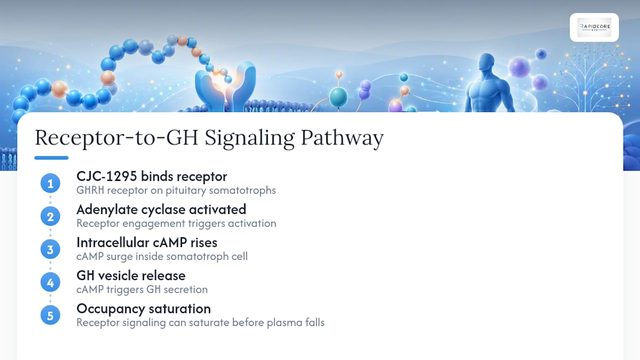
This is a critical distinction for anyone modeling dose-response relationships. Receptor occupancy and downstream cAMP signaling can saturate before circulating peptide concentration drops meaningfully, which means the relationship between plasma peptide levels and GH output isn’t strictly linear across the full exposure window. Preclinical modeling in GHRH knockout mice, where once-daily dosing normalized growth far more effectively than dosing every 48 to 72 hours, hints at this kind of nonlinear, frequency-dependent signaling behavior. Researchers modeling dose-response curves for CJC-1295 should treat receptor kinetics and plasma half-life as related but distinct variables, since collapsing them into a single PK assumption can misrepresent the actual signaling dynamics at the receptor level.
What Contraindications and Interactions Should Researchers Flag?
CJC-1295’s mechanism creates a specific set of interaction concerns worth flagging before designing any combination study, particularly one involving metabolic or endocrine variables.
Any research model involving insulin, insulin-sensitizing compounds, or glucose-regulating agents needs careful attention, since GH elevation counteracts insulin’s effect on blood glucose. Running CJC-1295 alongside a metabolic intervention without accounting for that interaction risks confounding both datasets simultaneously.
Corticosteroid interactions deserve similar caution in animal models, since glucocorticoids and GH signaling intersect at several points in growth and metabolic regulation. Thyroid hormone status is another variable worth controlling for, since thyroid function influences both GHRH receptor sensitivity and downstream IGF-1 production.
Models with any pre-existing pituitary or hypothalamic abnormality should be excluded from GHRH analog studies entirely, since the entire mechanism depends on functional somatotroph tissue responding appropriately to receptor stimulation. A model with impaired pituitary function will produce uninterpretable data rather than a true null result.
Combination studies pairing CJC-1295 with a ghrelin-mimetic like Ipamorelin article are common in the mechanistic literature, since the two peptides act on separate receptor pathways (GHRH receptor versus the growth hormone secretagogue receptor) and produce a synergistic GH pulse when studied together. That synergy is a mechanistic finding, not a license to assume the combination is automatically safer or more effective in any given protocol.
Storage, Handling, and Stability Considerations for CJC-1295 Samples
Peptide stability is one of the more overlooked variables in research reproducibility, and CJC-1295 is no exception. Lyophilized (freeze-dried) peptide is considerably more stable than reconstituted solution, which is why most vendors ship it in powder form for lab storage.
Unreconstituted CJC-1295 should generally be kept frozen, away from light and moisture, consistent with standard peptide storage practice across the research peptide category. Repeated freeze-thaw cycles degrade peptide integrity over time, so aliquoting a sample into single-use portions before freezing is a better practice than repeatedly thawing and refreezing one stock vial.
Temperature excursions during shipping are a genuine risk factor, which is why documented cold-chain handling from your vendor matters as much as the COA itself. A peptide that degraded in transit will produce a Certificate of Analysis that no longer reflects what actually arrives at your bench, unless the vendor can document consistent handling all the way through delivery.
Light exposure is a secondary but real concern, since peptide bonds can be susceptible to photodegradation over extended storage periods. Standard practice is amber vials or foil-wrapped packaging for any extended storage window. Labs running multi-week protocols should build periodic stability checks into their timeline rather than assuming day-one purity holds constant through the full study duration, particularly for longer DAC-based protocols where samples may sit in storage between dosing intervals.
Ethical Considerations in CJC-1295 Research
Any protocol involving CJC-1295 in animal models requires standard Institutional Animal Care and Use Committee (IACUC) oversight, with particular attention to endpoints around metabolic distress given the compound’s known effects on glucose regulation. The GHRH knockout mouse studies that anchor much of the preclinical literature followed this kind of structured oversight, and that standard shouldn’t slip for smaller or informal studies.
Human research involving CJC-1295, even at the Phase I/II level represented in the existing trial data, requires full Institutional Review Board (IRB) approval, informed consent documentation, and a clearly justified risk-benefit rationale given the compound’s unresolved long-term safety profile. The absence of Phase III data and long-term oncologic surveillance means any human protocol needs a conservative approach to dosing duration and monitoring frequency, regardless of how mild the reported Phase I/II adverse events were.
A separate ethical layer applies outside formal institutional settings entirely: self-administration by individuals outside a research or clinical framework, sometimes framed as personal biohacking experimentation, sits outside any ethical review process and outside the “not for human consumption” labeling that governs how this compound is legitimately distributed. Researchers writing or speaking publicly about CJC-1295 have a responsibility to be clear about that distinction, since conflating personal experimentation with legitimate research normalizes a practice that bypasses every safeguard the trial and review process is designed to provide.
How Are Research Dosing Protocols Typically Structured?
Published research protocols for CJC-1295 in preclinical models generally follow the pattern established in the GHRH knockout mouse studies, where dosing frequency was the key variable under investigation rather than escalating dose amount. Once-daily administration normalized growth outcomes in that model, while extending the interval to every 48 or 72 hours produced only partial effects, a finding that speaks directly to how the DAC construct’s extended half-life interacts with dosing schedule design.
In the human Phase I/II trial, researchers used a single-dose design specifically to characterize the pharmacokinetic and pharmacodynamic profile, tracking GH and IGF-1 over time rather than administering a repeated titration schedule. That single-dose structure is precisely what generated the half-life and hormone-elevation figures now cited throughout the literature.
This article does not provide dosing amounts, administration routes, or reconstitution instructions, consistent with the research-use-only framework under which this compound is distributed. What matters for protocol design is the structural lesson from the existing data: dosing frequency needs to be matched to the specific construct’s pharmacokinetics, testing intervals should be informed by the half-life differences between DAC and no-DAC forms, and any titration strategy belongs inside a formal IRB or IACUC-approved protocol with defined safety endpoints, not assembled informally from forum consensus or vendor suggestion.
Why Vendor Verification Matters More Than Most Researchers Assume
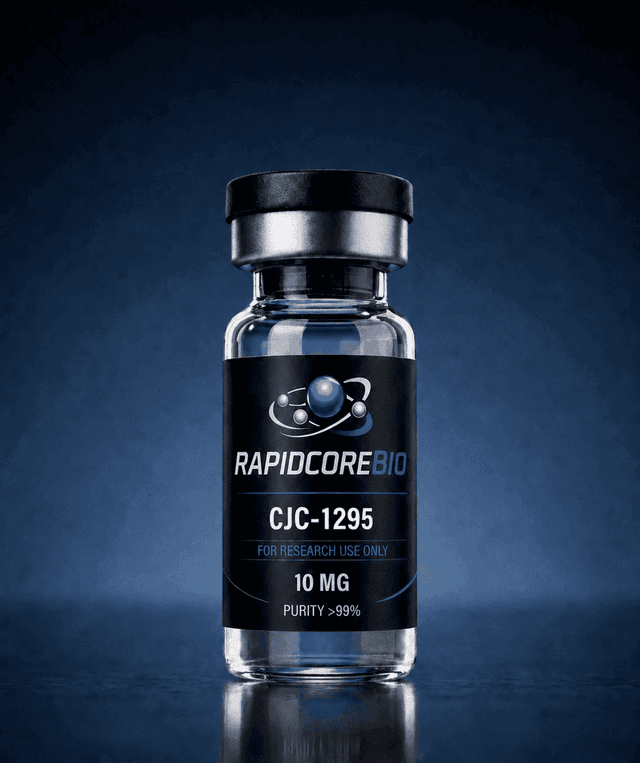
Most published discussion of CJC-1295 focuses on the Teichman trial’s hormone numbers, and rightly so, since that’s the most rigorous data available. What gets far less attention is how much of the research community’s actual experience with this peptide depends on something the trial never touched: whether the compound in the vial matches the compound on the label.
[
](https://www.rapidcorebio.com/product-page/cjc-1295-10mg/)
Supply-chain variability in research-grade peptides is a genuine and underdiscussed confounder. A study can be well-designed, properly powered, and ethically reviewed, and still produce garbage data if the peptide itself was underdosed, degraded, or misidentified before it ever reached the bench. That’s not a hypothetical risk in this category. It’s routine enough that batch-specific COA and independent HPLC/MS verification should be treated as a non-negotiable line item in any research budget, not an optional upgrade.
Every batch distributed by a reputable vendor should go through documented purity verification before it reaches a lab, to ensure researchers spend their time interpreting real biology rather than debugging reagent problems. This article stays within a strict research-use disclaimer: the compounds discussed here are for laboratory and preclinical research only, not for human or animal administration. If you’re evaluating a vendor’s documentation practices, our COA verification resources are a reasonable benchmark for what a batch record should actually contain.
— Adrian K. Solis
The Bottom Line for Researchers Evaluating CJC-1295
The core finding holds up under scrutiny: CJC-1295 with DAC reliably produces sustained GH and IGF-1 elevation in healthy human subjects, backed by real Phase I/II data. What it doesn’t yet demonstrate is a proven functional outcome, and no long-term safety record exists beyond the trial’s short observation window.
Three practical steps belong in any lab’s next move. First, verify every batch with a COA and independent HPLC/MS testing before it enters a protocol. Second, design your sampling schedule around the construct’s actual half-life, DAC or no-DAC, rather than a generic peptide template. Third, route any human or animal protocol through proper IRB or IACUC review before data collection starts.
For deeper reference material, the research handbook and COA verification page are good starting points.
Sourcing CJC-1295 for Your Next Research Protocol
Rapidcorebio exists for exactly the researchers this article was written for: labs and individual investigators who need a research peptide that arrives with documentation they can actually trust, not just a label that claims purity. Every batch from trusted vendors should come with third-party analytical verification, allowing researchers to focus their study budget on data collection instead of chasing down inconsistent quality control.

If you’ve read this far, you already understand why the DAC versus no-DAC distinction matters for your protocol design, and why a batch-specific COA isn’t optional. Our CJC-1295 product page lists the current available batch along with its verification documentation, and our research handbook covers the broader procurement standards we hold every product to. Check the product listing, review the batch documentation, and reach out to our team with any protocol-specific sourcing questions before you place an order.
This article is general information, not a substitute for advice from a qualified doctor. Consult a qualified healthcare professional about your own circumstances before acting on anything here.
Recommended