Benzyl Alcohol Bacteriostatic Water: A Researcher's Guide
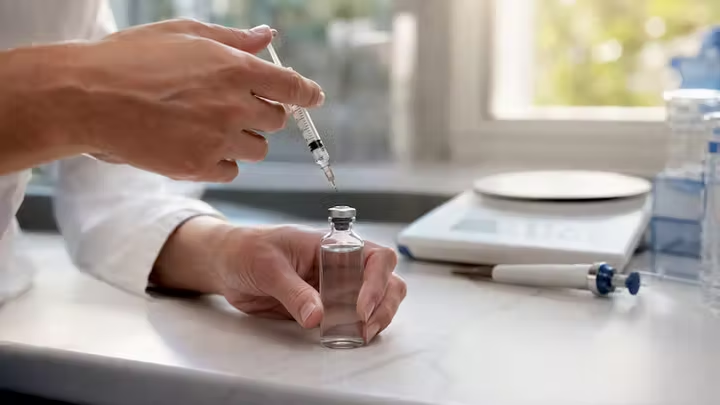
Bacteriostatic Water for Injection, USP is a sterile, nonpyrogenic water for injection containing 0.9% (9 mg/mL) benzyl alcohol as a bacteriostatic preservative, supplied in multi-dose containers. The single most important safety restriction you need to know before anything else: it must never be used in neonates, and it is not a fluid-replacement solution.
Three things to hold onto from the start:
Composition: 0.9% benzyl alcohol (9 mg/mL) in sterile, nonpyrogenic water; pH target 5.7 (allowable range 4.5–7.0)
Intended use: A multi-dose diluent for reconstituting or diluting drugs and research compounds for IM, IV, or SC administration
Top contraindication: Absolutely contraindicated in neonates; not for use as a volume-replacement fluid
Key Takeaways
Point | Details |
Composition is fixed | 0.9% (9 mg/mL) benzyl alcohol; pH target 5.7, allowable range 4.5–7.0. |
Neonatal use is prohibited | Label warning: solutions with benzyl alcohol must never be used in neonates due to documented toxicity risk. |
IV use requires isotonicity | Bacteriostatic water is hypotonic; the final admixture must be made approximately isotonic before any IV administration. |
Multi-dose vs. single-use | Benzyl alcohol preservative enables multi-dose vial use; preservative-free sterile water for injection is single-use only. |
Rapidcorebio provides documentation | Lot-specific COAs and supplier verification support are available for research-grade bacteriostatic water orders. |
Table of Contents
What is benzyl alcohol bacteriostatic water, exactly?
Primary uses and permitted routes of administration
Safety warnings and contraindications you cannot skip
How to handle and store multi-dose vials correctly
Compatibility and isotonicity: what you need to know before IV use
How bacteriostatic water differs from sterile water for injection
Verifying U.S. product labels through FDA and DailyMed
Choosing a supplier: quality signals and what Rapidcorebio provides
A researcher’s perspective on prudent laboratory use
Rapidcorebio’s research-grade bacteriostatic water
Sources
What is benzyl alcohol bacteriostatic water, exactly?
Bacteriostatic Water for Injection, USP contains 0.9% benzyl alcohol — that is 9 mg per milliliter — as its sole active preservative. The pH is targeted at 5.7, with an allowable range of 4.5–7.0. That pH window matters for peptide researchers because solubility and stability of many research compounds are pH-sensitive; a product outside the labeled range could affect reconstitution behavior.
Hospira-branded presentations include both 9 mg/mL (0.9%) and 11 mg/mL (1.1%) formulations, supplied in multi-dose fliptop vials in 20 mL and 30 mL fill volumes. When you are verifying a product, check the label concentration explicitly — do not assume all presentations are identical.
Parameter | Specification |
Preservative | Benzyl alcohol |
Concentration | Approximately 0.9% (about 9 mg/mL) or slightly higher in some presentations |
pH target | Approximately 5.7 |
pH allowable range | Within a moderate range around neutrality |
Presentation | Multi-dose vials of standard laboratory volumes |
Container type | Multi-dose fliptop (plastic or glass) |
Key label identifiers to look for when confirming product identity:
“Bacteriostatic Water for Injection, USP” on the label
Benzyl alcohol listed as the preservative with its concentration in mg/mL
NDC number (National Drug Code) linking to a DailyMed entry
Multi-dose designation on the vial label
Primary uses and permitted routes of administration
The label indication is clear: bacteriostatic water is for diluting or dissolving drugs for intramuscular, intravenous, or subcutaneous injection per the drug manufacturer’s instructions. It is a diluent, not a therapeutic agent in its own right.
The multi-dose design is the practical advantage here. Benzyl alcohol inhibits bacterial growth after the initial vial puncture, which means a single vial can support multiple withdrawals over its labeled use period when handled correctly. Preservative-free sterile water for injection does not offer this; once punctured, it is single-use and must be discarded.
[
](https://www.rapidcorebio.com/product-page/bateriostactic-water-10ml/)
For peptide researchers, the typical application is reconstituting lyophilized research compounds for short-term storage and subsequent use within a laboratory setting. Specific reconstitution calculations, dilution ratios, and handling protocols belong in your lab’s standard operating procedures (SOPs), not in a general product guide. What the label tells you is the diluent’s identity and compatibility baseline — the rest is compound-specific.
Primary use scenarios:
Reconstituting lyophilized research peptides and proteins for laboratory study
Diluting injectable drug preparations for IM or SC administration per drug-specific instructions
IV use only when the final admixture has been made approximately isotonic (see compatibility section below)
Safety warnings and contraindications you cannot skip
This is not a section to skim. The label-level warnings on benzyl alcohol bacteriostatic water are specific, evidence-backed, and non-negotiable for responsible research practice.
FDA/DailyMed Label Warning: Benzyl alcohol as a preservative has been associated with toxicity in neonates. Solutions containing benzyl alcohol must not be used in neonates. When the amount of benzyl alcohol required for dilution in neonates exceeds the safe threshold, a preservative-free alternative must be used instead.
The mechanism behind this warning is well-documented. Neonates lack the hepatic enzyme capacity to metabolize benzyl alcohol efficiently, leading to accumulation of benzoic acid and benzyl alcohol metabolites. This accumulation has been linked to “gasping syndrome” — a serious adverse event characterized by metabolic acidosis, CNS depression, respiratory distress, and cardiovascular collapse. The European Summary of Product Characteristics reinforces this across jurisdictions, noting serious adverse events including gasping syndrome in pediatric patients and advising strict limits on use in young children.
Beyond neonates, additional populations and scenarios require caution:
Fluid replacement: Parenteral preparations with benzyl alcohol must not be used for fluid replacement. This is a labeled contraindication, not a general advisory.
Large-volume IV use: Repeated large-volume administration increases the cumulative preservative load. Patients with hepatic or renal impairment may accumulate benzyl alcohol metabolites more readily.
Hypersensitivity: The SmPC notes that benzyl alcohol can cause hypersensitivity reactions. Researchers working in regulated or clinical-adjacent settings should document any known sensitivities and consult a pharmacist or institutional safety officer before proceeding.
Combined preservative load: When multiple benzyl-alcohol-containing preparations are used concurrently, the cumulative dose matters. This is particularly relevant in pediatric research contexts.
The evidence base for these warnings spans labeled product information, animal toxicology data, and clinical adverse-event reports. DailyMed provides the authoritative U.S. label language researchers should cite when confirming product specifications and warnings.
How to handle and store multi-dose vials correctly
Storage and handling are where good lab practice either holds or falls apart. The label governs here, and the general principle across multisource guidance is to discard opened multi-dose vials within 28 days unless the manufacturer specifies a shorter period. Document the open date on the vial the moment you puncture it.
Best practices for multi-dose vial use in a research setting:
Use a sterile needle and syringe for every withdrawal — no exceptions, no reuse
Minimize the number of punctures per session
Store per label temperature requirements; do not expose to extreme heat or freeze unless the label explicitly permits it
Discard if the solution appears discolored, cloudy, or contains visible particulates
Record lot number, open date, and assigned responsible researcher in your lab records
Pro Tip: Attach a label to the vial at first puncture with the open date, lot number, and initials of the researcher who opened it. Pair this with the batch COA in your lab documentation file. If an audit or quality review ever comes up, you want that chain of custody to be airtight.
Lab documentation to maintain for each opened vial:
Lot number and NDC
Certificate of Analysis (COA) from the supplier
Vial expiry date and calculated discard-after-opening date
Storage temperature log
Name of responsible researcher
Compatibility and isotonicity: what you need to know before IV use
Bacteriostatic water is hypotonic. That single fact has significant implications for IV administration. Injecting a hypotonic solution directly into a vein can cause physiological stress, including osmotic disruption of red blood cells. The label is explicit: bacteriostatic water must be made approximately isotonic before IV use.
Compatibility Warning: Bacteriostatic water is not isotonic and cannot be administered intravenously as-is. The final admixture must be rendered approximately isotonic by adding appropriate solutes per the drug manufacturer’s instructions before any IV route is considered.
Benzyl alcohol’s preservative chemistry also introduces compatibility considerations that are compound-specific. Some active pharmaceutical ingredients and research peptides may interact with benzyl alcohol, leading to precipitation or chemical degradation. There is no universal compatibility assumption — you must check the drug or compound manufacturer’s reconstitution guidance for each specific product.
Practical compatibility checklist:
Confirm isotonicity of the final admixture before any IV application
Verify benzyl alcohol compatibility with the specific research compound using manufacturer or pharmacist guidance
Never assume compatibility based on physical appearance alone; some incompatibilities are not visible
Consult peptide reconstitution guidance for worked calculations and theoretical frameworks relevant to research compound handling
How bacteriostatic water differs from sterile water for injection
These two products are not interchangeable, and the distinction matters practically.
Bacteriostatic Water for Injection contains benzyl alcohol as a preservative. That preservative is what makes multi-dose use possible. After the first puncture, the benzyl alcohol continues to inhibit bacterial growth, extending the vial’s usable life when stored correctly.
Sterile Water for Injection (preservative-free) contains no preservative. It is a single-use product: once the vial is opened or punctured, it must be discarded. There is no bacterial inhibition after that first puncture, so any delay between withdrawal and use creates contamination risk.
Sterile water (non-parenteral) is a separate category entirely, intended for laboratory washing, equipment rinsing, and other non-injectable applications. It is not manufactured to the same sterility or pyrogenicity standards as parenteral-grade water.
When to use preservative-free sterile water for injection instead:
Neonatal applications (absolute requirement)
Certain clinical procedures where preservative-free status is specified by protocol
Single-dose reconstitution where the entire vial will be used immediately
Any application where benzyl alcohol is contraindicated for the patient population or compound
When bacteriostatic water is the appropriate choice:
Multi-dose reconstitution of compatible research compounds
Laboratory settings where a single vial will be accessed multiple times over days or weeks
Applications where the drug manufacturer’s instructions specifically call for a bacteriostatic diluent
Verifying U.S. product labels through FDA and DailyMed
DailyMed is the authoritative U.S. repository for FDA-approved drug labeling. It is where you go to confirm that the product you received matches its labeled specifications — not a vendor’s website, not a third-party summary.
Label fields to verify for any bacteriostatic water product:
Active/inactive ingredients: Confirm benzyl alcohol is listed with its concentration in mg/mL
pH: Verify the labeled target and allowable range
Route of administration: Confirm IM/IV/SC diluent designation
NDC number: Cross-reference with DailyMed to confirm the product is a registered U.S. drug
Warnings section: Read the neonatal contraindication and fluid-replacement warning in full
Storage conditions: Note temperature requirements and discard-after-opening guidance
Hospira-branded NDC listings illustrate how 9 mg/mL and 11 mg/mL presentations appear in product supply tables, including vial sizes and packaging formats. These serve as useful reference examples when you are learning to read label tables, but they do not substitute for the batch-specific COA from your actual supplier.
A short, practical workflow: search DailyMed by product name or NDC, open the full label PDF, and compare the active ingredient concentration, pH, and warnings against what your supplier’s COA states. Any discrepancy between the label and the COA is a red flag worth resolving before use.
Choosing a supplier: quality signals and what Rapidcorebio provides
The COA is not optional. It is the minimum documentation any responsible researcher should request before accepting a shipment of bacteriostatic water for laboratory use. A COA without a lot number, or with vague sterility language, is not a COA — it is a placeholder.
Essential quality signals to request from any supplier:
Lot-specific COA with benzyl alcohol assay result and water purity data
Sterility and endotoxin testing statement tied to the specific lot
pH result for the lot, not just the labeled range
Manufacturing date and vial fill volume
Preservative concentration confirmed analytically, not just labeled
Supplier contact available to answer batch-specific questions
Red flags that should stop a purchase:
No COA available, or COA with no lot number
Sterility described generically without a test method or result
No NDC or label reference on the product listing
Supplier unable or unwilling to answer batch-specific questions
Rapidcorebio supplies research-grade bacteriostatic water with accessible lot documentation, and the COA checklist for researchers on the Rapidcorebio site walks through exactly what to look for in supplier documentation. For labs that want deeper context on sterility verification, the peptide sterility testing guide covers quality assurance processes relevant to requesting and interpreting vendor documentation.
Pro Tip: When you log a new vial into your lab records, staple or digitally attach the supplier’s COA to the open-date record. If a quality question arises weeks later, you will have the lot-specific data immediately at hand rather than chasing the supplier for documentation after the fact.
A researcher’s perspective on prudent laboratory use
The gap between “technically correct” and “actually safe” in laboratory practice often comes down to documentation discipline, not scientific knowledge. Most researchers who work with bacteriostatic water understand the chemistry. Fewer maintain the paper trail that makes their work defensible.
Bacteriostatic water is a laboratory diluent for research compounds. It is not a therapeutic product in this context, and it is not intended for human or veterinary therapeutic use outside approved clinical frameworks. Every use in a research setting should be governed by institutional SOPs, reviewed by qualified personnel, and documented at the lot level. If your institution has a pharmacist or safety officer, loop them in before introducing any new diluent into a regulated workflow. That consultation costs nothing and protects everyone.
The neonatal contraindication is not a technicality. It reflects real, documented harm from benzyl alcohol accumulation in a population that cannot metabolize it safely. Researchers working anywhere near pediatric or neonatal contexts should default to preservative-free sterile water for injection, full stop.
Rapidcorebio’s research-grade bacteriostatic water
Research-grade diluents are only as reliable as the documentation behind them. Rapidcorebio supplies bacteriostatic water for research use with lot-level documentation available on request, including COA data and supplier verification support. No mystery-meat sourcing — you can ask about the lot, and you will get an answer.
For researchers who want to verify analytical documentation before committing to a batch, Rapidcorebio’s COA verification page is the starting point. All products are supplied for research use only and are not intended for human or veterinary therapeutic application. If you have batch-specific questions, the support team is available to walk through documentation with you. View the product page, request your COA, and confirm your lot before it enters your lab workflow.
Research-use disclaimer: All Rapidcorebio products are intended for laboratory research purposes only. They are not approved for human or animal therapeutic use.
Sources
Authoritative U.S. and international references for label language, NDC verification, and safety data:
sterile water for injection, USP, bacteriostatic vial — Pfizer Medical
Bacteriostatic Water for Injection - Summary of Product Characteristics (emc)
This article is general information, not a substitute for advice from a qualified doctor. Consult a qualified healthcare professional about your own circumstances before acting on anything here.